
SpaceX IPO: Why the $2 Trillion Valuation Doesn't Add UpScott Galloway's take: this is a $600 billion company asking for $2 trillion
80%Women account for 80% of all fiction sales in the U.S., U.K., and Canada.
Are you a teacher? Prof G Media wants to hear from you. Help us understand how AI is impacting learning in schools by filling out this fully anonymous, five-minute survey.
Starlink Is a Great Business. SpaceX Is Asking You To Ignore Everything ElseOne of the most anticipated IPOs in years is finally happening. SpaceX officially filed to go public last week, giving investors their first detailed look at the company’s financials ahead of its planned June 12 debut. The company is looking to raise at least $75 billion at a valuation of up to $2 trillion, which would make it the largest IPO in history. SpaceX made $18.7 billion in revenue in 2025, up 33% from the previous year. But losses have ballooned from a profit of $791 million in 2024 to a loss of $4.94 billion last year. The company’s new AI division is to blame. Out of SpaceX’s nearly $21 billion in capex spending last year, $12.7 billion went to building out data centers for xAI — that’s more than the company spent building rockets or satellites. Sixty percent of SpaceX’s revenue comes from Starlink, its satellite internet business that now has more than 10 million subscribers. Its core rocket launching business accounted for 22% of total revenues.
SpaceX’s target valuation is hard to square with the reality of its financial statement. At $1.75 trillion, the low end of the target, SpaceX would trade at 94x sales. To understand how high that is, Palantir has the highest trailing P/S multiple in the S&P 500 — and it trades at 67x sales. If investors take the sum of the three business lines — space, connectivity, and AI — and assume that each segment will command a multiple that is twice as high as competitors, the sum of those parts equals about $1 trillion. So how are SpaceX’s bankers explaining the target $1.75 trillion valuation? By telling investors that the company’s total addressable market (TAM) is the size of the entire U.S. economy — $28 trillion. That target market includes an estimated $22.7 trillion in revenue from enterprise applications. That is 30x larger than the entire existing enterprise software market.
The implied growth is so ambitious that SpaceX is targeting a valuation higher than Meta, Broadcom, and Berkshire Hathaway — while having lower revenues than Macy’s. SpaceX’s governance is also unusual. Elon Musk, who will likely become the world’s first trillionaire after the IPO, will be CEO, CTO, and chairman of the board. With 85% of total voting power, Musk essentially cannot be fired without his own consent.
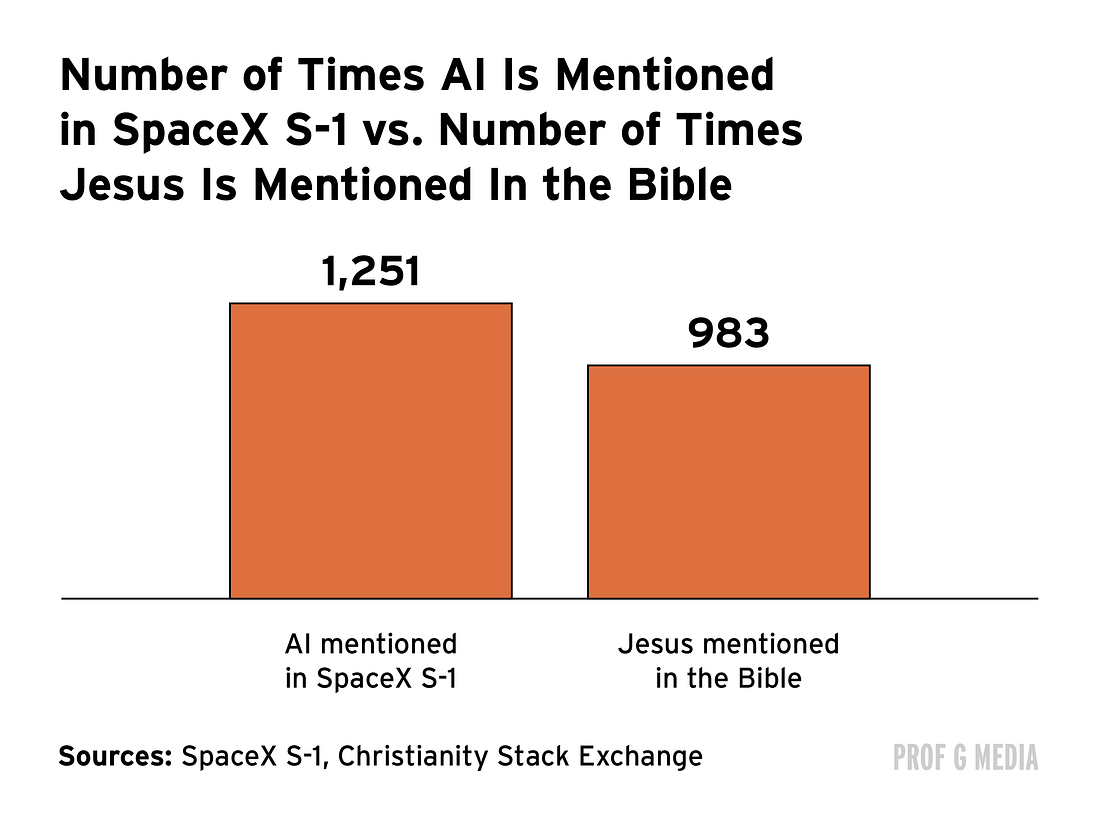
This feels like an amazing company with bags of sh*t strapped onto it. Start with the S-1, which reads like an ayahuasca trip. The first 14 pages are pictures of rockets. A direct quote from the filing: “We do not want humans to have the same fate as dinosaurs.” Well, thank God you’re here. Here’s the reality: Starlink is genuinely excellent — $3.3 billion in revenue in a single quarter, $1.2 billion in operating income, a 36% margin, no serious competitor. If that were the whole company, it would be one of the great businesses of our era. But stapled onto that rocket ship is xAI, which is — clinically speaking — a money furnace.
This valuation doesn’t hold up against the IPO comparables. When Meta went public, it was growing 88% and traded at 28x trailing revenue. Google was growing 240% and traded at 10x. Saudi Aramco — not exactly a growth darling — traded at 5x trailing revenue and was actually growing faster than SpaceX is today.
Most IPOs allocate between 5% and 10% of shares to retail investors. SpaceX is making as much as 30% of shares available to retail investors through Robinhood, Charles Schwab, and Fidelity. Musk isn’t doing this out of the goodness of his heart. He knows that the only way SpaceX gets to this valuation is if it becomes a meme stock. He’s betting that the same retail investors who have stanned Tesla will buy SpaceX shares at any cost.
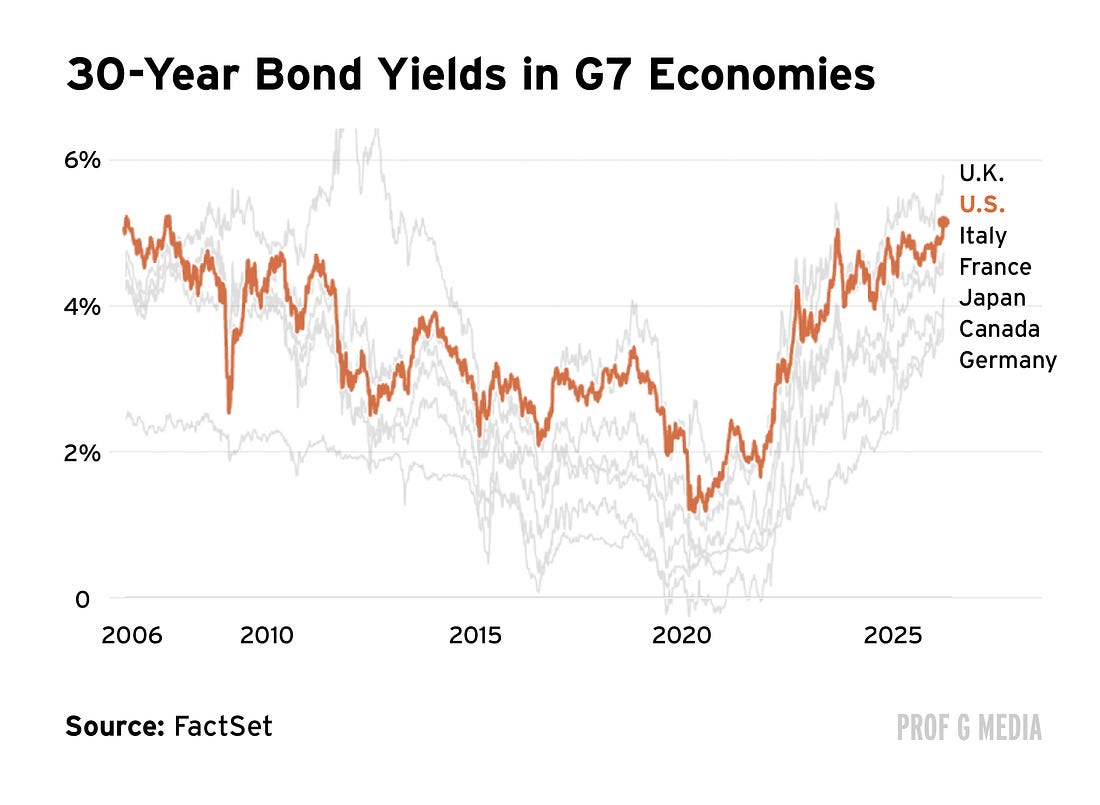
Bond Markets Are Flashing Red, and This Time, Trump Can’t Tweet His Way OutInflation fears drove the yield on 30-year Treasurys to the highest level since 2007 last week, and 10-year notes hit a 15-month peak of 4.613%. Surging yields weren’t just an American story: The average 10-year yield across the Group of Seven (G7) nations (Canada, France, Germany, Italy, Japan, United Kingdom, and the United States) hit the highest since 2004.
Why is this happening? Conflict in the Middle East is driving prices higher, and when inflation rises, bond yields rise. Inflation also increases the likelihood that the Federal Reserve will have to hike interest rates — which will only push bond yields higher.
Gas prices are up 45% year over year, and there’s still no end in sight for the Iran war. President Trump has now promised that it is almost over on 28 separate days since the war began; but without any real progress, his assurances have become … less reassuring. Higher yields don’t just impact bond investors; they can have a significant impact on the equity market and consumers. This is because the 10-year Treasury yield serves as a benchmark for lending rates across the economy. So, when Treasury yields rise, banks charge higher interest rates on mortgages, student loans, car loans, and business loans.
A bond yield is the annual return you earn based on the price you pay for the bond. If you buy a 10‑year bond for $100 and its yield is 5%, you earn $5 per year for 10 years. Bond yields and bond prices move in opposite directions: when prices go up, yields go down, and vice versa. Three main factors cause bond yields to move: recession risk, inflation, and expectations of Fed rate cuts or hikes.
If investors believe the Fed is going to keep interest rates high for the next few years (because inflation is sticky), they’re going to demand higher yields.
A year ago, the bond market was the adult in the room. Trump dropped his tariffs after the 10-year yield jumped more than 50 basis points in three days — the biggest three-day move in over two decades. The question now is whether the same mechanism works with Iran. And the honest answer is probably not. We’ve already spent north of $25 billion, lost 13 lives, nearly 400 wounded. Trump’s already requested $1.5 trillion for next year’s defense budget. This isn’t a tariff you can pause with a tweet. The difference between now and last year is that the escape hatch is gone, and that’s what makes this potentially more dangerous — not just economically, but structurally.
When interest rates go up, the first casualty is speculation, and right now, the market is basically all speculation — 75% of S&P gains have come from AI companies. Here’s the thing about growth stocks: These companies aren’t making much money today. The entire bet is that in five or 10 years, they’ll be generating Microsoft-level revenue. But that future revenue is only valuable if you can translate it back to what it’s worth right now. And that’s where interest rates come in. Higher rates and higher inflation make future money worth less — and growth stocks are essentially just a pile of future money. So when interest rates spike, their valuations get cut in half. But here’s the thing — and this is why capitalism is such a gorgeous organism — rate spikes are painful because they’re supposed to be. It’s the economy destroying excess and repricing risk. It’s the cold shower we’ve all needed to take for a while.
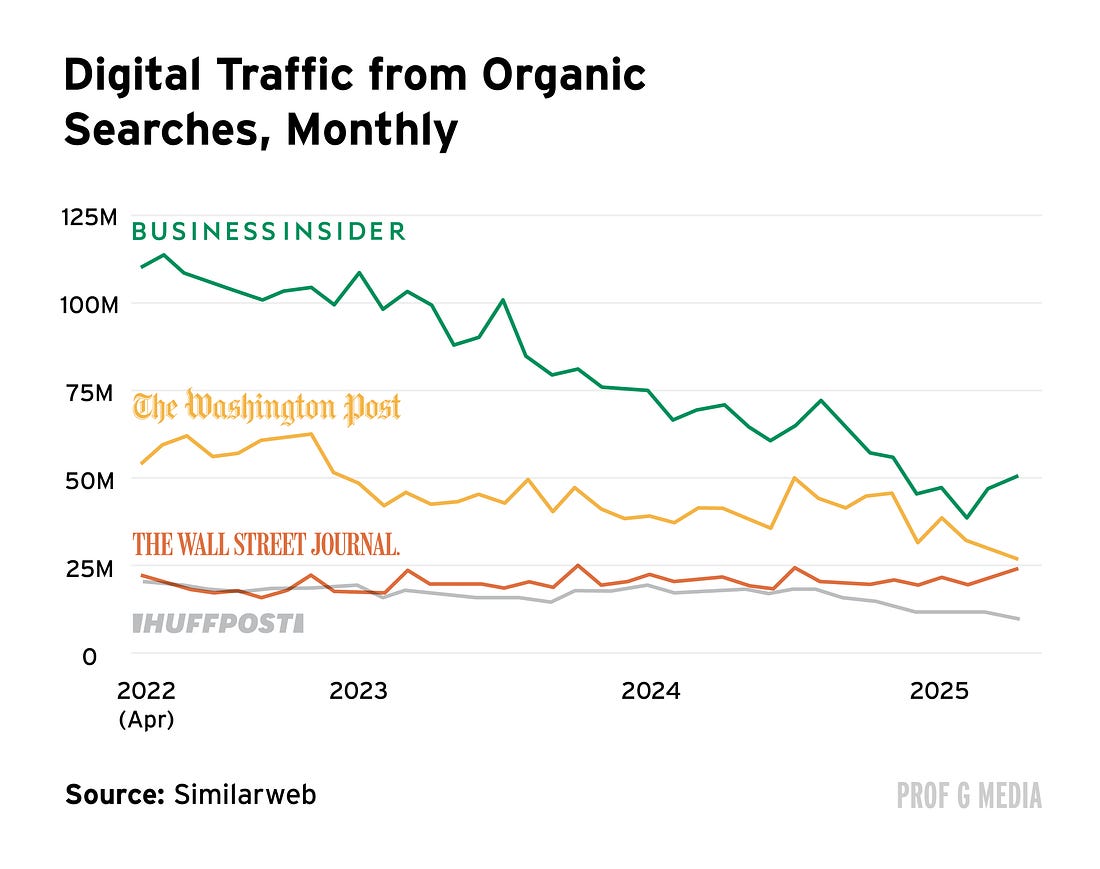
Why Did James Murdoch Buy Half of Vox Media?There’s a shake-up happening in the media industry. James Murdoch is acquiring the Vox Media Podcast Network, along with New York magazine and the Vox news site, in a deal reportedly worth around $300 million. The sale reflects the realities of the changing media landscape. Google’s AI overviews are cutting off traffic to digital media outlets, and, at the same time, consumers increasingly favor podcasts and video formats. The result is that organic search traffic has plummeted for written publications. Vox’s properties that are primarily text-based, including The Verge, Popsugar, and SB Nation, are not included in the deal.
Media executives have been frank about the impact of AI overviews going forward. The Atlantic’s CEO, Nicholas Thompson, told staff to assume Google traffic would “drop toward zero.” Podcasts are a different story. Last year, podcast advertising grew nearly 18% and 55% of Americans reported watching or listening to a podcast monthly. That’s up from 17% in 2015. Vox’s podcasts, which generated about $80 million in revenues last year and together have almost 15 million subscribers on YouTube, were a major driver of the deal. The Vox Media Podcast Network sells advertising for Pivot and Prof G Media’s pods.
New York magazine is a trophy asset. It punches above its weight — it’s like the HBO of magazines. But at the end of the day it’s a magazine business. It’s like the New York Jets: Nobody makes money owning it, but there’s always someone who wants to. James Murdoch seems genuinely civic-minded, so part of the draw was probably the cultural influence and the ability to punch out stories that actually matter. I’ve said this before: Billionaire Republicans buy football teams. Billionaire Democrats buy media properties. The crown jewel, though, is the podcast business. That’s what Murdoch actually wanted.
SpaceX does not price at $2 trillion. This thing is a $600 billion company.
You're currently a free subscriber to Prof G Media. For the full experience, upgrade your subscription.
|
























No comments:
Post a Comment