Welcome to One Thing Better. Each week, the editor in chief of Entrepreneur magazine (that's me) shares one way to achieve a breakthrough at work — and build a career or company you love.
Please forward this newsletter to someone you appreciate! And if you received the forward, please subscribe here.
You're working hard on something, but it isn't working.
Maybe you hit a dead end on a project. Or fell behind on a deadline. Or you're staring at a blank page, unable to create something brilliant.
Today, we'll fix that problem. You'll improve your performance. You'll have a breakthrough idea. You'll rock through your tasks.
All you need to do is this: Relax and use less of your brain.
It's a counterintuitive idea I stumbled upon myself, then discovered has deep roots in psychology.
I'll explain how to do it — but first, I'll show you how it helped me.
How I became a sharpshooter
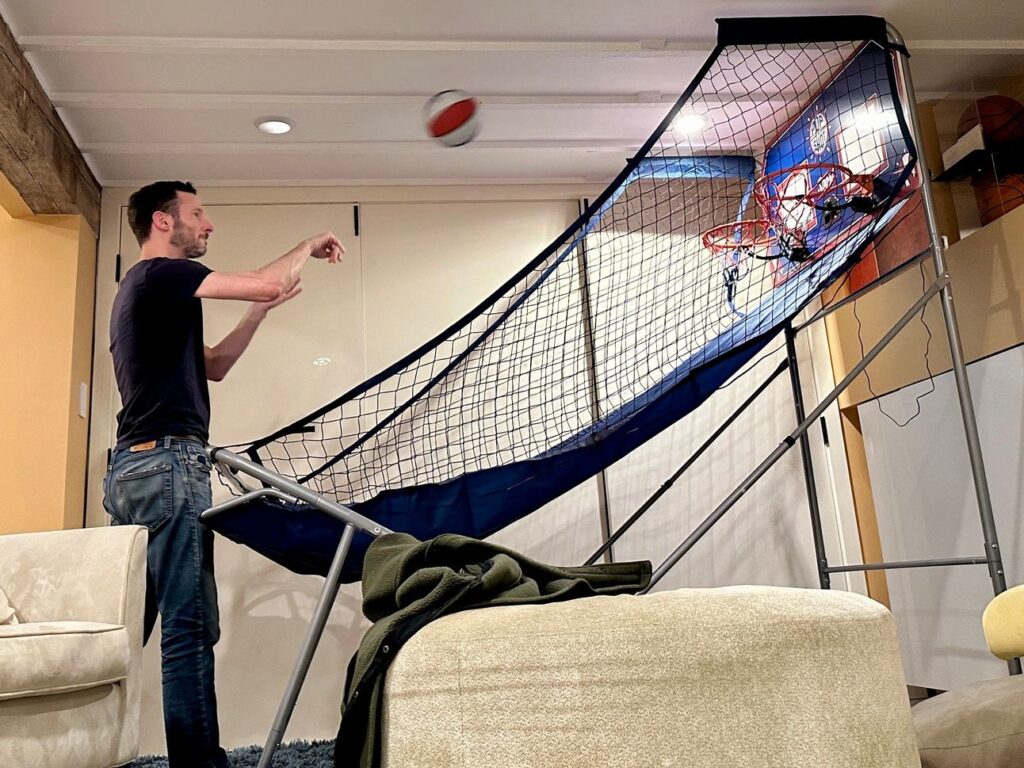
A few years ago, I bought a basketball game and set it up in my basement. I said it was for my kids, but let's be honest — it was for me.
I love this thing. It's a great way to relax. And as I've played, I noticed an interesting pattern:
🏀 When I shoot in silence, I'm just so-so. My high score is maybe 50.
🏀🔥 When I play music and sing along as I shoot, I become Steph Curry. My current high score is 121.
Why? I developed a theory: When I'm shooting in silence, I'm focused on my shot. But when I'm listening to music, my brain is partially occupied and my body takes over — and that's when I shoot better.
It's like a formula — less brain, more instinct!
I wondered: Is this a thing? So I started researching, and oh yeah — it sure is!
The perfect balance of effort
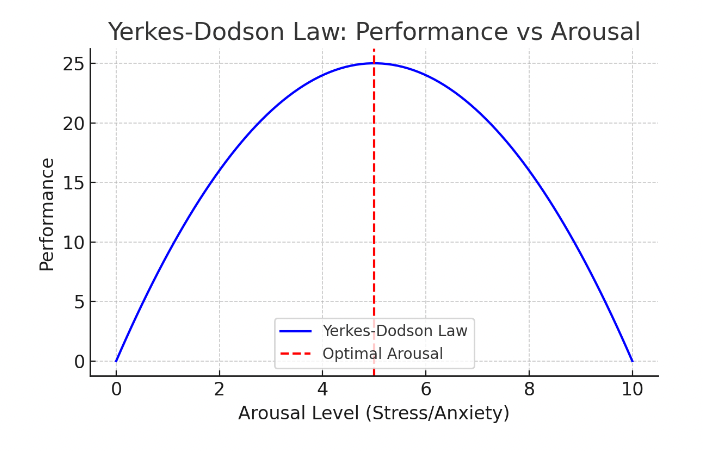
In 1908, two psychologists developed what's called The Yerkes–Dodson Law. It's basically the Goldilocks theory of performance, and it looks like this:
Here's what this means: If you're too passive or too intense about something, you'll perform it poorly. But when you get that stress just right, your performance spikes.
In 1990, psychologist Mihaly Csikszentmihalyi offered a more casual way to describe this phenomenon: He called it flow — and he said that people are most creative, productive, and happy when they've achieved it.
He described flow as…
"a state in which people are so involved in an activity that nothing else seems to matter; the experience is so enjoyable that people will continue to do it even at great cost, for the sheer sake of doing it."
In other words: When you do something without thinking too hard about doing it, you do it better. Just like me shooting baskets in my basement.
That got my wondering: Can we apply this elsewhere? How else can we subtract our brains, and increase our instincts?
Let's start here:
When to dial back your brain
I've found three instances that work for me:
1. Walking and talking.
My day, like yours, is full of video calls. I don't like this. It's too much focus.
So I've started an experiment: Whenever it feels appropriate, I suggest that we go off video. "I'm going to take a walk while we talk," I'll say. "I've been stuck in front of the computer too long."
At first, I worried that this would seem unprofessional. But people thank me. They don't want to be on video either! And some have even joined me in walking.
When I walk, my brain is engaged by multiple things — and instinct can take over. Ideas flow more freely. I become more animated. The meetings are better.
I strongly suggest this. Or even better, invite people to take an actual IRL walk with you! Multiple business partnership of mine started this way.
2. Lowering the stakes.
My work involves a lot of high-stakes moments. I pitch big clients. I meet major celebrities. I join important meetings.
I used to hype myself up for these beforehand. I'd think, "This is a big deal. Don't blow it." Then I'd walk into the room a little jittery.
Now I spend very little time thinking about these meetings beforehand. I walk in cool and casual, treating this "big moment" like it's just any other moment. And I always perform better as a result. I'm a quicker thinker, more engaged, and drive better outcomes.
Athletes are trained to think the same way. Is the entire game on the line, and you're taking the last shot? A player is trained to think of it as any other shot, on any other day.
The stakes are a distraction. Just enter the flow.
3. Don't micromanage the moment.
I give a lot of keynote talks. I've never written down or memorized one.
That's not to say I wing these talks! I create an outline, rehearse, and refine. But I also structure my talks around familiar stories I love telling, and exercises that I've shared many times. That way, I intuitively know this stuff — so when I'm on stage, I'm acting on instinct. I sound fresh, adjust on the fly, and can react to the audience in real time.
If you memorize something word-for-word, the opposite will happen: You're anchored to your words. You'll be stiff. And if you lose your place, you'll never find it again.
The possibilities are endless!
The point here isn't to be prescriptive. It's to focus less and feel more.
You're at your best when you're you, not when you're trying to be you. So let go a little. Trust yourself. You've got this. Sing as you shoot.
That's how to do one thing better.
My advice for CPG founders...
Are you building a CPG business (beverage, food, cosmetics, household goods)?
I write a tactical newsletter that'll help you grow.
It's called CPG3. Every other week, I share three useful tips from the best in the biz. We're talking about…
- Liquid Death's marketing strategy
- How to find the right influencers
- Simple ways to get media attention
- How to optimize your ad spend
And more.
It's totally free. Subscribe here!
Final notes for today...
P.S. Achieve more without burning out. I had a fantastic conversation about burnout, resilience, and how to keep growing without running out of energy. Listen now!
P.P.S. Need a great, simple bookkeeping service? I use Kick. It easily tracks all my expenses and produces a P&L that makes taxes simple. Try it!
P.P.P.S. Send this newsletter to someone who needs it! Forward to them, or just send this link to today's edition.
That's all for this week! See you next Tuesday.


No comments:
Post a Comment