Hi! Manic Monday: Stocks rallied and oil prices dropped this morning after President Trump said the US would delay strikes on Iran's energy infrastructure for five days following "productive" talks with Tehran — Iran has denied the negotiations. Today we're exploring: |
- Slow coach: Major US airlines are scaling back on economy seats.
- Shake up: Danone is buying meal replacement maker Huel for ~$1.2 billion.
|
US airlines are still doubling down on premium seats, as the K-shaped economy takes off |
With airports across the nation still seeing delayed security wait times amid ongoing TSA chaos, some travelers might be wishing they had shelled out for a first or business class ticket to get into the "Priority" lane. And it seems America's biggest airlines are also betting that passengers are now more willing to upgrade: a new report from the WSJ, published Sunday, details how airlines have shrunk traditional economy cabins over the last decade to make room for a growing number of premium offerings. Indeed, according to aviation data from Visual Approach Analytics cited in the report, the number of scheduled first-and business-class seats on domestic flights has expanded by 27% since January 2020 — almost 3x greater than the 10% growth seen for scheduled economy seats. That's not even accounting for premium economy, an intervening class that became a standard option for many major airlines in the 2010s, which, the WSJ wrote, can be "priced at least twice as high as regular economy seats and only take up slightly more room on the plane." |
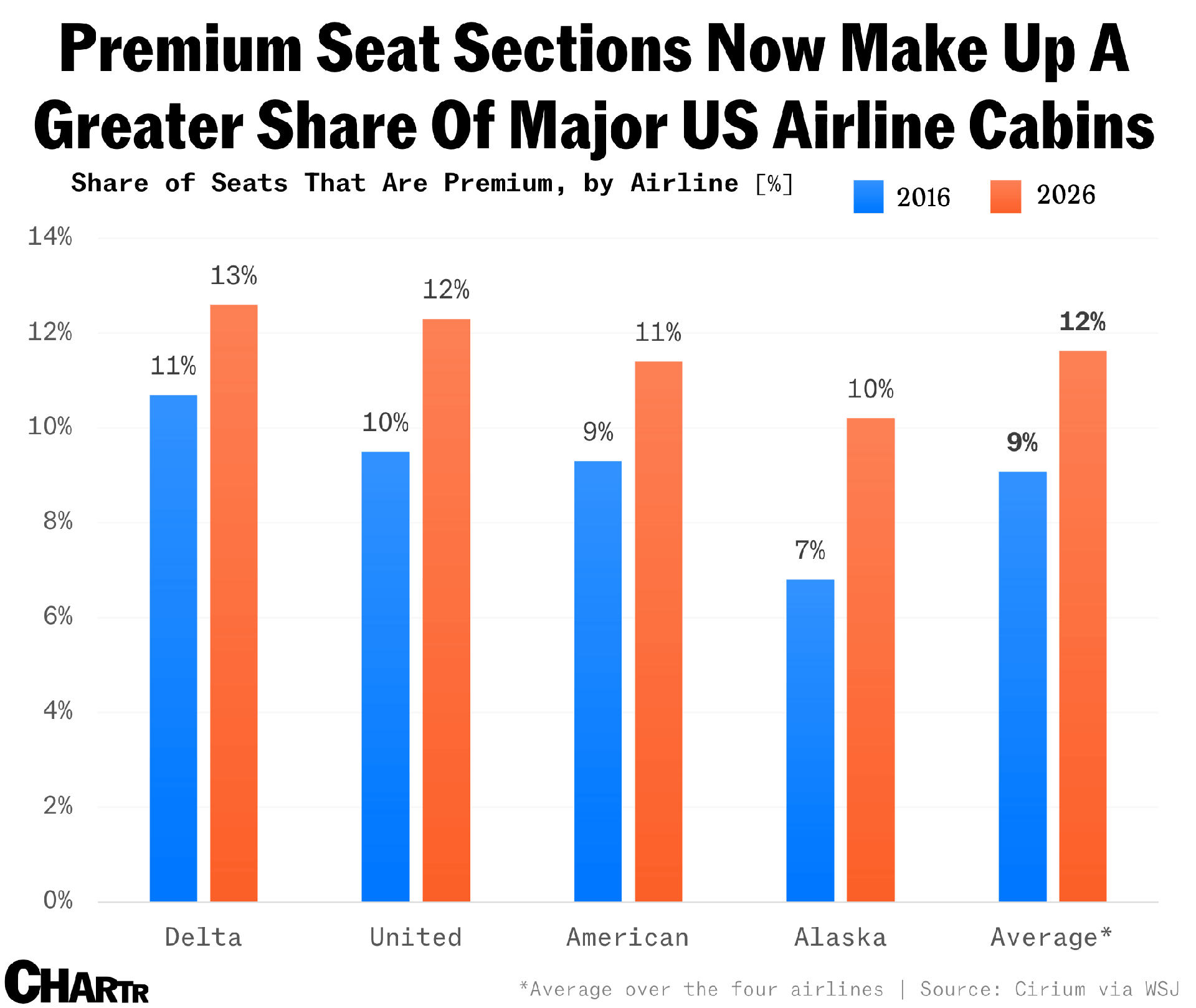
Looking at four of the biggest air carriers in the US — Delta Air Lines, United Airlines, American Airlines, and Alaska Airlines — all have increased their respective shares of premium seats since 2016, now comprising 12% of their cabins on average in 2026. |
Many airlines are rolling out redesigned cabins to make planes "financially efficient," adding room for more expensive tiers by cutting into cheaper sections. The trend speaks to the emergence of America's K-shaped economy, in which wealthier consumers continue to splurge as lower-income spenders cut back. For example, United's new Dreamliner jet layout includes 16 more business class seats, 14 more Premium Plus seats... and 65 fewer seats in the economy section. Delta has already found success squeezing profits from the top, with its premium ticket sales growing more than 7% last year, while main cabin ticket sales fell 5%. |
Danone acquires meal replacement shake maker Huel for ~$1.2 billion |
Very big things happening today in the world of nutritionally complete products that taste like chalk, as Danone agrees to buy the celebrity-backed protein bar, powder, meal, and meal-replacement shake maker Huel for €1 billion (~$1.2 billion). In a statement announcing the acquisition, Danone — apparently the number-one yogurt producer in the US, as well as the nation's top plant-based food and beverage company — said that buying Huel will enhance its "presence in functional nutrition and extend its portfolio into the fast-growing Complete Nutrition space." Danone, the parent company behind Evian and Actimel, also praised Huel's "best-in-class digital execution" and fan bases across the UK, Europe, and the US. |
Huel, a portmanteau of "human" and "fuel," was set up just over a decade ago, but thanks to its marketing efforts; a buzzy product range that marries on-the-go eating with nutrient-dense, plant-based ingredients; and a decent list of (mostly UK-based) celebrity investors, like actor Idris Elba and talk show host Jonathan Ross, sales have soared. |
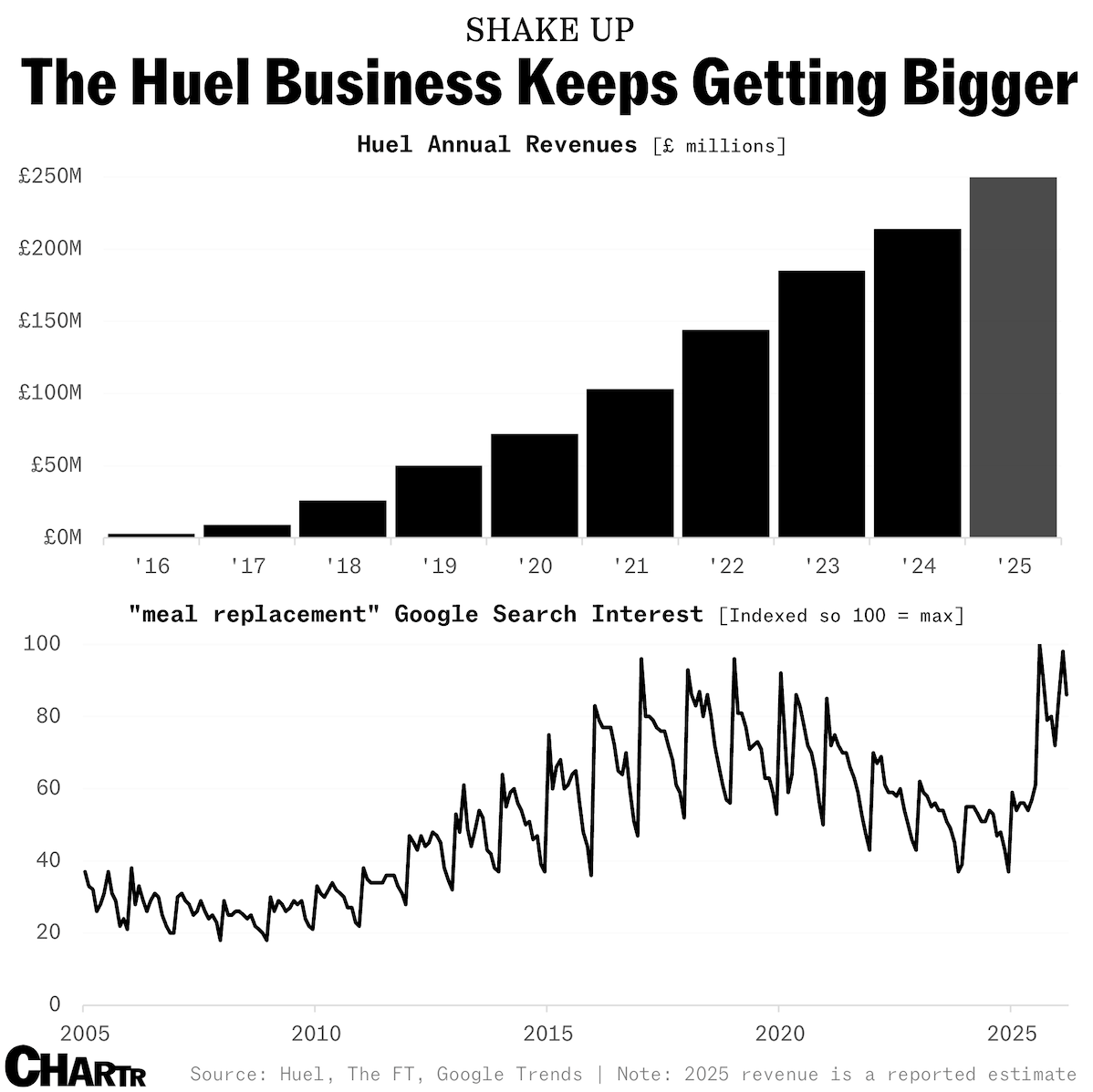
Alongside the wider proliferation of the protein-in-everything culture and set against the unending dietary chat about the best way to lose weight, Huel has positioned itself as an alternative for time-poor people looking for a snack, shake, or easy meal that won't damage whatever health goal they're aiming towards, promising that "every meal contains a balance of protein, carbs, essential fats, fibre, plus all 26 essential vitamins and minerals, and phytonutrients." Customers are lapping it up, too, with revenues rising 74% each year on average since 2016. According to reporting from the Financial Times today, Huel's revenue is expected to surpass £250 million (~$337 million) this year, as a growing number of people, despite having presumably outsourced most of their actual work to chatbots, somehow still don't have the time to cook. |
|
|
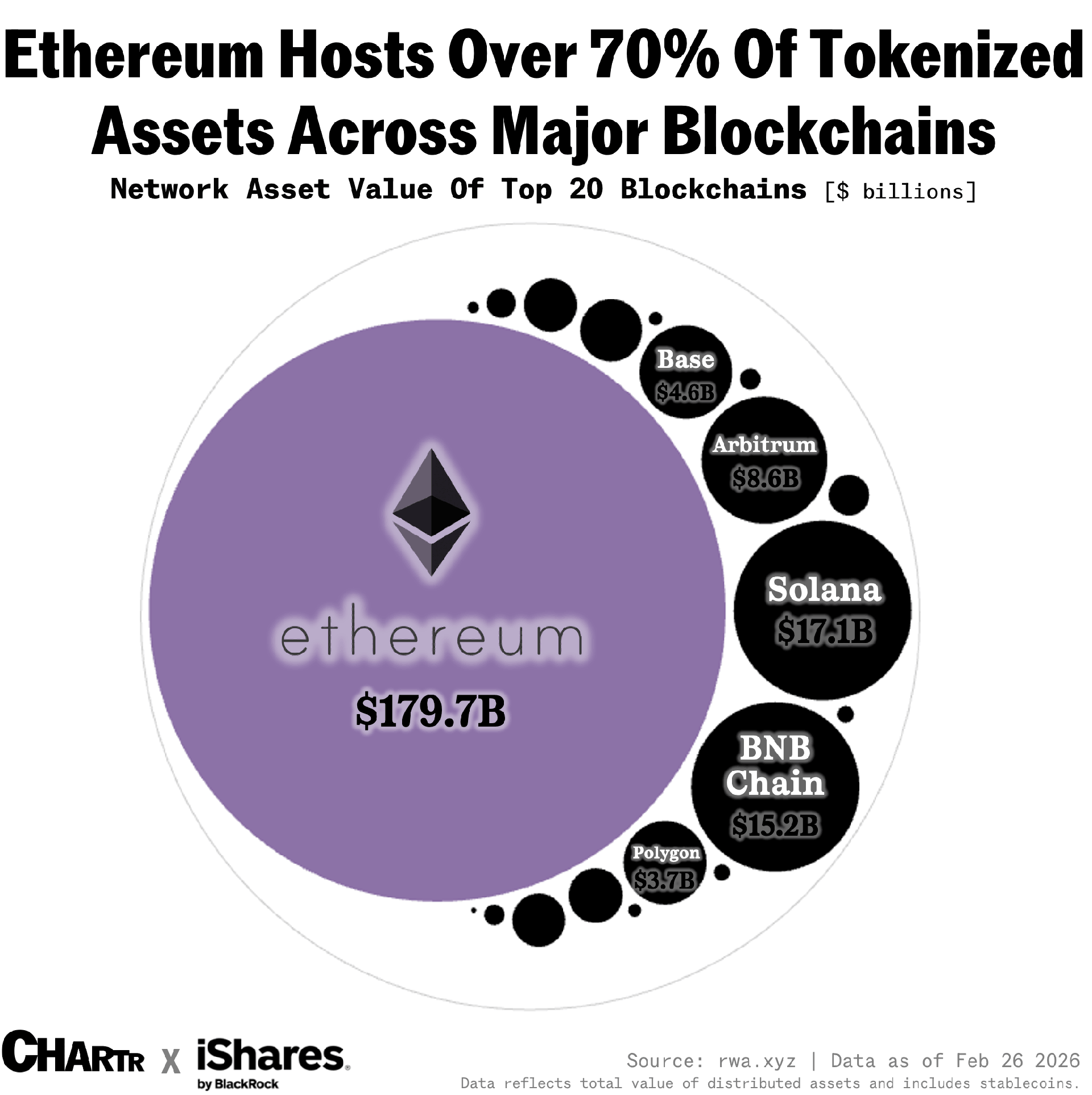
Ether is the world's second-largest cryptocurrency by market capitalization,1 and its applications are far-reaching. The Ethereum blockchain is used for many types of tokenization, including USD-linked stablecoins — which helps explain why the majority of tokenized assets are issued on it.2 |
ETHB, the latest exchange-traded product (ETP) launch from iShares, is an option for investors seeking to track the price movements of Ether while also pursuing staking rewards. That makes it possible to earn income or "rewards" from staked assets while maintaining cryptocurrency exposure, all within a convenient ETP wrapper. Explore ETHB, the iShares Staked Ethereum Trust ETF: the ETP investment to combine Ether exposure and staking rewards. |
The iShares Staked Ethereum Trust ETF is not an investment company registered under the Investment Company Act of 1940, and therefore is not subject to the same regulatory requirements as mutual funds or ETFs registered under the Investment Company Act of 1940. |
|
|
- Elon Musk just unveiled Terafab, a chip manufacturing facility jointly run by Tesla and SpaceX that could produce ~1 terawatt of compute annually and cost up to $45 billion in capital expenditure.
- OnlyFans owner Leonid Radvinsky, who saw the company's revenues rise from around $60 million in 2019 to $1.4 billion in 2024, has died of cancer at 43.
- National average gas prices are closing in on $4 a gallon for the first time since 2022, hovering near $3.96 earlier today, according to AAA.
- To the moon: Sci-fi epic "Project Hail Mary" rocketed to $140.9 million at the global box office over the weekend, marking 2026's largest debut so far and the biggest ever for Amazon MGM.
- Astronomers found clusters of new moons around Jupiter and Saturn, taking their total moon counts to 101 and 285, respectively.
|
|
|
Around 70% of tokenized assets are issued on the Ethereum blockchain2 — and as tokenization takes hold, Ethereum may be poised for growth. Learn how the ETHB can help you capture it. |
|
|
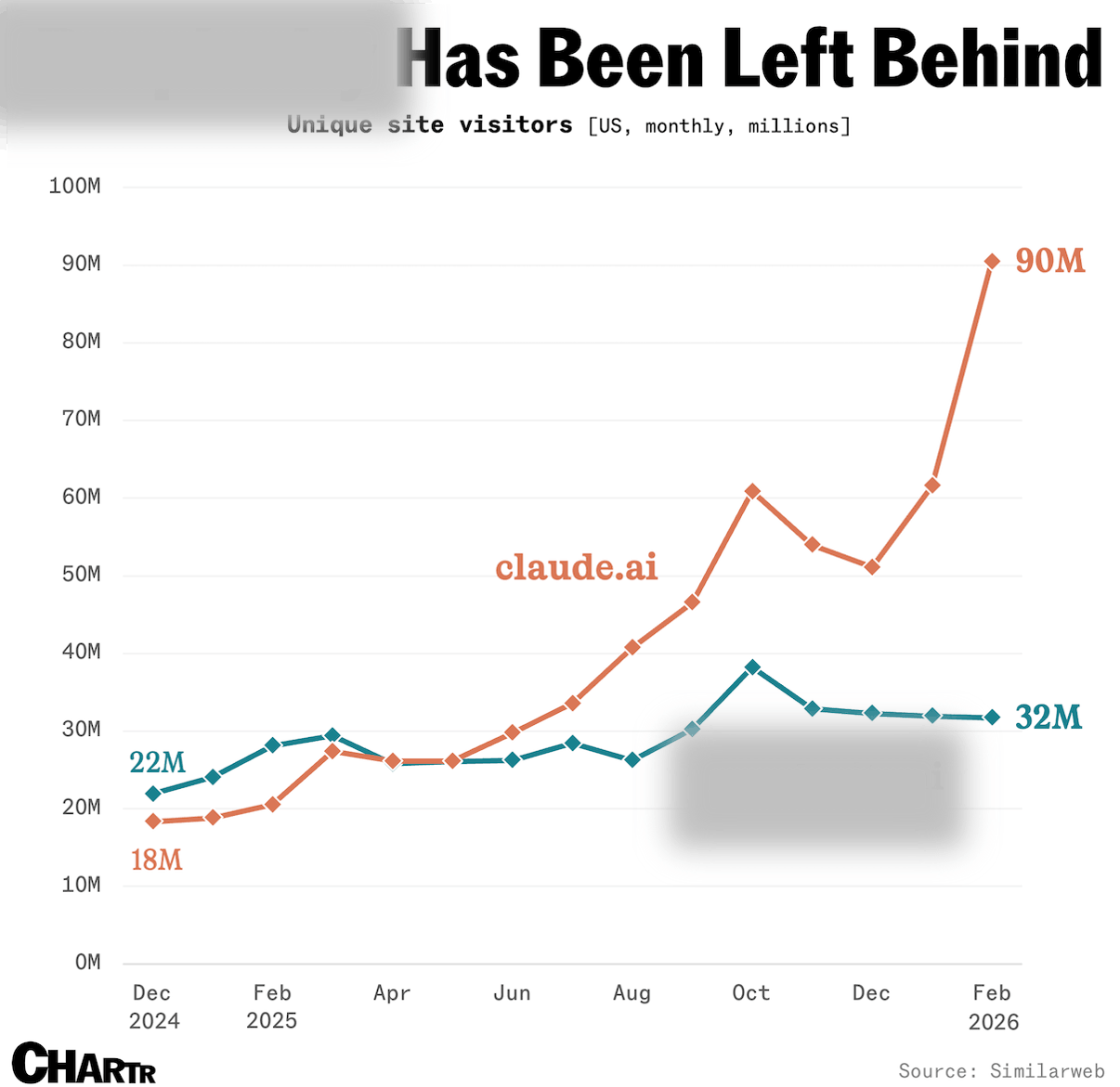
Off the charts: Which once-buzzy AI search startup has seen its web traffic stall over the past year, while rival Claude has more than quadrupled its visitors? [Answer below]. |
Not a subscriber? Sign up for free below. |
Advertiser's disclosures: 1 The Block, as of Feb 12, 2026. Ethereum's market capitalization of $238.6 billion is measured by use of its native token, ether. 2 BlackRock using data from RWA as of 2/26/2026. For illustrative purposes only. Subject to change. Not an exhaustive list. This information must be accompanied or preceded by a current iShares Staked Ethereum Trust ETF prospectus, which may be obtained by clicking here. Please read the prospectus carefully before investing. The iShares Staked Ethereum Trust ETF is not a commodity pool for purposes of the Commodity Exchange Act. Before making an investment decision, you should carefully consider the risk factors and other information included in the prospectus. Investing involves a high degree of risk, including possible loss of principal. An investment in the Trust is not suitable for all investors, may be deemed speculative and is not intended as a complete investment program. An investment in Shares should be considered only by persons who can bear the risk of total loss associated with an investment in the Trust. Investing in digital assets involves significant risks due to their extreme price volatility and the potential for loss, theft, or compromise of private keys. The value of the shares is closely tied to acceptance, industry developments, and governance changes, making them susceptible to market sentiment. Digital assets represent a new and rapidly evolving industry, and the value of the Shares depends on their acceptance. Changes in the governance of a digital asset network may not receive sufficient support from users and miners, which may negatively affect that digital asset network's ability to grow and respond to challenges Investing in the Trust comes with risks that could impact the Trust's share value, including large-scale sales by major investors, security threats like breaches and hacking, negative sentiment among speculators, and competition from central bank digital currencies and financial initiatives using blockchain technology. A disruption of the internet or a digital asset network would affect the ability to transfer digital assets and, consequently, would impact their value. There can be no assurance that security procedures designed to protect the Trust's assets will actually work as designed or prove to be successful in safeguarding the Trust's assets against all possible sources of theft, loss or damage. Staking introduces a risk of loss of ether, which could adversely affect the value of the Shares. Staking includes an activation, exit, and withdrawal process. During each stage of the process, the Trust's staked ether cannot be sold or transferred, thereby making it illiquid for the period it is being staked. The Ethereum protocol limits validator activations and exits per epoch, so only a controlled amount of staked ETH can turnover during each period. During periods of elevated validator demand, the activation queue may extend for days, weeks, or months. While queued for activation, the Trust's ether will not accrue rewards. The staked ether will also not accrue rewards during the withdrawal period. At each step in the staking process, staked ether may also be exposed to risks such as security breaches, smart contract vulnerabilities, and validator or custodian failure or compromise, any of which could result in a complete loss of the staked ether or associated rewards. There is no guarantee that the Trust will receive any rewards with respect to staked ether. Smart contracts, including those relating to decentralized finance applications, are a new technology and their ongoing development and operation may result in problems, which could reduce the demand for ether or cause a wider loss of confidence in the Ethereum network, either of which could have an adverse impact on the value of ether. This information should not be relied upon as research, investment advice, or a recommendation regarding any products, strategies, or any security in particular. This material is strictly for illustrative, educational, or informational purposes and is subject to change. Shares of the Trust are not deposits or other obligations of or guaranteed by BlackRock, Inc., and its affiliates, and are not insured by the Federal Deposit Insurance Corporation or any other governmental agency. The sponsor of the Trust is iShares Delaware Trust Sponsor LLC (the "Sponsor"). BlackRock Investments, LLC ("BRIL"), assists in the promotion of the Trust. The Sponsor and BRIL are affiliates of BlackRock, Inc. The iShares Staked Ethereum Trust ETF (the "Trust") is not sponsored, endorsed, issued, sold or promoted by Stiftung Ethereum (the "Ethereum Foundation"), nor does the Ethereum Foundation make any representation regarding the advisability of investing in the Trust. BlackRock is not affiliated with the Ethereum Foundation. Ethereum Marks are owned by the Ethereum Foundation, used under license. BlackRock, Inc. and its affiliates are not affiliated with Sherwood Media, LLC, Robinhood Markets, Inc., or their affiliates. BLACKROCK and iSHARES are trademarks of BlackRock, Inc. or its affiliates. All other trademarks are those of their respective owners. MKTG0326-5260184-EXP0327 |
Sherwood Media, LLC produces fresh and unique perspectives on topical financial news and is a fully owned subsidiary of Robinhood Markets, Inc., and any views expressed here do not necessarily reflect the views of any other Robinhood affiliate... See more |
|
|
SHERWOOD MEDIA, LLC, 85 Willow Road, Menlo Park, CA 94025 |
|
|
|





No comments:
Post a Comment