Former Assistant U.S. Attorney Maureen Comey, in a wrongful termination lawsuit filed today against the government, starts out by saying she spent almost a decade in her job, pursuing her responsibilities “without fear or favor.” Based on the allegations in her complaint, the same cannot be said of the entities she has sued, including the Justice Department, the Executive Office of the President, the Office of Personnel Management, and individuals like Attorney General Pam Bondi.
There is a lot of factual and legal detail in the case, but it’s important because it will have an impact on Trump’s ability to fire at will in the federal bureaucracy, ignoring existing civil service protections for government employees, not just at DOJ, but likely closer to government wide. The 38-page complaint alleges the following violations of law when Comey was fired:
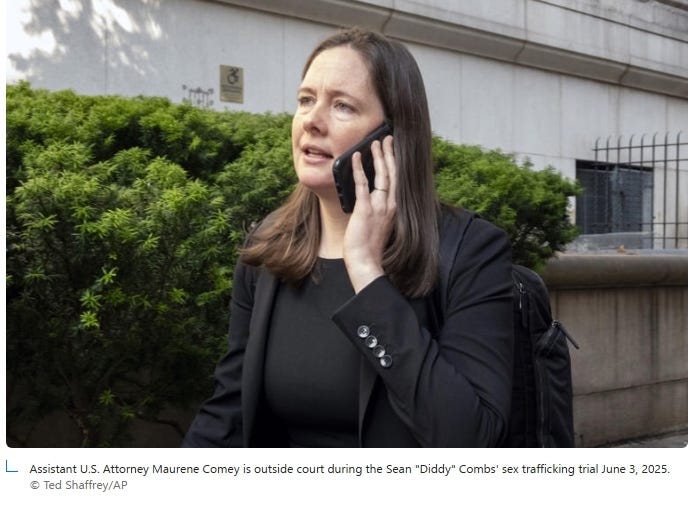
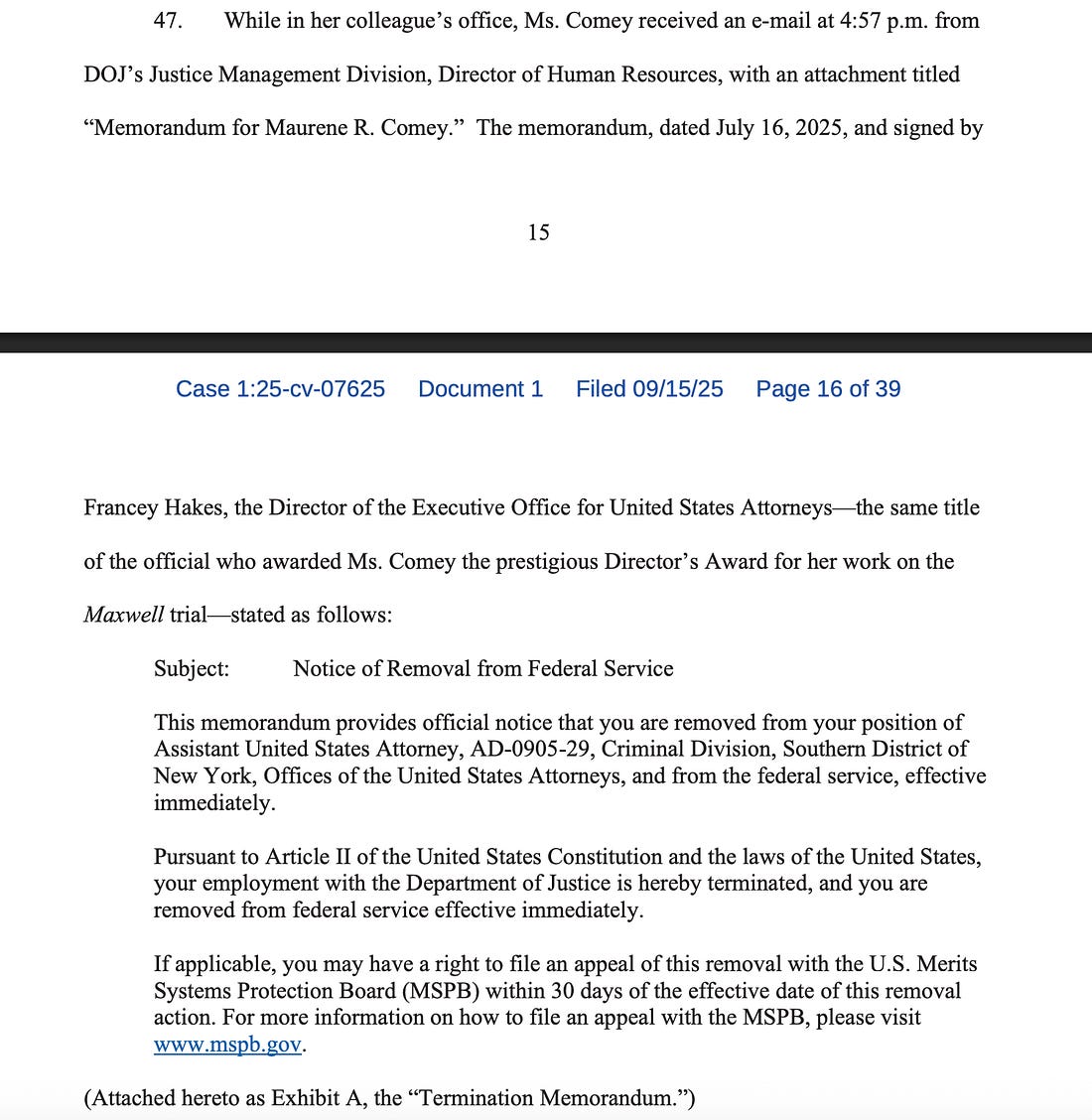
We’ll get to those claims in a minute. This, of course, is a civil case, not a criminal one. That means it’s two parties suing each other over damages—no one goes to prison at the end of a civil case. And we have a “complaint” instead of an indictment, alleging different violations of constitutional and civil law that Comey, the plaintiff, says mean she’s entitled to both monetary and other compensation from the government. Because that’s a lot, and because this is a very important case, we’ll spend time tonight going through the allegations in the complaint in more detail. What’s at stake is the ability of the president to fire prosecutors, even exemplary ones, because he doesn’t like them, or their father, or the cases they’ve been working on, or simply thinks they lack personal loyalty to him, or just wants to get rid of them. That’s no way to run the Justice Department, where prosecutors have civil service protections that make it difficult to fire them absent solid cause. But the administration did an end run around those longstanding rules in Maurene Comey’s case, despite the fact that she’d been asked to be the lead prosecutor on “a major public corruption case” just the day before she was fired. Comey is asking the court to rule that the government violated multiple provisions of federal law when she was fired. She asks to be reinstated immediately, with the government enjoined from taking any additional adverse personnel action against her, absent the appropriate procedural and substantive due process. She also asks for back pay for the time she has been out of work and asks that the government be forced to pay the costs of the lawsuit she has filed, including her attorney fees. The complaint tells a story, as all good civil complaints do. Comey points out that she obtained “hundreds of criminal convictions” in serious cases including homicides, racketeering, and public corruption. She prosecuted Sean “Diddy” Combs, Robert Hadden, Jeffrey Epstein, and Ghislaine Maxwell. She was promoted and she received awards for her work, including an “outstanding” evaluation—the highest a prosecutor at DOJ can receive—just months before she was summarily fired. She wasn’t fired by her boss, the U.S. Attorney for the Southern District of New York, Jay Clayton. Instead, she received an email saying she was being terminated “[p]ursuant to Article II of the United States Constitution and the laws of the United States.” In other words, by virtue of presidential power. As Trump put it during a Turning Point USA speech to young people during his first term in office in 2019, “I have an Article II, where I have the right to do whatever I want as president.”
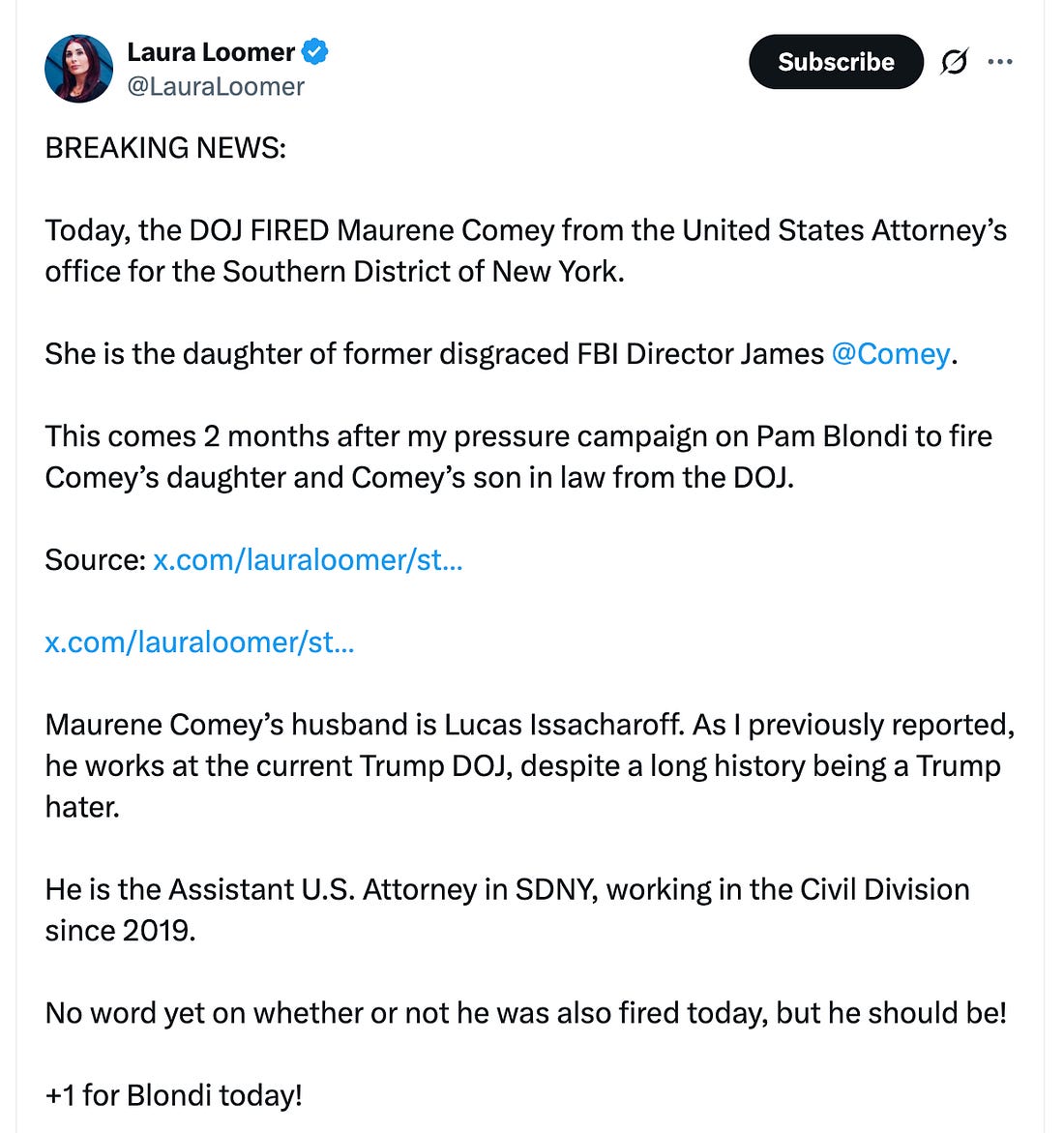
Comey’s lawyers in this case say, not so fast. The lawsuit claims that Comey’s termination—without cause, without advance notice, and without any opportunity to contest it—was unlawful and unconstitutional. They point out that there hasn’t been even an effort to point to a legitimate reason for her firing. That, they write, is because there isn’t one: “Defendants fired Ms. Comey solely or substantially because her father is former FBI Director James B. Comey, or because of her perceived political affiliation and beliefs, or both.” In a footnote, they point out that Comey, who refused to swear a loyalty oath to Trump, has been the subject of repeated vitriol by the president on social media, noting “President Trump has posted (or reposted) approximately 259 times about Mr. Comey from October 16, 2016, to the date of this filing, including repeatedly calling him the ‘worst’ FBI Director in history.” Jim Comey’s firing from his job as FBI Director and the subsequent release of information regarding conversations he had with Trump during his tenure led to the opening of the Mueller Investigation into Trump’s ties to Russia in 2017, if you can remember that far back. Trump clearly can. The complaint suggests that it was an incident with Jim Comey that triggered his daughter’s firing. In May, he posted a photo of seashells arranged to form the numbers "86 47," on his Instagram account. Outrage erupted over this “threat” against the president, and Comey promptly removed the photo, saying he had not meant it to be anything of the sort. Trump called Comey a “dirty cop” and said the post was an “assassination message.” But it triggered Laura Loomer to call for Maurene Comey’s firing, which happened in short order. Loomer, who has 1.7 million followers on social media, boasted after the firing that she had waged a months-long “pressure campaign” on AG Pam Bondi to make it happen.
When Ms. Comey asked U.S. Attorney Jay Clayton why she was being fired, he told her, “All I can say is it came from Washington. I can’t tell you anything else.” She was never given any other explanation. The complaint notes that Comey’s service was apolitical in nature: “Ms. Comey served with distinction through Democratic and Republican administrations, earning the support and confidence of supervisors, United States Attorneys, and DOJ officials serving under Presidents Obama, Trump, and Biden.” Among her notable cases, Comey and her team obtained the indictment charging Ghislaine Maxwell with enticing a minor to travel to engage in criminal sexual activity and other charges, and she led the prosecution that resulted in Maxwell’s conviction. Quite a coincidence. Comey was promoted to supervisory roles in the office beginning in February 2021, and “oversaw the team that indicted and tried former New Jersey Senator Robert Menendez (and his wife and three other business associates) on federal bribery charges in September 2023.” In other words, she wasn’t exactly the partisan warrior Laura Loomer tried to make her out to be. The complaint explains that Article II of the Constitution does not give Trump the unfettered ability to fire assistant United States attorneys (AUSAs) without cause: “Neither the President nor the Department of Justice have unlimited authority to remove Assistant United States Attorneys. Specifically, the Civil Service Reform Act of 1978, Pub.L. No. 95–454, 92 Stat. 1111 (codified as amended in scattered sections of 5 U.S.C.), provides crucial guardrails that protect these federal employees from arbitrary or unlawful termination. Accordingly, the Government may not terminate federal employees like Ms. Comey unless doing so comports with statutorily defined ‘merit system principles’ and does not constitute statutorily defined ‘prohibited personnel practices,’ and even then, the Government may terminate federal employees like Ms. Comey only after following established pre- and post-removal procedures.” Federal employees like Comey are entitled to receive at least 30 days’ advance notice before they can be fired and are entitled to at least seven days to file a response. They are entitled to receive a written decision that includes specific reasons for the action being taken against them. As someone who has been in the position of having to take action against a DOJ employee, I can tell you that these rules are taken seriously. The Executive Office of U.S. Attorneys in Washington, D.C., provides support to local U.S. Attorneys’ offices, particularly when a matter involves firing an employee, to ensure all of the rules are followed. For instance, progressive discipline is required before firing is even on the table, with the employee given the opportunity to improve their performance before such a serious punishment is imposed. Obviously, none of that happened here, from the failure to issue a reason for the “personnel action” to the timeline it occurred on, with no notice or opportunity to respond, to the claim that Comey was being fired based on the President’s Article II powers. Each of Comey’s claims or “counts” in the complaint is an independent basis for some or all of the relief she is seeking. In other words, the court doesn’t have to decide that she prevails on all of them for her to win. But the decisions on each count will be important, as they will determine just how far Trump can go in firing public servants for no reason and with no advance notice in his quest to create a federal bureaucracy that is personally loyal to him. If you find this explanation of legal proceedings, based on 25 years at the Justice Department, beneficial, I hope you’ll consider subscribing to Civil Discourse. Your support makes it possible for me to write the newsletter and keep it free for everyone. Information is power, and we all need that now, more than ever. We’re in this together, Joyce You're currently a free subscriber to Civil Discourse with Joyce Vance . For the full experience, upgrade your subscription.
|
Monday, September 15, 2025
A Prosecutor Sues





Subscribe to:
Post Comments (Atom)
Growth Today: Instagram Expands to TV, Gmail AI Reshapes Email, and Wordle Goes Mainstream 🔥
Short. Smart. Addictive. ...

No comments:
Post a Comment