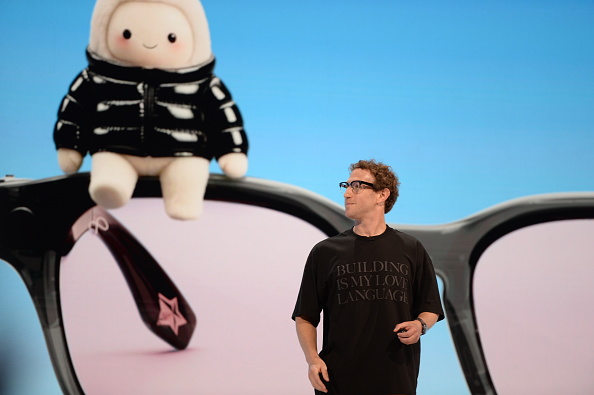
Mark Zuckerberg, CEO of Meta. Behind him is a personalized mascot of the AI assistant Muse.
(Andrej Sokolow/Getty Images) |
|
|
|
When companies wanted to get their trashcans and bear bags approved as “bear-resistant,” they had to go through “Kobuk the Destroyer,” a captive grizzly bear employed by the testing industry to see how good the bear-safe tech actually was. Kobuk is one bright bear, capable of solving clever bearproofing not merely by brute force but also by intelligently manipulating the device with his shockingly nimble claws.
Don’t get it twisted, though: “The Destroyer” was so named not because of any ursine brutality but rather because he destroyed the hopes and dreams of many inventors of sub-par anti-bear tech.
Stocks closed up on Friday, capping off a solid week for equity markets.
|
|
|
|
Meta was losing the AI race, so they put all their effort into making a harness anyone can use. Whether it succeeds isn’t up to Meta or its users. |
Meta’s stock finished last week up 13% on the heels of the release of Muse, which is the company’s big play to try to get consumers using AI in their day-to-day lives.
|
- Lots of the earliest applications of AI were in coding; LLMs trained on every StackOverflow and GitHub page turned out to be rather canny programmers, which is one reason that some of the earliest adopters and advocates were in tech, amazed that the madlibs machine was pretty good at writing code.
- The emergence of ChatGPT was a milestone because it demonstrated that the LLMs had applications replacing certain features of search engines, which lots of consumers use day-to-day, and which launched the tech into the mainstream.
- Still, lots of the actual applications of this stuff — the things that moved markets — were people at companies using AI tools to write code faster, more effectively, and to scale up projects that would have required engineering resources more quickly.
- This is one reason we saw so much disruption in the SaaS space, as those companies began to worry that their clients could make Claude write the program that they were on retainer to produce
- Other uses remained firmly in the industrial or scientific space; image models are good at spotting anomalies, at processing large amounts of data, and so on, and so we began to see promising developments in things like archaeology, astronomy, and other fields where there were enormous piles of data and not enough time or money to sift through it.
|
That’s all well and good, but you don’t get to be a trillion dollar industry by selling software to archaeologists. The grail is and was: how do we get consumers relying on this thing multiple times per day? And one solution was not just new and better models, but an effective harness that consumers would actually use.
|
- Those early adopters in the tech scene — the ones who saw the appeal of AI tools in their coding jobs — became enamored with a tool called OpenClaw, which allowed these nerds to build self-hosted systems on Apple Mac Minis that were connected by Telegram and have it actually do stuff like make dinner reservations and write emails.
- With a harness like that, you can make AI models do things that they otherwise aren’t able to do, making them more powerful in the specific applications you might want them to do by offering a set of rules and tools that they can reliably use rather than hallucinating reactions on the fly. They’re rather neat, and can be a missing link between a chatbot and a piece of software that can get you new car insurance.
- Most normies do not have a spare Mac Mini, they are insufficiently Russian to have Telegram on their phone, and they don’t have time to deal with this. There is a reason that nobody asked you to fix their OpenClaw setup or reset their Hermes password last year at Thanksgiving.
- Meta in particular saw this opportunity. They realized that perhaps no company in the tech space has as much insight into the, shall we say, unique technological disposition of the median internet user. Salt-of-the-earth types. You catch my meaning.
- They set out to make a harness for the masses, an “OpenClaw” that — with an appropriate amount of handholding, the kind of built-in security measures that you design when you believe core customer struggles to open Tylenol bottles, and a mascot that looks like a Republican Labubu — you could be the one to bring AI to the masses even if your AI models were middle-of-the-pack.
|
This worked pretty well for them, as Muse is a big ol hit.
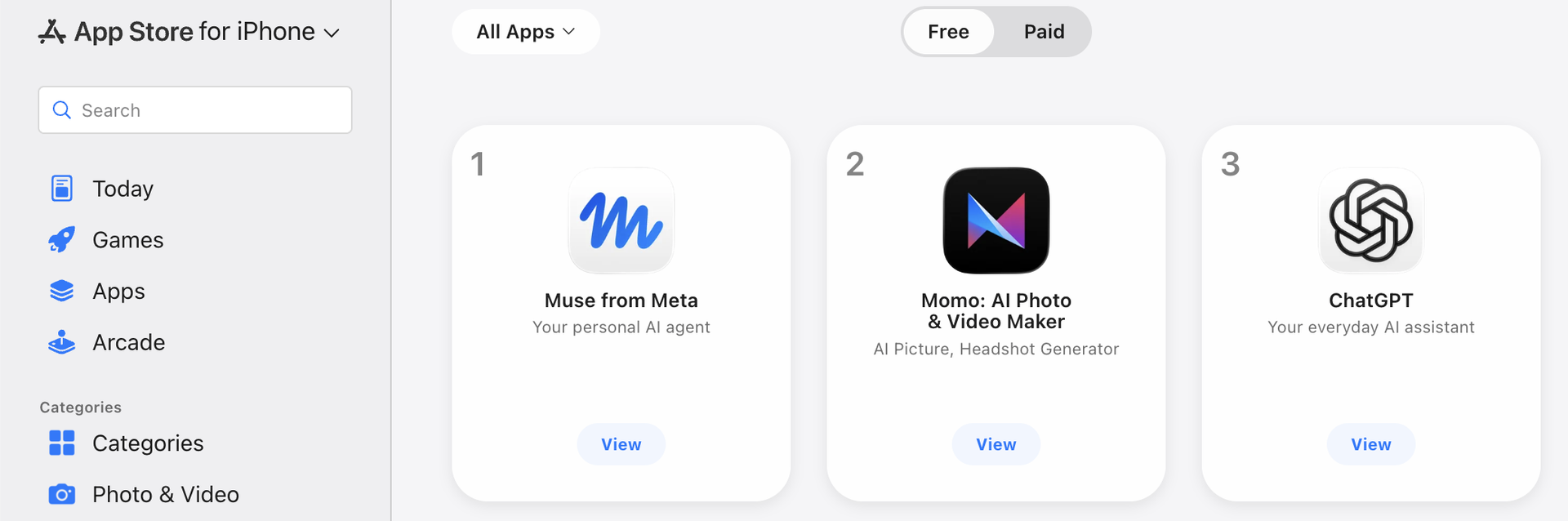
Still the launch revealed one key thing. The success or failure of a given AI product these days isn’t actually all that related to the power of the model underneath it. Muse is a harness for that model, and appears to have impressed enough consumers out of the gate to propel its app to the top of the charts. But the launch revealed another thing that will decide whether your AI product will actually catch on: a surprisingly large part of this is going to come down to the simple question of how much the companies you interact with want to deal with Meta.
|
|
|
|
Take, for instance, a key use of Muse, which is that it should be able to buy stuff for you. One can imagine a very convenient scenario where you tell Muse that you want to buy more detergent and it goes ahead and orders it for you after shopping around for the best price.
But, you and Muse aren’t the only one involved in that transaction; it’s contingent on Amazon or Walmart, both of which have their own shopping AI, being willing to play ball. A day after launch, Muse got a bit of air taken out of it when Amazon announced that it’s blocking the thing from its website. Amazon does not want Meta mining its stuff and, god forbid, finding deals. Will Muse even be able to access price information when the robots.txt of every merchant has a line explicitly telling it to buzz off?
Heck, Amazon shows just how far a retailer is willing to go to deprive its rivals of even the most tangential of consumer insight; have you noticed that Amazon’s emailed shipping notifications have stopped listing the actual products you’ve bought, and now just say “household item” or “computer item”? That’s because Amazon doesn’t want Alphabet to know anything about what you buy, to avoid Gemini from rugpulling them, even if that means a worse consumer experience. This is a real hurdle for Muse; otherwise the only retailer eager to work with it will be Facebook Marketplace, so I hope you’re fine scoring that detergent used and from a guy in a Panera parking lot.
This example is mainly to underscore some of the core issues coming up for hyperscalers, and it’s not just retail sales. If I’m an auto insurer, can I screen out Muse? A reservation app? An airline? They don’t want you getting a cheaper deal. Why should they work with Meta?
That’s why the next step will be deals, not just silicon. Can you make a model? Sure. Who can’t at this point? Can you design a harness on it that normies want to use? The early buzz for Muse is a surefire sign that yeah, seems like it!
But can you find a business that, knowing the past decade and a half of Facebook’s bareknuckle, AUT ZUCK AUT NIHIL, damn-the-torpedos-and-damn-the-privacy-policy business practices, and is still willing to to hand its business, its customer pipeline, its client relationships over to Mark Zuckerberg? We’ll see!
|
|
|
|
- 🏀 WNBA: The market still believes in the Lynx as a heavy title favorite, setting them at 44% (or nearly 3x anyone else’s odds) despite the difficult opening-round path. Read more about this in Friday’s Scoreboard.
- 🏈 MNF: The Philadelphia Eagles are big 69-31 favorites over the Chicago Bears on Monday, in large part to the injury sustained by Bears QB Caleb Williams, whose absence turned this game from an expected tossup to a solid Eagles favorite.
|
*Event contracts are offered through Robinhood Derivatives, LLC — probabilities referenced or sourced from KalshiEx LLC or ForecastEx LLC.
|
|
|
|
Think that Pumpkin Spice Latte tastes good? Think that those 12-foot Home Depot skeletons are charming? Did you enjoy the equinox last week? Well guess what, Autumn’s over already, I don’t make the rules here and according to the rules it’s basically already Christmas, as Hallmark has revealed their Countdown to Christmas schedule for 34 new Hallmark movies.
|
|
|
|
Researchers have described a fascinating new organism discovered in a geothermal pool in Lassen Volcanic National Park that they’re calling Incendiamoeba cascadensis. It can survive at hotter temperatures than any other known eukaryotic organism and continues to be able to reproduce up to 145 degrees Fahrenheit, with researchers believing that it should be able to change into a cyst to survive at even hotter temperatures. So, with one known form change and a name like Incendiamoeba, it sure seems like Pokémon are real and we have discovered a fire-type one.
|
|
|
|
- Monday: Jefferies Financial Group and Vail Resorts slated to release earnings after the close.
- Tuesday: CarMax and Carnival Cruise scheduled to release quarterly results premarket. August Job Openings and Labor Turnover Survey due out at 10 a.m. ET. MongoDB hosts investor day.
- Wednesday: Conagra and Jabil earnings slated for release ahead of the open. August PCE inflation report due out at 8:30 a.m. ET. HPE and Synopsys host investor day events. Micron slated to publish quarterly results after the close.
- Thursday: Accenture and McCormick slated to release quarterly results premarket. JPMorgan hosts its software forum through Friday. Nike results due out after the close.
- Friday: September non-farm payrolls report due out at 8:30 a.m. ET.
|
|
|
|
Was this email forwarded to you? Don’t miss out on future stories — subscribe to Snacks and get your daily dose of financial news straight to your inbox.
Craving more insights in your inbox? Subscribe to EntryPoint and Scoreboard for quality reads.
|
|
|
|
Sherwood Media, LLC produces fresh and unique perspectives on topical financial news and is a fully owned subsidiary of Robinhood Markets, Inc., and any views expressed here do not necessarily reflect the views of any other Robinhood affiliate... See more
|
|
|
|
SHERWOOD MEDIA, LLC, 85 Willow Road, Menlo Park, CA 94025
|
|
|
|
|





No comments:
Post a Comment