
This week, the Trump administration will continue its transparent efforts to manipulate the election this year in its favor. There is no other way to interpret the events we are now living through.
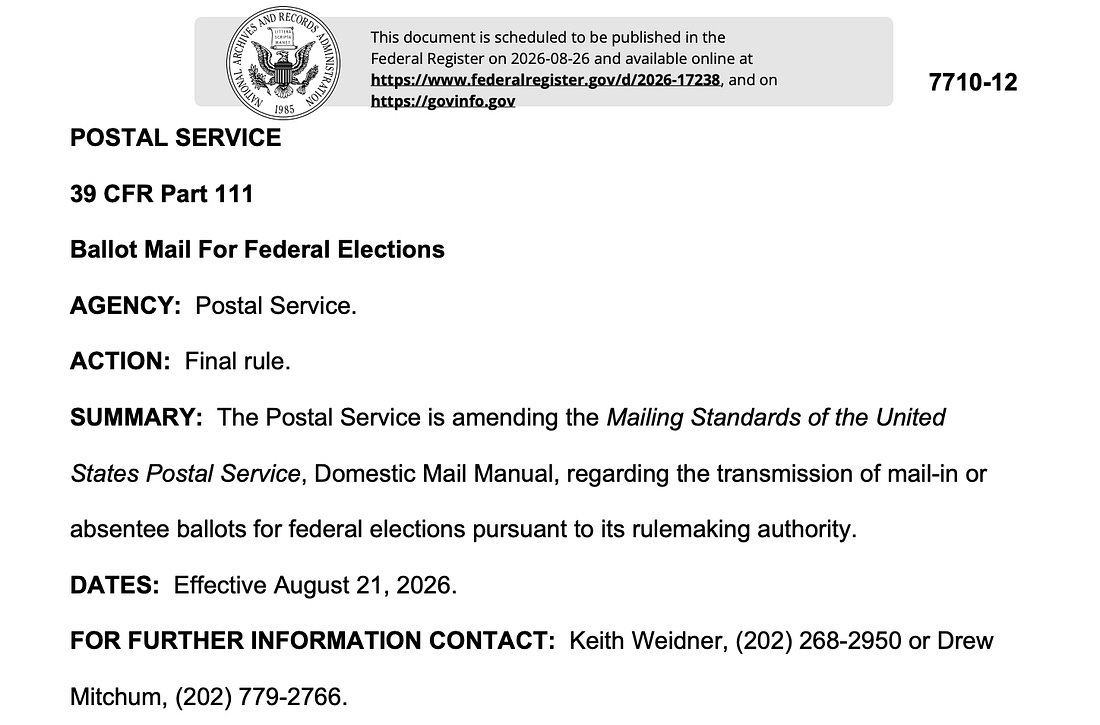
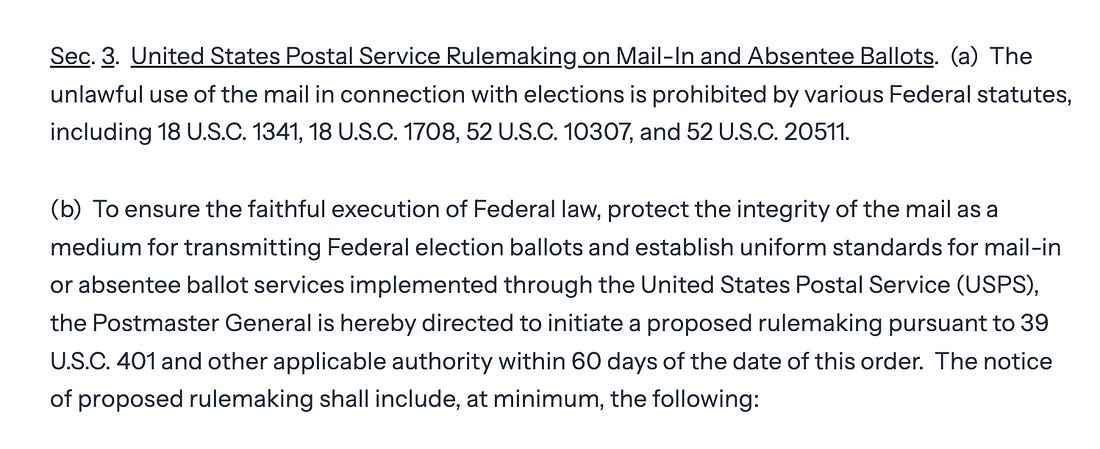
The Postal Service, pursuant to the executive order we’ve been discussing ever since Trump promulgated it earlier this year, is on board to try to keep ballots out of the hands of people whose votes this administration fears. In a 95-page “final rule” it has scheduled for publication in the Federal Register on Wednesday, it “is amending the Mailing Standards of the United States Postal Service, Domestic Mail Manual, regarding the transmission of mail-in or absentee ballots for federal elections pursuant to its rulemaking authority.” This is how the executive order, which is largely an aspirational statement of what the president wants to see happen, would be put into effect. It would circumvent states’ control over their own elections by imposing a federal restraint in the form of which ballots the Post Office will accept and deliver. We discussed the executive order on August 11th, when Judge Indira Talwani in Boston issued a nationwide injunction in the League of Women Voters lawsuit, which blocked the Postal Service from doing exactly what it’s now trying to do. The government’s major argument in that case had been that the dispute wasn’t “ripe” for a decision from the courts because the government hadn’t taken sufficient steps to put the EO into effect. That argument would seem to be off the table now. And how does the government gild the lily, since there is an injunction against putting the EO in place for the 2026 elections? They try to do it like this: “To ensure the faithful execution of federal law in connection with federal elections, this rule has an immediate effective date.” They claim that “Delaying the effective date would jeopardize implementation of this rule in time for the 2026 general election,” before conceding that “Given injunctions currently in place … the Postal Service will not take actions to implement the rule specifically for the 2026 election unless and until the government obtains relief from those injunctions.” On the one hand, they write a rule meant to apply to 2026. On the other, they pay lip service to following court orders, which is mighty nice of them since they have no choice in that matter unless the Supreme Court intervenes for the administration. But there’s another problem with what the government has done, since they specifically discuss application of the new measure to the 2026 elections. Judge Talwani ordered that the government was “preliminarily enjoined from implementing, giving effect to, or enforcing Section 3 of Executive Order No. 14399, with respect to the November 3, 2026 or any earlier federal election, including refusing to transmit mail-in or absentee ballots; or otherwise initiating or completing rulemaking to promulgate the specific regulations outlined in Section 3(b)(i)–(v) or (d) of the EO for the November 3, 2026 or any earlier election.” [emphasis added]. Section 3 of the executive order, which the Judge enjoined the government from implementing, is the part of Trump’s order that applies to the Postal Service’s role in interfering with Americans who are trying to cast ballots. In other words, the government is proceeding in precisely the manner the Judge told them they could not.
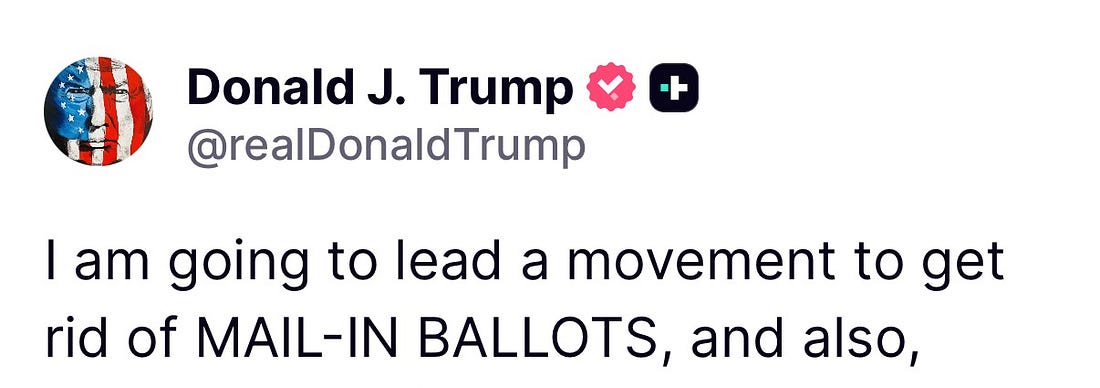
Judge Talwani has only enjoined the government with regard to the 2026 elections, leaving the questions of both ripeness for action and the legality of the substance of the EO for future proceedings. There are also cases in front of other judges. So this issue doesn’t go away after 2026, but the legal issues are particularly acute now, with the election less than three months away and Trump intent on preventing eligible Americans from voting. We should never forget Trump’s August 18, 2025, Truth Social post that started like this:
Yes, it’s ironic. Trump votes by mail, as do a significant number of Republicans. But this is about something more for him; this is about building a narrative of fraud that he can try to use to overturn an election whose outcome he doesn’t like. That’s what it’s all about, Trump versus the voters of the United States. He has no respect for the Constitution, the democratic process, or the rule of law. We know that. He showed it for everyone to see on January 6. And having essentially gotten away with it and now being well on the way to erasing the insurrection from the history books, he is looking forward to the next election and figuring out how to erase losses there too. If only he would put as much energy into earning the voters’ trust and working for them as he does into circumventing their will. In 2024, Trump told a gathering of conservative Christians ahead of the election that it would be the last election they’d ever have to vote in if he won. Your right to vote shouldn’t turn on whether a hastily prepared federal list, almost certain to be full of errors, includes your name. The Constitution leaves decisions about elections, including who is qualified to vote in them, up to each state. Every day, the press, the Democratic Party, and the public should be bombarding everyone aligned with Trump with one simple question: “Why don’t you trust the voters?” We’ll be watching the litigation over this as it takes shape this week. Saturday night, the League of Women Voters filed an emergency motion to enforce their injunction. Judge Talwani ordered the government to respond by 8 a.m. Tuesday morning, to permit her to rule before the Wednesday date the Postal Service indicated it would publish its new rule. When I left the Justice Department the night before Trump’s first inauguration, I never imagined that my interest in voting law would become a mainstream topic of conversation in our country. But I’m deeply grateful to those of you who care and who trust me to help explain it when you read this newsletter. We’ve known since Trump first issued this Executive Order what everyone else is waking up to now: that it’s a deeply disturbing signal of Trump’s willingness to bypass the voters’ wishes and the fundamentals of democracy. Thank you for sticking with me and for relying on Civil Discourse for plain talk and an explanation of how the law works and intersects with our politics. We’re in this together, Joyce You're currently a free subscriber to Civil Discourse with Joyce Vance . For the full experience, upgrade your subscription.
|





No comments:
Post a Comment