
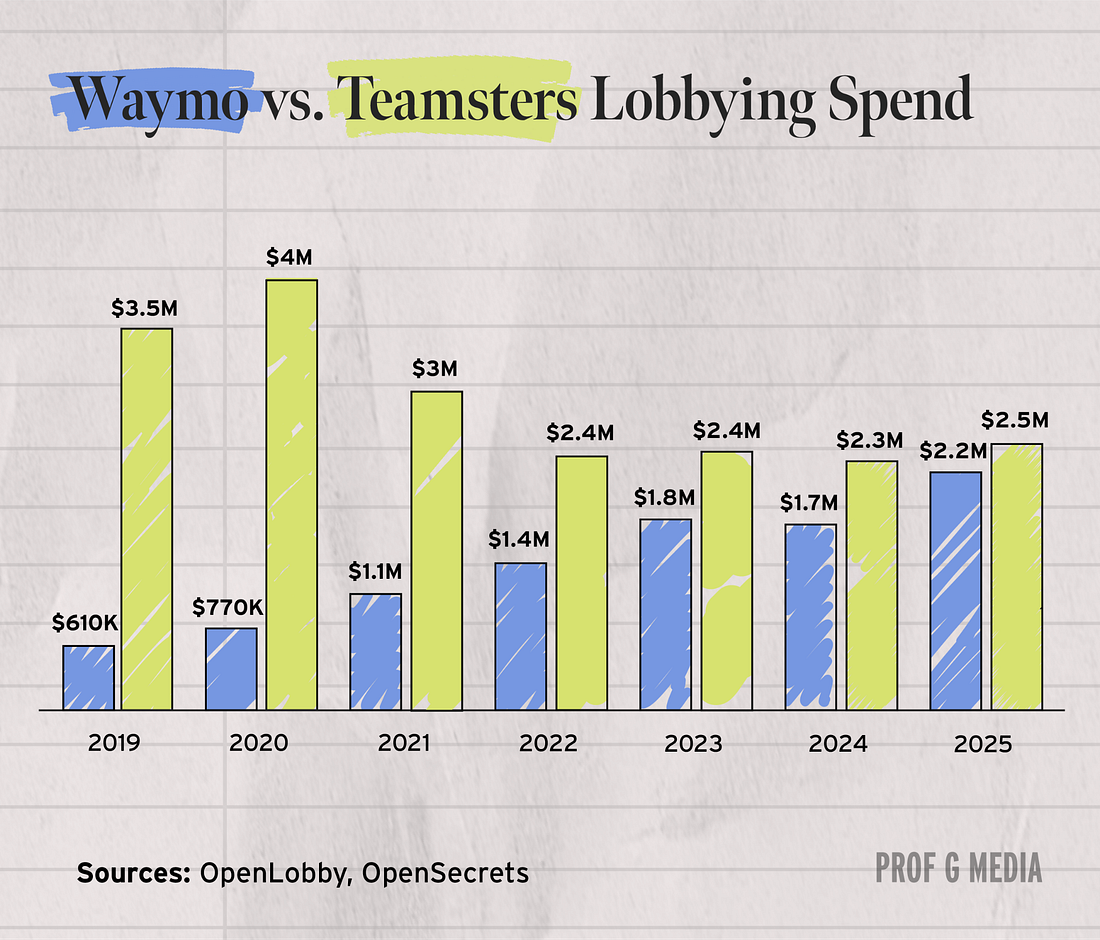
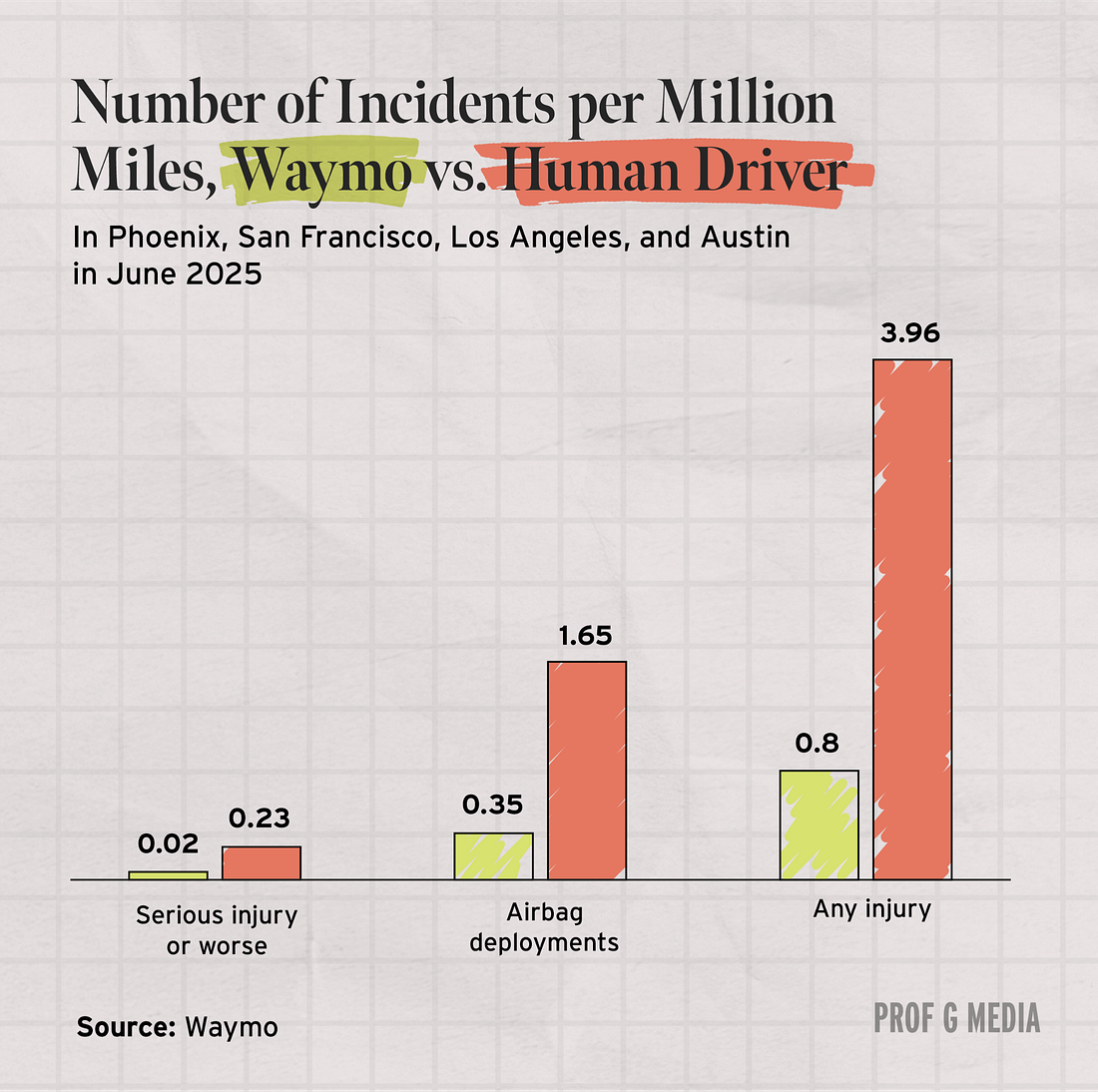
Every year, more than 36,000 Americans die in car accidents. Compared with human drivers, Waymo’s autonomous vehicle (AV) technology results in 92% fewer serious accidents, suggesting it could prevent many of those deaths. But after a year of the company operating eight cars with zero accidents in New York City, Mayor Zohran Mamdani let Waymo’s testing permit expire anyway. When asked why at a press conference, Mamdani made his position clear: “Look, if a company like Waymo finds itself in New York City, what they will also find is a City government that is committed to delivering for the workers who keep the city running, and those workers also include our taxi drivers who, for far too long, have been sold a dream of being able to work their way to the middle class, only to have the rug pulled out from under them.” To translate: The mayor of New York City will not let technology companies automate the work of taxi drivers and rideshare drivers. He won’t be the last politician to take that stance. Hit the BrakesFor as long as autonomous driving has existed, there has been organized resistance to it. Mamdani is not an outlier — he’s the latest and most prominent face of a movement that has been working for nearly a decade to slow, stall, or stop autonomous vehicles from replacing human workers. That movement has a name, a headquarters in Washington, D.C., and 1.3 million members: the International Brotherhood of Teamsters, America’s largest private-sector union and the most powerful force standing between autonomous vehicles and the open road. Nearly a decade ago, the Teamsters successfully lobbied Congress to exclude autonomous semitrucks from legislation that paved the way for autonomous vehicle testing. Four years later, in 2021, they shut down a bill that would have relaxed federal autonomous vehicle rules. In 2023, the Teamsters backed a California bill that would’ve required human drivers in all autonomous trucks. The bill made it past the state Legislature, but Gov. Newsom vetoed it. As autonomous driving develops into more serious technology, so do the Teamsters’ efforts to halt it. Last year, the conflict intensified when Teamsters Local 25 called on Waymo to pause their planned Boston rollout altogether. “Waymo is steamrolling into cities throughout our country without concern for workers or residents,” said Local 25 President Tom Mari at a rally outside of Boston’s City Hall. “They’re doing this because they want to make trillions of dollars by eliminating jobs.” As of now, Waymo is continuing their testing in Boston despite the Teamsters’ opposition. Under the current Massachusetts permitting process, all autonomous vehicles need a human operator behind the wheel. There’s currently a bill in the Massachusetts State House that would change this — but it’s been met with a competing Teamsters-backed bill that would officially codify the requirement for human operators. It’s unclear how or when this conflict will be resolved, especially as Waymo continues to ramp up its lobbying spend.
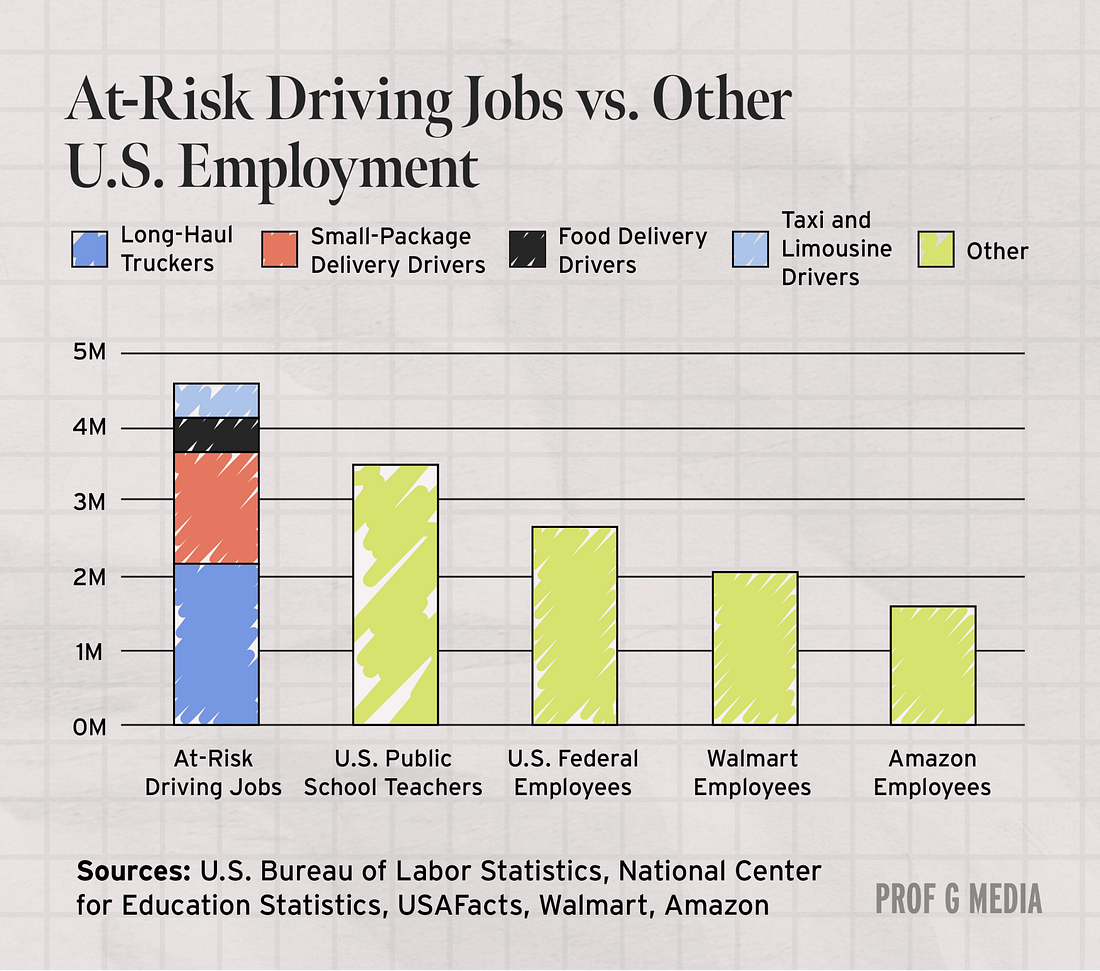
What is clear, however, is that these legislative battles are not one-off events. They’re the beginning of what will be a long path to seeing autonomous vehicles on the roads of all 50 states. And for good reason — the Teamsters have a point. Job destruction is coming. Driver DestructionSince ride-sharing services began popping up in the early 2010s, they’ve become the backbone of the gig economy. According to Deloitte, about a third of the American workforce participates in the gig economy. From there, it’s estimated that at least a quarter of American gig workers drive in some capacity, whether that be delivering food, groceries, or humans. Autonomous vehicles put all of these jobs at risk. If we zoom out to include other driving occupations, it gets even worse. According to the Bureau of Labor Statistics, there are roughly 440,000 taxi and limousine drivers, 460,000 food delivery drivers, 1.5 million small-package delivery drivers, and 2.2 million long-haul truckers. That’s a total of 4.6 million jobs. Driving is also the most common occupation among young men without a college degree, by far. All of this means that, as you read this, nearly 3% of the American workforce is in the crosshairs of Big Tech.
Nearly all of those occupations are, in some capacity, represented by the Teamsters union. The transportation sector as a whole has a union penetration rate of about 14% — a minority, obviously, but still more than double the rate of the private sector in total. The Teamsters’ fight against autonomous driving is important not only to its members but also to its very existence. If the Teamsters begin bleeding members due to automation, they’ll start losing dues, which would place pressure on the union’s finances and dampen its political influence. Outside of unions, it can be assumed that there will be plenty of political capital to be gained in future elections for politicians who choose to take a stance against Big Tech and autonomous vehicles. The tide is turning on all forms of AI, and public polling already reflects this reality.
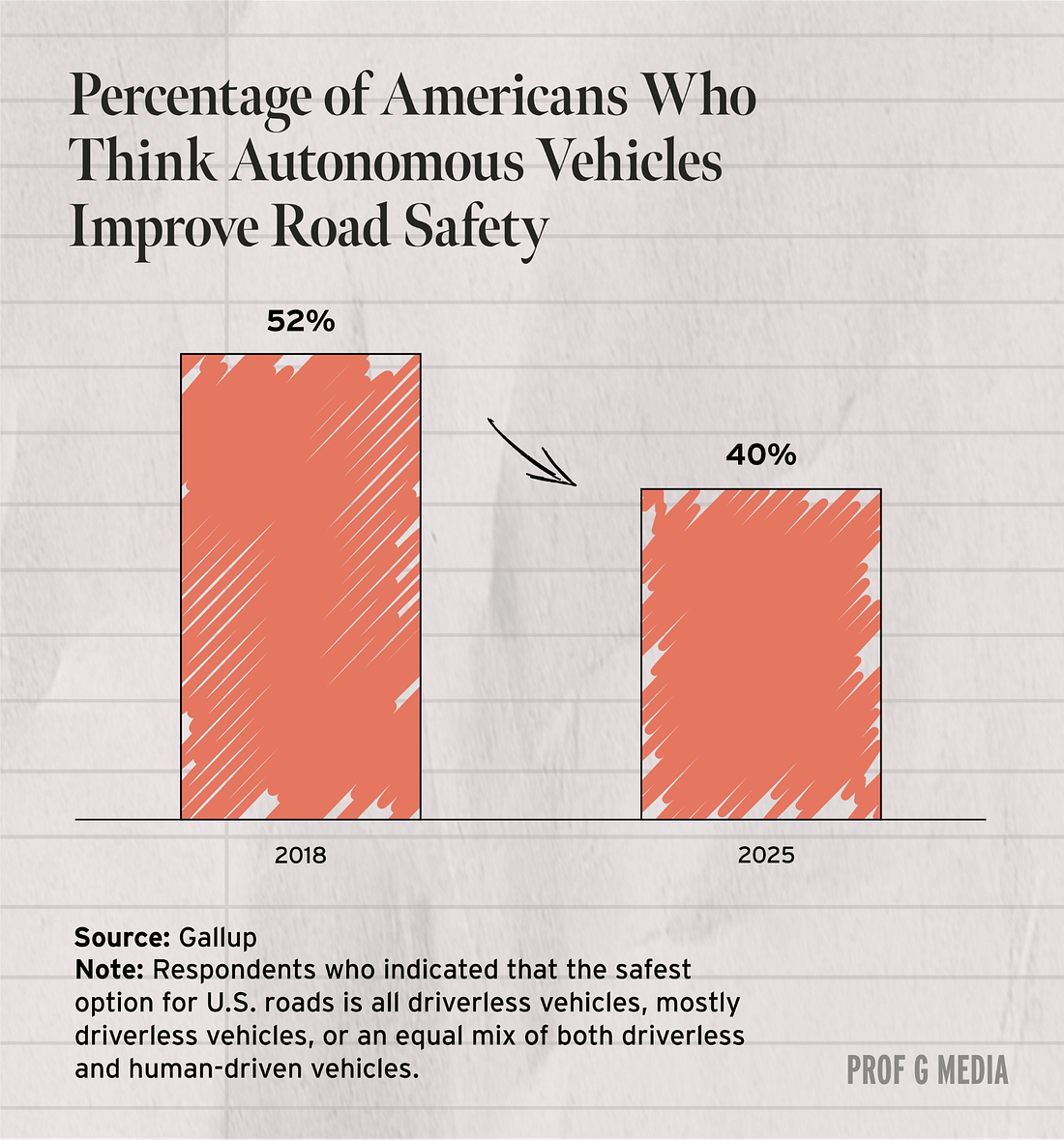
The share of Americans who think AVs improve road safety has actually fallen 12 percentage points since 2018 — and that’s despite the technology becoming exponentially safer over the same period. Compared with human drivers, Waymo vehicles have 82% fewer injury-causing crashes, 92% fewer crashes involving injured pedestrians, and 85% fewer crashes involving injured cyclists. Last year, car accidents were the leading cause of death for Americans ages 5 to 29. In an entirely Waymo’d world, more than 33,000 lives would be saved annually. But without public buy-in, none of this matters.
The raucous boos at graduation ceremonies across the country illustrate how unpopular artificial intelligence and autonomous technologies more broadly are in America. Autonomous vehicles are possibly the most visceral and physical embodiment of AI that the average American might interact with on a regular basis. In cities where Waymo or Tesla or Zoox operate, autonomous vehicles are everywhere. They serve as a constant reminder of the once-farfetched, unrecognizably transformed future that awaits us — a future that most Americans interpret as dystopian. Let’s TalkThe Teamsters are not the first union to stand in front of automation. In the 1810s, English textile workers — the original Luddites — smashed power looms with hammers in the dark of night. In the end, it didn’t save their jobs. A century later, elevator operators’ unions fought to keep humans at the helm of automatic elevators. Those jobs are long gone. In the 1960s, longshoremen’s unions battled the introduction of shipping containers. The longshoremen lost that fight, but not before negotiating severance funds and job guarantees that softened the blow for existing workers. The pattern is undefeated: Technology always wins, the only question is how much protection workers are able to take with them on the way out. This is exactly why Mamdani and the Teamsters are wrong. Letting the permit expire is not good for labor — in fact, it has the opposite effect. The more honest and useful fight is the one the longshoremen eventually settled for: not blocking the technology altogether but demanding that the companies deploying it bear some of the cost of the disruption they’re causing. Retraining funds, transition payments, even a Waymo-funded safety net for displaced drivers are all policies worth proposing. Instead, the Teamsters’ current Luddite-inspired strategy will leave workers empty-handed. The question they should ask themselves is: Do you want to be right or do you want to be effective?
Each week, this section will give you an inside look at how this article came about, as well as the analytical and storytelling techniques the author used to report it. Working with Ed on Markets has made me acutely aware of the public’s souring perception of all things artificial intelligence. Months before commencement speakers were getting heckled for mentioning AI, Ed pointed out the mounting opposition to data center construction across the country and its relation to politics. I’ve been following the autonomous race closely, and Ed’s findings made me wonder: Is the same thing happening with robotaxis? I realized that the answer was a resounding yes. But when you think about the trade-off between safety and jobs, things get complicated … and a lot more interesting. One more thing: Part of being a good analyst is recognizing patterns across different domains. When a new story reminds you of something you’ve seen before, follow that instinct. History might not always repeat, but it’s always instructive. Dan Chiolan is a research analyst on the Prof G Markets team. He started as an intern in 2024 before joining Prof G Media full time after graduating from Temple University.
You're currently a free subscriber to Prof G Media. For the full experience, upgrade your subscription.
|








No comments:
Post a Comment