
Sunday night, we discussed the Southern Poverty Law Center’s motion to “address the government’s materially false statements.” It’s an extremely unusual motion coming from a defendant in a criminal case. The gist of the argument is that the Justice Department made false statements about SPLC, and that they knew they were false statements, because SPLC gave them notice in advance, and again, after the acting Attorney General, Todd Blanche, made false comments during the press conference on the case. SPLC asked the government to “correct its false statement” before filing the motion, but apparently didn’t get any satisfaction.
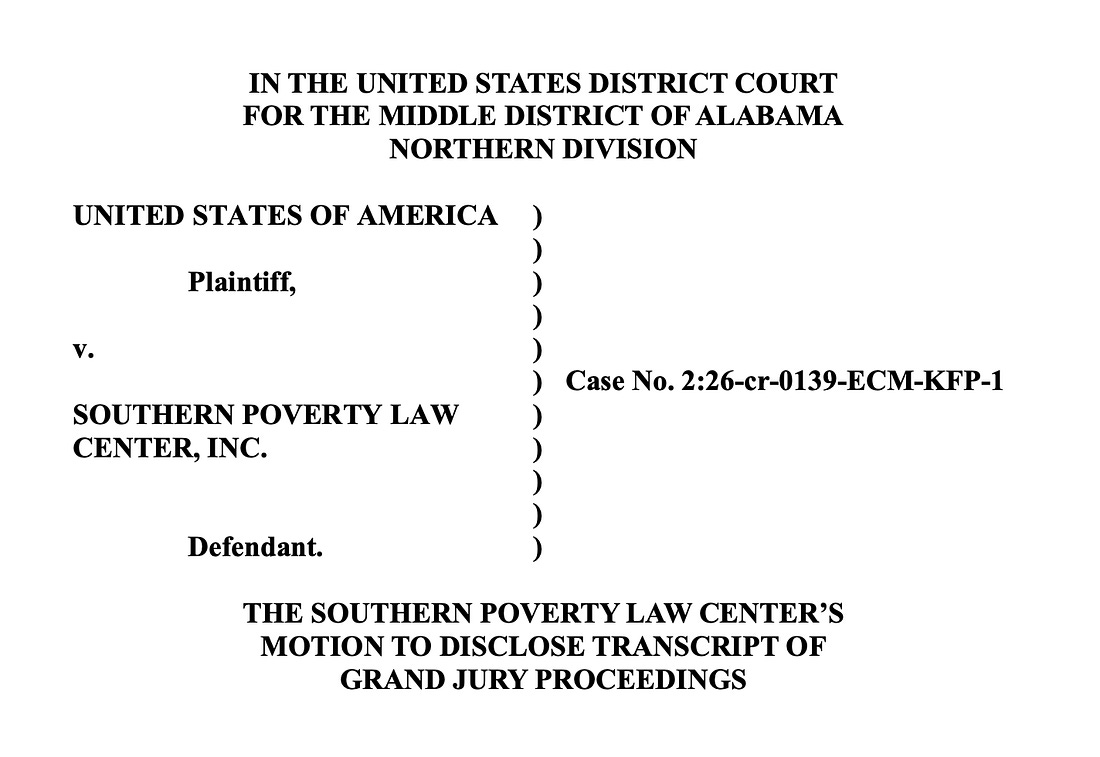
You can read their full motion here. The government’s response was due today, and when it came, it left prosecutors looking a lot like a deer in the headlights. The meat of the government’s response is as follows: “On April 26, 2026, Acting Attorney General Blanche made the following statement on Fox News Sunday with Shannon Bream, ‘It is true that over the years they have selectively shared information with law enforcement. That’s well-documented and there’s no dispute there. They aren’t charged with any of that conduct.’” “To the extent that any clarification was needed,” the government’s response continues, “Acting Attorney General Blanche’s remarks on a major Sunday television program certainly suffice.” Then, the government humbles itself further, “Regarding Defendant’s second relief request, the United States of America has no intention of making any false or misleading statements in this case or any other case. It is well aware of its obligations under the law and applicable rules and will act accordingly.” SPLC will undoubtedly dispute whether a vanilla statement on Fox will “certainly suffice.” But even before we get there, the government has in essence conceded the motion—they don’t dispute in their three-page response that Blanche, Patel, and the president of the United States made false statements, accusing SPLC of advancing white supremacist causes and denying SPLC provided information about those groups to the government in an effort to take them down. This is an indictment that’s in trouble. Then it gets worse. Because SPLC filed another, related, motion back on April 28, that one seeking transcripts of the government’s grand jury proceedings. The motion can be found here.
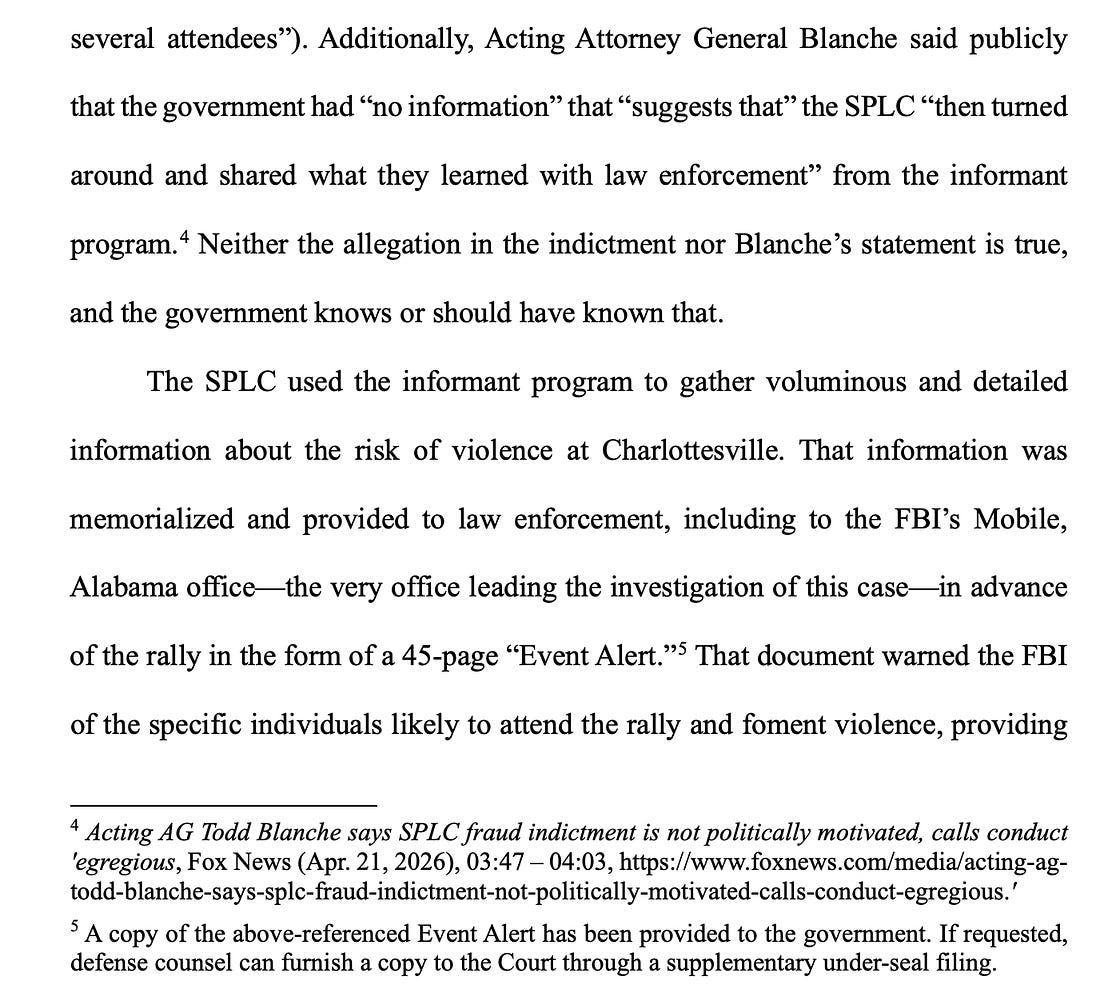
Courts don’t routinely order disclosure just because a defendant asks. It’s extremely rare. A defendant has to show a “particularized need” for the transcripts that outweighs the interest in maintaining grand jury secrecy; it must be more than just a fishing expedition. Here, SPLC is arguing that, “The substantial likelihood that the government carried gross misrepresentations of material issues into the grand jury proceeding warrants disclosure of grand jury materials.” It must persuade the court that disclosure is essential to avoid a possible injustice. It’s a very serious allegation of misconduct to make against the government. But once the government has conceded in its response to the other motion that it was making false statements about SPLC’s conduct, its claim here starts to look pretty good. In its motion, SPLC argues that “The indictment repeatedly alleges the SPLC sought to promote the Unite the Right rally in Charlottesville, Virginia in August 2017 … Acting Attorney General Blanche said publicly that the government had ‘no information’ that ‘suggests that’ the SPLC ‘then turned around and shared what they learned with law enforcement’ from the informant program.” Of course, from SPLC’s other motion, we know they maintain that this isn’t true, and they seem to have the receipts—the FBI’s Mobile, Alabama field office, the same office whose agents worked on the criminal indictment, received a 45-page intelligence product from SPLC before the rally.
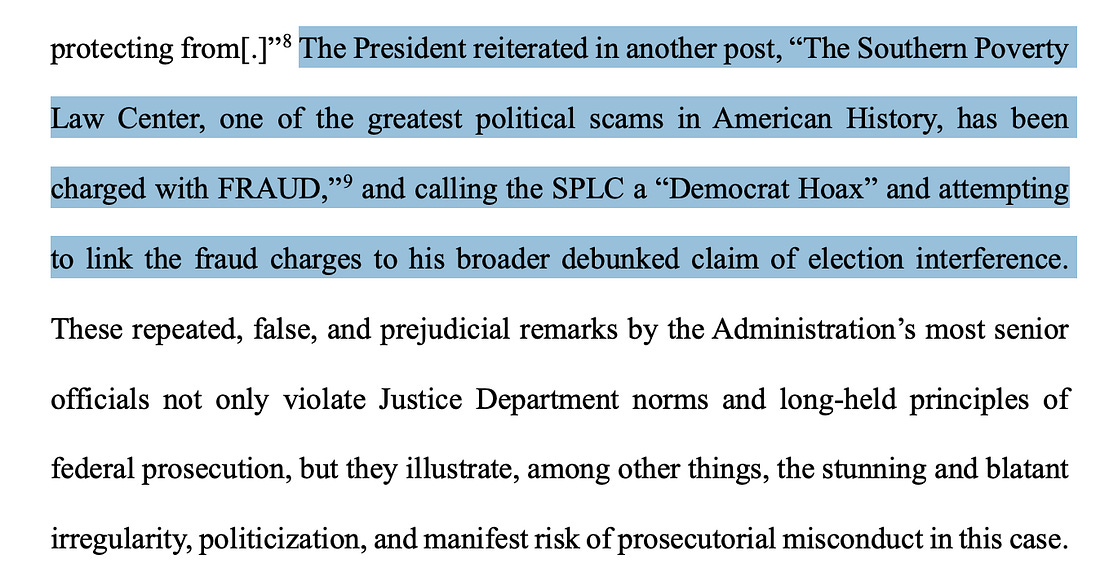
SPLC also objects to what they characterize as “repeated false and highly prejudicial statements about the SPLC and its activities,” made by high ranking government officials including Blanche, even though they aren’t made in the indictment, “that the SPLC is ‘giving money to the KKK.’” SPLC calls those claims “fanciful and baseless.” As we discussed Sunday evening, prosecutors are forbidden from going beyond information contained within the “four corners of the indictment” when discussing a matter under indictment publicly. It wasn’t just Blanche and FBI Director Kash Patel who SPLC says made these false comments. The president got into the act, too.
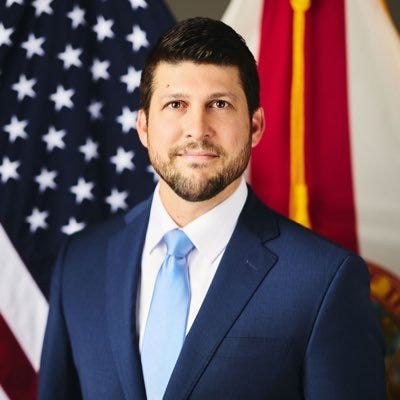
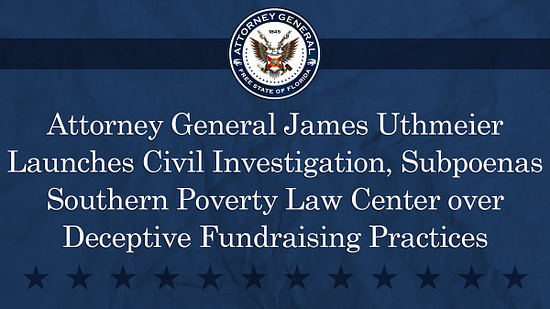
“On its face,” SPLC concludes, “the indictment has fundamental flaws that raise concerns about the prosecutors’ instructions to the grand jury on the legal basis needed to return an indictment.” Because the government acts as the grand jury’s legal advisor, helping it understand the legal requirement for returning an indictment, this is an argument that has some teeth here. But the Middle District of Alabama is a deeply conservative court, with no active judges who were appointed by a Democratic president. Whether loyalty to party will trump loyalty to country, and more importantly, the rule of law here, remains to be seen. You’d like to think the courts will ignore the noise and do their job. One argument that may land hard against the government is that the government is not entitled to the “presumption of regularity,” the presumption that prosecutors do their jobs legally and in good faith unless proven otherwise. Courts have routinely applied it before this, but SPLC notes, “As one court recently described, while ‘[g]enerations of presidential administrations and public officials have validated this underlying premise of the presumption of regularity,’ ‘[i]n just six months, the President of the United States may have forfeited the right to such a presumption’ entirely,” because of repeated instances of dealing with the courts in a fashion that doesn’t comport with the duty of candor prosecutors owe to judges. The government’s response was due today. “The secrecy of the grand jury is sacrosanct,” they start out. “Here, the Southern Poverty Law Center, Inc. (“SPLC”) seeks to invade the province of the grand jury based on speculation and unsubstantiated allegations. The request lacks support in the law and in fact.” That sounds pretty hollow after they’ve just conceded that both the attorney general and the director of the FBI, along with the president, have been pushing out information about the defendant that isn’t true. The government does push back, arguing that SPLC hasn’t specifically advised the court why it believes the government improperly advised grand jurors about the law, but it fails to confront SPLC’s position that there is no more presumption of regularity for the government to cloak the behavior of its prosecutors in. It’s not a clear call, but there is more than fair reason for the court to permit SPLC to review at least key portions of the grand jury transcript. But the impact of the government’s misconduct is clear. Lying about a criminal defendant’s behavior has consequences. That’s how this DOJ rolls. Based on its rhetoric, Florida’s attorney general is now threatening to open an investigation. Conservative media is full of talk equating the Southern Poverty Law Center with support for white racist groups, which is ironic when you think about how much support for white racist groups comes from the very people who are now reviling the SPLC. If anything, you would think that they might want to start donating. But of course, it’s not a joke. SPLC has operated under heavy security for decades. They do that because their history suggests that they’re a target: Their founder faced repeated death threats. Criminal indictments are one thing. The government is entitled to put its evidence into them. But the process isn’t supposed to be a punishment. And prosecutors certainly aren’t supposed to expose a defendant to the threat of violence with unfair, baseless comments that, given SPLC’s background, could easily make them a target. Earlier this week, I published a note on Stay Tuned with Preet, entitled “The Worst Sort of Injustice.” After assessing the arguments the administration is making about SPLC’s guilt, I concluded, “But here, there is something even more sinister at work. It’s not just an attempted takedown of an individual, it’s a cudgel thrown at the heart of the civil rights community itself. This administration would like nothing better than to silence the voices from the civil rights community and civil society, calling for a restoration of democracy and justice. That makes this indictment the worst sort of injustice.” Moments like this are why I do this work the way I do it—reading the filings closely and tracing the arguments back to their source documents. So much depends on actually understanding what’s in them and how the legal system works. If you agree that’s important, I hope you’ll consider subscribing to Civil Discourse if you don’t already. Your paid subscriptions make this work possible. We’re in this together, Joyce You're currently a free subscriber to Civil Discourse with Joyce Vance . For the full experience, upgrade your subscription.
|





No comments:
Post a Comment