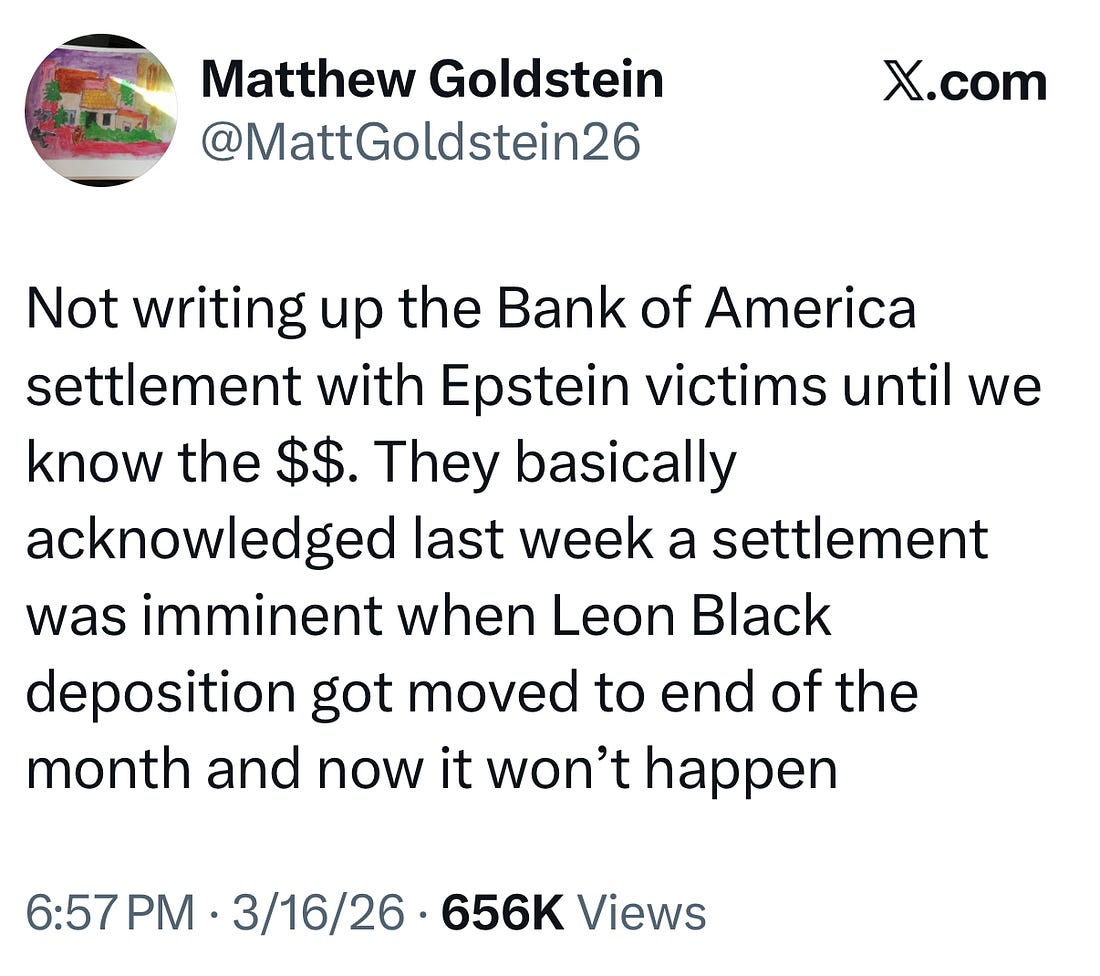
Even though Donald Trump went to war in Iran, arguably according to at least some commentators and even a Republican congressman, to distract from the Epstein Files, we have not forgotten about them or about the survivors who deserve justice. The survivors have not forgotten either. Something new in the offing? Yesterday, New York Times business reporter Matthew Goldstein tweeted this:
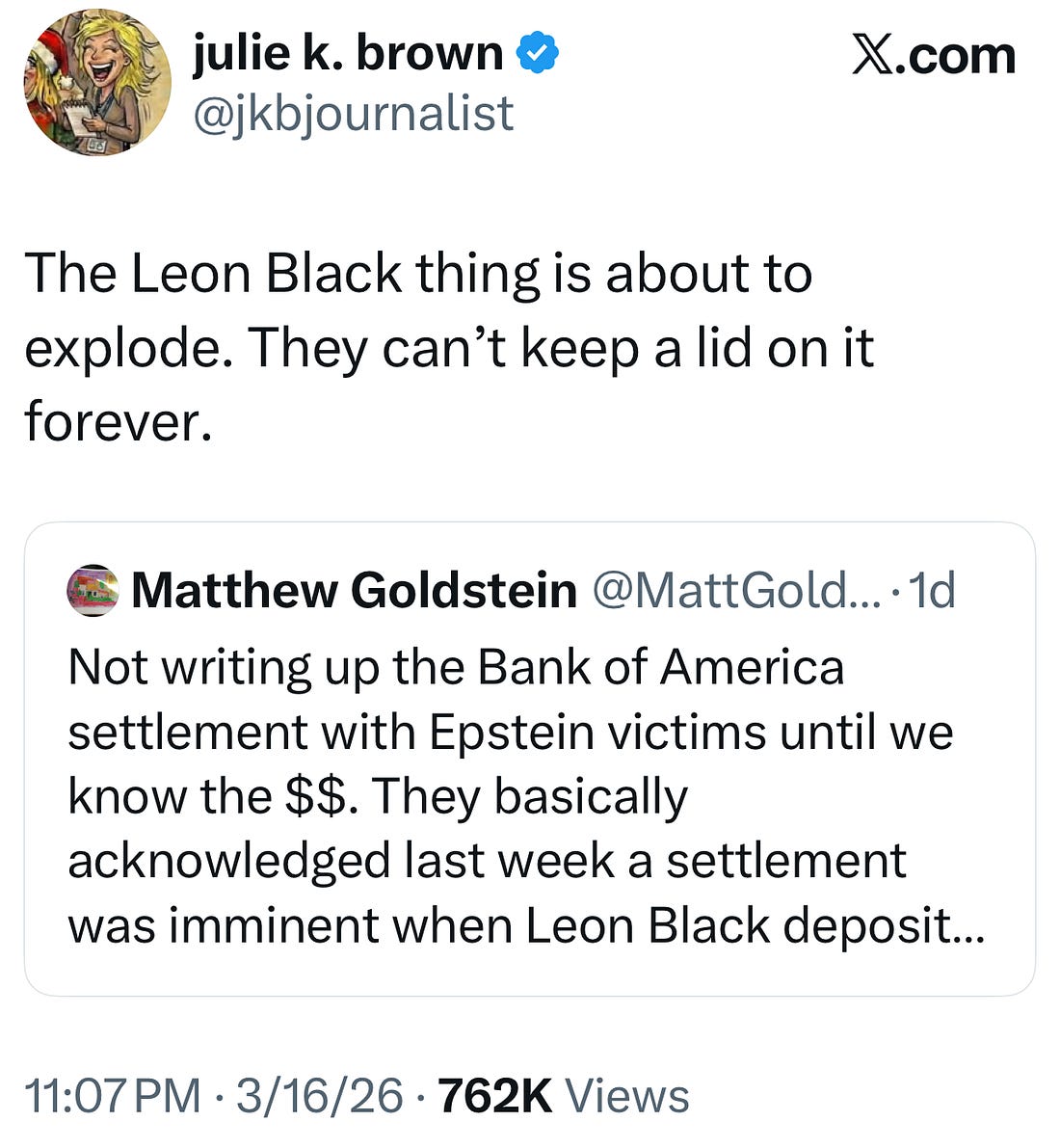
This is a reference to one of the two federal lawsuits filed by Epstein survivors last October. One was against Bank of America and the other against Bank of New York Mellon. The lawsuits accused both banks of being “complicit financial institutions” that were more concerned with keeping their wealthy and well-connected clients happy than they were with complying with anti-trafficking laws. Both lawsuits allege multiple violations of the Trafficking Victim Protection Act and negligence. For example, the complaint against Bank of America alleges: “Rather than merely providing routine banking services to Epstein, Bank of America went far beyond what a non-complicit bank would have done and instead assisted Epstein in setting up the necessary financial structure to operate his sex-trafficking venture.” Late last week, Epstein survivors announced they had reached a proposed settlement in principle with Bank of America. Such a settlement requires approval from the federal judge overseeing the case, and its terms are not public. It follows on the heels of 2023 settlements with JPMorgan Chase and Deutsche Bank. Julie K. Brown, the reporter responsible for putting the Epstein story on America’s front burner, retweeted Goldstein, commenting: “The Leon Black thing is about to explode. They can’t keep a lid on it forever.”
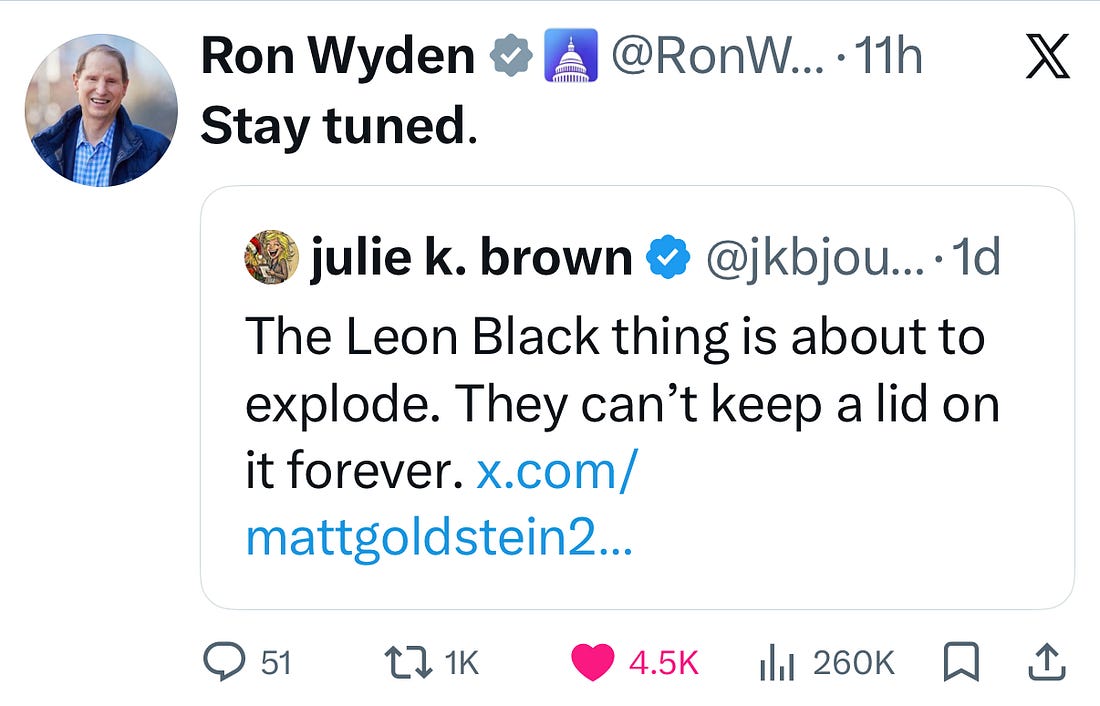
Julie K. Brown’s reporting was instrumental in unearthing the unconscionable sweetheart plea deal Epstein got in Florida and forcing further investigation into the matter, which led to the prosecution of Jeffrey Epstein and Ghislaine Maxwell. So when she makes a statement that is this definite, it’s time to pay attention. Leon Black is an American private equity investor. He co-founded Apollo Global Management, which is billed as one of the world's largest alternative investment firms. It makes investments in asset classes other than capital stocks, bonds, and cash. Black was Apollo’s CEO until 2021, when he resigned amid revelations of his business relationship with Jeffrey Epstein. To give you some idea of how well he has done, he recently sold his Beverly Hills home for $47 million, according to the Wall Street Journal. Oregon Senator Ron Wyden is the ranking member of the Senate Finance Committee and someone who understands what is meant by “follow the money.” He retweeted Julie K. Brown’s tweet. “Stay Tuned,” he added.
In fact, both lawsuits filed by Epstein survivors last year refer to the long-term investigation Wyden has been conducting. In a January update, he wrote, “Every one of these banks that enabled Epstein by waiting years to flag his suspicious transactions ought to face criminal investigation for violating the Bank Secrecy Act, and individual bankers ought to be investigated too. If the Trump administration wasn’t running a full-on pedophile protection program, these investigations would already be underway.” Wyden’s investigation began in 2022, when he started looking into Epstein’s financial relationship with Black. According to his Senate Finance Committee release, he received information documenting Black’s payment of $170 million to Epstein, “ostensibly for tax and estate planning services.” Last June, before the Epstein Files Transparency Act was passed and documents started to be released, Wyden wrote a blueprint for what he characterized as “a proper follow-the-money investigation.” When folks like this are paying attention, it suggests something important is coming. Scrutinizing the allegations in the civil case against Bank of America reinforces that.
The lawsuit starts with a charge based on an unusual criminal-civil hybrid theory. It involves a provision in federal criminal law that can be enforced only by the DOJ. However, the law also specifically allows victims to recover through a civil lawsuit. 18 USC 1595 reads: “An individual who is a victim of a violation of this chapter may bring a civil action against the perpetrator (or whoever knowingly benefits, or attempts or conspires to benefit, financially or by receiving anything of value from participation in a venture which that person knew or should have known has engaged in an act in violation of this chapter) in an appropriate district court of the United States and may recover damages and reasonable attorneys fees.” So, the survivors look to the criminal charge in 18 USC 1591 as the basis for their civil case. That statute makes it a crime if someone “recruits, entices, harbors, transports, provides, obtains, advertises, maintains, patronizes, or solicits by any means a person; or” (and here is the relevant part for purposes of these lawsuits): “benefits, financially or by receiving anything of value, from participation in a venture knowing, or…in reckless disregard of the fact, that means of force, threats of force, fraud, coercion…will be used to cause the person to engage in a commercial sex act, or that the person has not attained the age of 18 years and will be caused to engage in a commercial sex act.” In plain English, that law means that people who were trafficked can bring a civil lawsuit against an entity, like a bank, if it benefited because they were trafficked and knew, or recklessly disregarded, what was happening. There is an “interstate commerce” requirement, but that’s met here because of Epstein’s movement of girls and women across state and federal boundaries. There are other counts alleging that the bank participated in sex trafficking and obstructed investigation into it. And there are two final counts alleging the bank was negligent and failed to take reasonable steps that would have prevented harm to the survivors. Given these allegations, the news that a settlement is imminent should certainly raise the temperature at the White House. Before the war in Iran began, the contents of the Epstein files and the names of those implicated in them seemed to be all anyone was focused on. Bill and Hillary Clinton testified before we bombed Iran. Shaiel Ben-Ephraim, an analyst and former Israeli diplomat, noted that once that happened, Google searches for the Epstein Files “plummeted.” What more had the White House hoped to prevent from being disclosed? It appears that at least some of it is about to come to light. If you weren’t aware this settlement was brewing, now you know. And, if all you’d seen so far was headlines about a possible settlement, this is the context that makes them make sense—the history, the allegations, and what they reveal about how power actually works behind the scenes. I’ve dug through the civil cases and pulled forward what matters now, so you’re not left guessing at the implications. Subscribe to Civil Discourse to get this kind of clear, fact-based analysis when it counts most. We’re in this together, Joyce You're currently a free subscriber to Civil Discourse with Joyce Vance . For the full experience, upgrade your subscription.
|
Wednesday, March 18, 2026
We Have Not Forgotten About The Epstein Files







Subscribe to:
Post Comments (Atom)
“Stunning Interference”
Listen now (11 mins) | ͏ ͏ ͏ ͏ ͏ ͏ ͏ ͏ ͏ ͏ ͏ ͏ ͏ ͏ ͏ ͏ ͏ ...
-
On Monday, Leon County Circuit Judge Angela Dempsey rejected Bear Warriors United's request for a temporary injunction to halt the s...
-
Four Ohio cities ranked in the nation's top 100 best cities for single people, according to a WalletHub survey that considered fact...


No comments:
Post a Comment