Read Time: 4 minutes. |
Every now and then, I send a tweet to our family group text. |
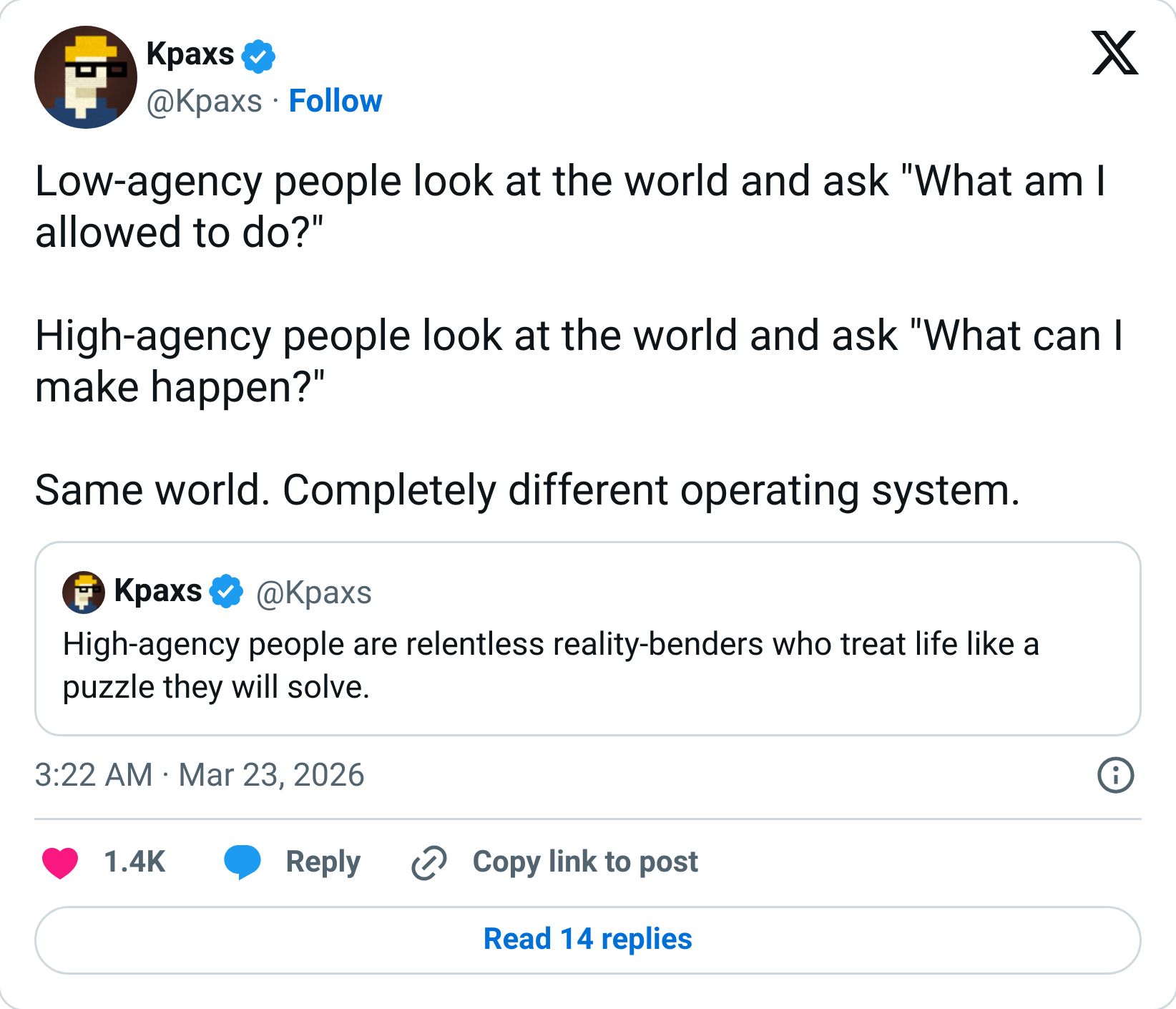
Last week it was this one: |
|
Every nudge. Every reminder. Every round trip drive to practice. |
Every push outside their comfort zone comes down to my unwavering belief: |
High agency people get more out of life than low agency people. |
As a result, they attract opportunity.
They manufacture the luck that others seem to envy. |
Paul Mack devoted 7 months to writing the definitive article on high agency, but the concept is not new. The idea that some people operate differently, often times unconventionally or unreasonably, is timeless. |
|
Whatever you call them, the renewed focus on high agency is excruciatingly timely. |
We're hearing more and more stories about students graduating from top universities unable to land entry level jobs. |
Why? |
Most entry level, white collar jobs are apprenticeships comprised of low agency work that was too expensive to fully automate. |
Bankers cranking out late night excel models. Paralegals searching through case law to prepare briefs. Management consultants turning partner ideas into slide deck revisions.
|
Enduring this grind was part of the test. It was the entrance fee (paid in the form of corporate hazing) into the more lucrative leadership roles down the road. |
And then AI showed up. |
It never needs a vacation. It won't complain about the long hours. It work best when you give it clear, direct feedback.
|
And here's the double whammy: |
It's smarter than 90% of the people you could hire anyway It produces equal or better work 100x faster at 1/100th the cost
|
That math is impossible to ignore. |
The people on the right side of this equation? |
They're all high-agency. |
Which is why the question that keeps me up at night as a parent: |
Can you teach someone to be high agency? |
Most signs point to Yes. |
It's a behavior pattern. And behavior patterns can be shaped. Especially when someone is operating in an environment that's new to them. |
But there's a catch. |
You can't lecture someone into it. You can't assign a book about it. |
The only way to develop agency is to practice it. Real stakes, real consequences, and no one swooping in to rescue you. Try, fall down, get back up. |
Which means if you want to help someone develop high agency, you have one job: |
Get out of the way. |
Here's what that looks like across the three places that matter most. |
|
At Home |
The research is humbling. Most parenting instincts — protecting, rescuing, smoothing the path — are agency killers dressed up as love. |
The tactical shift: stop solving problems for them. Start asking… |
"What do you think you should do?" "What's the worst that could happen if you tried?" "How else could you solve it if your first path doesn't work out?"
|
Three moves that compound over time: |
Give real responsibility. Not fake chores. Real ones with real consequences. The laundry doesn't get folded, you're going to school a wrinkled mess. Accountability requires stakes. Praise the verb, not the noun. "You worked hard on that" builds agency. "You're so smart" builds a fragile identity. One creates a belief that effort drives outcomes. The other creates a fear of anything that might challenge the label. Let them be bored. Structured activities are the enemy. Unstructured time is where kids learn to make something happen. When every minute is scheduled or filled with cheap dopamine, this muscle atrophies
|
|
On Your Team |
Here's the uncomfortable truth: most organizations are perfectly engineered to produce low-agency behavior. |
Every approval process, every escalation policy, every "let me run that up the chain" moment trains people that initiative is risky and waiting is safe. |
The highest-ROI move a leader can make: make action safer than inaction. |
Publicly celebrate the person who tried something and failed. Quietly penalize the person who spotted a problem and did nothing. |
Flip the incentives, and the behavior follows. |
Then get specific about what ownership actually means. "Take initiative" is an idea, not an observable and repeatable behavior. |
Something like: "If you see a problem, you own it until it's solved or you've explicitly handed it off. The best example of this was when…" |
Make it clear enough to act on.
And uncomfortable enough to matter. |
|
The easiest way to encourage high agency on your team? Make your employees responsible for their own 1:1 check-ins with you. We'll show you how in next free Lightning Lesson: |
How AI Can 10x The Effectiveness of Your One-on-One Meeting |
Join 300+ leaders on Thursday April 9th at 11 AM ET. |
|
In Hiring |
If you want people who are high agency, the cheapest path is to ensure that's their default mode when you bring them in. |
In this case: buying is MUCH cheaper than building. |
High-agency candidates have a tell. In interviews, low-agency people describe what happened to them. High-agency people describe what they made happen. |
Listen for the pronoun. Listen for the verb. "We were blocked because..." is a red flag. "I figured out that if I..." is the signal. |
Three questions I'd put in every interview: |
Tell me about a time you solved a major problem with no playbook and limited resources. Describe something you did that wasn't in your job description. What's a project where the plan failed and you had to invent a new one?
|
Bonus: give them an ambiguous real problem before the offer. No instructions. Minimal context. How they respond tells you more than any resume ever will. |
|
The Bigger Point |
Whether it's your daughters or your direct reports, the formula is the same. |
Create the conditions. Remove the safety nets. Hold people accountable to outcomes, not just effort. And resist every urge to make it easier than it should be. |
The world is about to ruthlessly sort people into two categories: those who make their dent on the world, and those who let the world crash into them. |
Lead on,
Dave & Mar |
PS: Today's issue was in response to feedback we got from one of the leaders in our MGMT Accelerator. She asked, "I learned so much from the personal stories you shared in the program, how come those rarely make it into the newsletter?" |
Tell us what you think… |
Weave more personal stories into future MGMT Playbooks? |
|
| | | | Ways To Work With Us | MGMT Accelerator: A live cohort-based leadership development program. MGMT Fundamentals: A two-week training program for new managers. Custom Programs: Workshops built and delivered for your company. 1:1 Executive Coaching: C-suite leaders looking to scale. Keynote speaking: Leadership lessons for your event or offsite.\
| Learn about them all at: davekline.com |
| |
| | |
|
. |




No comments:
Post a Comment