We thought we could resist the siren call of a new gaming system, and to date we'd managed not to purchase a Switch 2. Until a new game hatched: "Pokémon Pokopia," which unfortunately for our wallets, combines our passion for "Pokémon" with Nintendo's second-bestselling game of all time, "Animal Crossing." We're not alone: the game is selling out globally, driving a host of new buyers for the console and raising Nintendo's share price, too. The S&P 500 and Russell 2000 dipped, while the Nasdaq 100 just barely eked out a gain yesterday. Despite the largest-ever release of oil from strategic reserves, the price of crude oil continued to climb, and while February CPI showed that headline inflation rose an expected 0.3% month on month, these numbers might not matter much right now, as the volatility in oil prices promises to dominate the inflation outlook in the near term. |
💡 You know us — help us get to know you. Our anonymous, three-minute audience survey lets us understand what topics matter most to you, so we can cover what you care about. Take the survey here. |
|
|
- The alarm bells were rung by South Korean government officials last week, who cautioned that semiconductor production could be disrupted if key materials from the Middle East cannot be sourced, including helium.
- Because it's chemically inert and nonreactive, manufacturers use helium as a blanket and purge gas around silicon wafers to insulate the process from unwanted reactions as the wafers are etched.
- As AI interest peaked, so did demand for helium. The semiconductor industry overtook the previous biggest consumer of helium across industries — use in MRI machines — in October 2025, data from analytics firm TechCET shows.
|
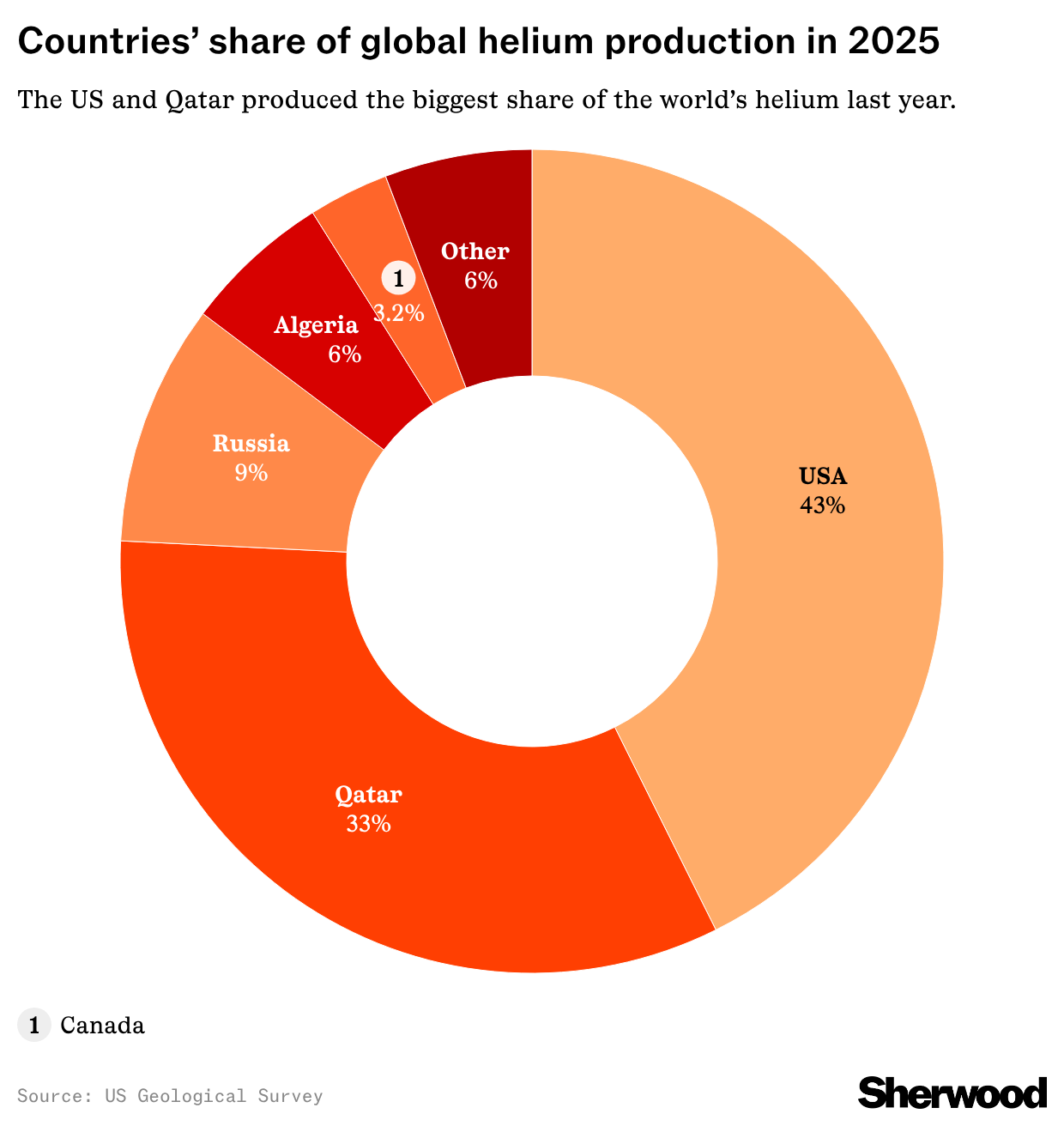
Roughly a third of the world's supply of helium comes from Qatar as a byproduct of the country's massive liquefied natural gas (LNG) production, which itself is facing headaches trying to get its cargoes out of the Middle East and to the rest of the world. |
|
|
QatarEnergy halted production at its massive Ras Laffan facility — the planet's biggest LNG export hub — after Iranian drone strikes in the early days of the conflict. Because no LNG tankers have been able to leave the region, producers are shutting their gas wells — meaning that the byproducts, like helium, aren't entering the market either. Two of the country's three helium plants are tied directly to LNG production, which means helium output depends on LNG continuing to flow through the strait. Experts expect that in the coming weeks, major helium suppliers will start declaring force majeure with their customers, customers which as it stands are on the hook for a whole lot of chips that lots of large companies are counting on. |
|
| Between 1998 and 2000, Jeremy Grantham was one of the few highly public skeptics from the world of finance urging investors to avoid internet-related shares, a contrarian stance. When the market ultimately collapsed in early 2000, GMO regained all it had lost and more, turning Grantham into something of a stock market celebrity. Now, he sees something on the AI horizon. |
- Grantham argues that previously impregnable tech corporations — including Meta, Amazon, Microsoft, and Alphabet — are about to see their profits squeezed as never before, first by costs related to their simultaneous rush to spend hundreds of billions of dollars on data centers, and later by the fact that the AI businesses they are building with those data centers will ultimately pit these market monsters against one another.
- That sort of head-to-head competition, while good for consumers, is all but certain to damage profits, he says.
- Financial history, BCA Research's Peter Berezin pointed out, is full of episodes where important, productivity-boosting inventions didn't actually turn out to be profitable for the mass of companies and investors sinking capital into them.
|
During the internet boom, tech company profits essentially went nowhere for years, Berezin said. And while stock prices soared, the ongoing lack of profitability eventually eroded investor confidence, contributing to the market crash. |
|
|
"These guys are overinvesting. They have no real prayer of making a handsome return on their investments. And they are moving into competition with each other," Grantham said. "It's like they're digging trenches and getting the machine guns well oiled, aiming at each other. This is the kind of quiet before the storm, the phony war. But they're lining up, ready for battle." He added, "This is not how they got rich and happy." |
|
|
A number of western US cities had their hottest winter on record last year, with ski meccas reporting record-low snowpacks. A chart of visits to Vail Resorts is looking as rocky as a ridgeline, as visits shrank 12.5% year over year amid the lack of powder. While the company is investing $100 million in artificial snowmaking, revenue from its primary mountainside moneymaker — lift passes — is slipping as snowbirds flock to fresher slopes. |
|
|
*Event contracts are offered through Robinhood Derivatives, LLC — probabilities referenced or sourced from KalshiEx LLC or ForecastEx LLC. |
|
|
Correction: Some placeholder text was incorrectly included in yesterday's email. We regret the error. |
Was this email forwarded to you? Don't miss out on future stories — subscribe to Snacks and get your daily dose of financial news straight to your inbox. Craving more insights in your inbox? Subscribe to Chartr and The Wrap for quality reads. |
| |
Sherwood Media, LLC produces fresh and unique perspectives on topical financial news and is a fully owned subsidiary of Robinhood Markets, Inc., and any views expressed here do not necessarily reflect the views of any other Robinhood affiliate... See more |
|
|
SHERWOOD MEDIA, LLC, 85 Willow Road, Menlo Park, CA 94025 |
|
|
|




No comments:
Post a Comment