Read Time: 2 minutes. |
The Scaling Paradox |
Every growing team faces the same tension: |
How do you coordinate without killing creativity? |
Too little structure and you have chaos. Everyone reinventing the wheel, going in different directions, burning energy on problems someone else already solved. |
Too much structure and you have bureaucracy. Slow decisions, permission-seeking, rules that strangle innovation. |
The best teams live on the edge.
Not out of control, but not in comfort either. |
Here's how to find your edge. |
|
The Standardization-Judgment Matrix |
|
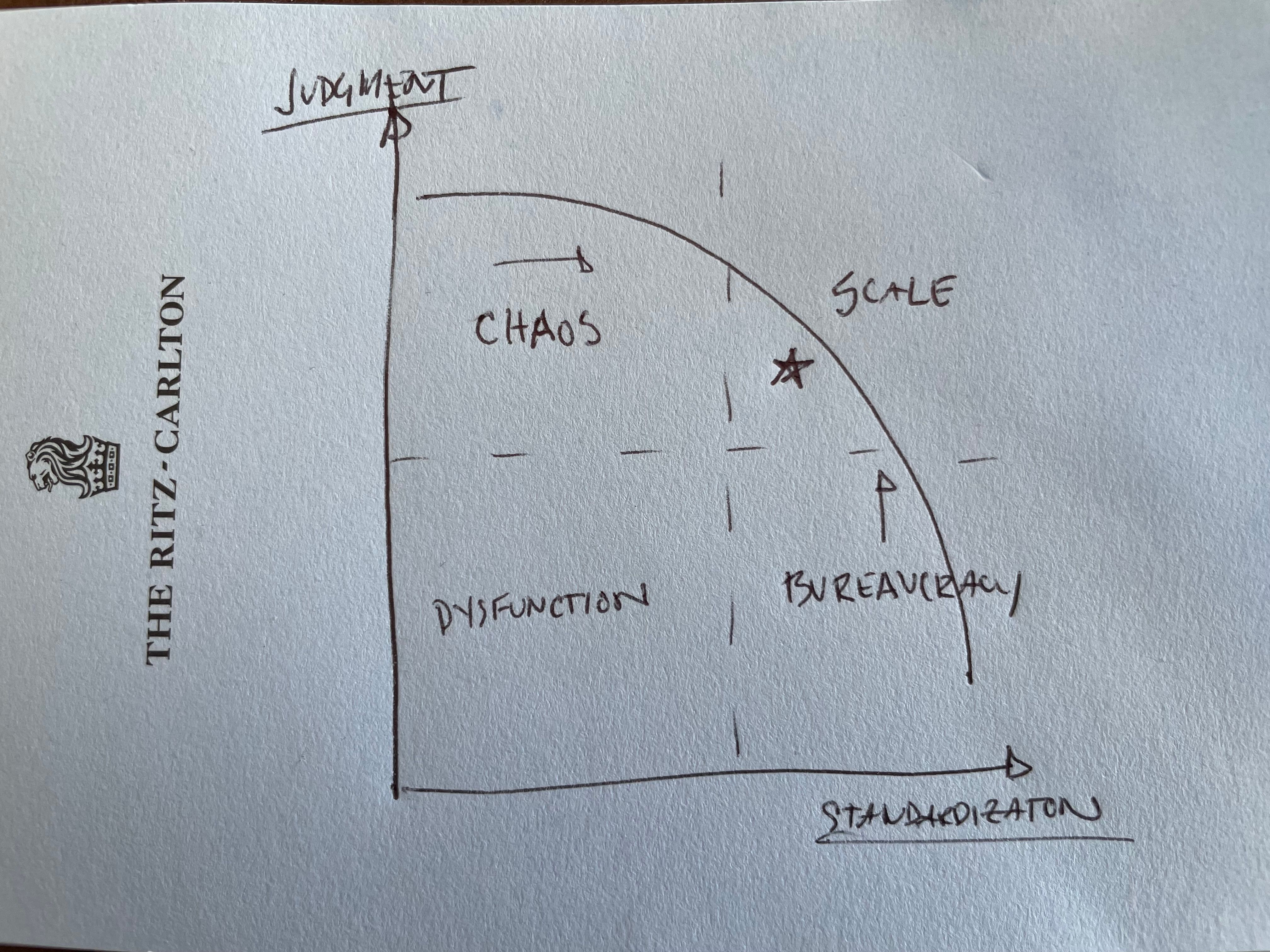
Think of your team on two axes: |
X-Axis: Standardization (processes, automation, documented ways of doing things)
Y-Axis: Judgment (ability to think critically, adapt, innovate, make good decisions) |
The Four Quadrants: |
Top Right - Optimal Scaling:
High judgment + just enough standardization. People think critically but don't reinvent wheels. Processes exist to compound learning, not control behavior. |
Top Left - Chaos:
High judgment but no coordination. Everyone's smart and going in different directions. Tribal knowledge. Hero culture and fire drills. Nothing compounds. |
Bottom Right - Bureaucracy:
Lots of process but people stop thinking. "That's not how we do it here." Permission-seeking. Innovation dries up. Agility atrophies. And your best people leave. |
Bottom Left - Dysfunction:
No process and no judgment. No team can last in the position for long. |
|
Indicators You're in Chaos |
You know you're here when: |
Fire drills are the norm, not the exception New hires struggle to be immediately productive You're solving the same problems repeatedly Success depends on specific heroes showing up Knowledge tribal, not systematic Quality is wildly inconsistent You can't take a vacation without everything breaking
|
What's happening: Individual excellence isn't translating to team performance. You're burning energy on delivery that should be going to developing systems. |
|
Indicators You're in Bureaucracy |
You know you're here when: |
Decisions take weeks because of approval chains People ask permission for things clearly own "We've always done it this way" is weaponized New ideas get killed by delay, not clear decisions Your best performers are frustrated or leaving Risk is avoided rather than managed well More time goes to reviews and checks than actual work
|
What's happening: You've optimized for control instead of outcomes. The process has become more important than the results. |
|
Living on the Edge: Optimal Scaling |
The edge is where magic happens. Just enough process to coordinate and compound, but not so much that it stifles judgment. |
What this looks like: |
Clear outcomes, flexible methods Processes that make good decisions easier, not mandatory People empowered to edit and delete as easily as they add Standards that guide without dictating; Principles vs. policies Automation that frees people to think, not replaces thinking
|
The principle: Minimum Viable Process.
Just enough to trigger compounding, nothing more. |
|
How to Shift Your Team |
If You're in Chaos, Add lightweight Structure: |
Document the 3-5 decisions you make most often and the criteria you use Create templates for recurring work (not mandates, just starting points) Establish a single source of truth for key information Run a weekly 15-minute sync to align on priorities
|
The key: Add the minimum structure that prevents repeated problems. Stop as soon as it works. |
|
If You're in Bureaucracy, Prune aggressively: |
Revisit any process that exists "because we've always done it" Replace approval chains with clear decision rights Turn "ask permission" into "inform and proceed" Eliminate reviews that don't alter outcomes
|
The key: Carve out a day every month or two to focus on streamlining. Remove steps until something breaks, then take only one step back. |
|
Your Next Move |
This week, diagnose where your team sits: |
If you see chaos indicators: Pick one repeated problem and create the minimum process to prevent it. |
If you see bureaucracy indicators: Pick one approval or review process and eliminate it. See what breaks (probably nothing). |
Because the goal isn't perfect process.
It's optimal process. |
Just enough to coordinate. Not enough to control. |
That's where high-performing teams scale. |
Lead on,
Dave |
PS - What did you think of AI-Powered Coach playbooks (Part 1, Part 2)? Would you like to see more like this? |
Hit Reply with a simple Yes or No. Or feel free to suggest the next topic should use AI to help you out with. |
| | | | Ways To Work With Us | MGMT Accelerator: A live cohort-based leadership development program. MGMT Fundamentals: A two-week training program for new managers. Custom Programs: Workshops built and delivered for your company. 1:1 Executive Coaching: C-suite leaders looking to scale. Keynote speaking: Leadership lessons for your event or offsite.\
| Learn about them all at: davekline.com |
| |
| | |
|
. |




No comments:
Post a Comment