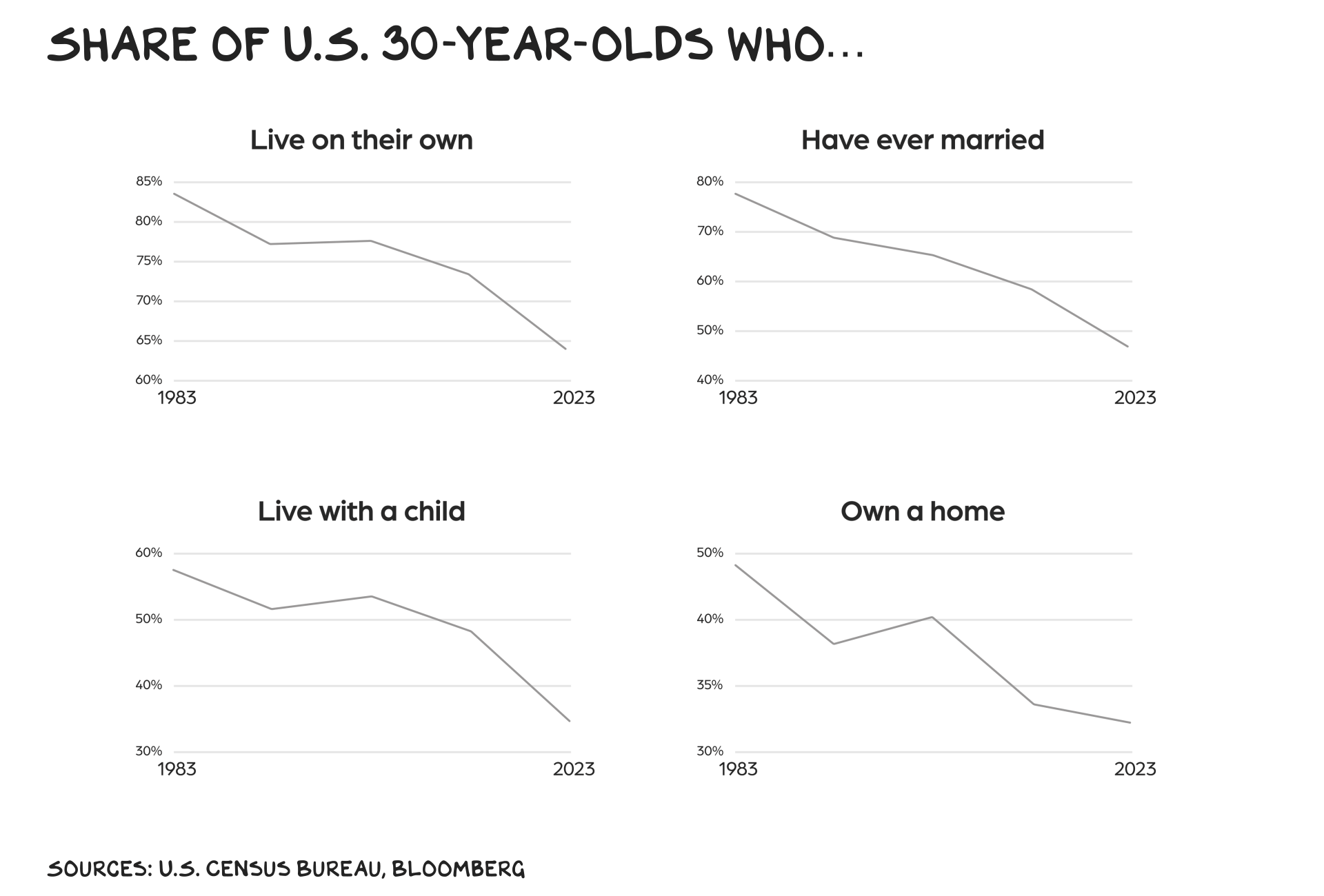
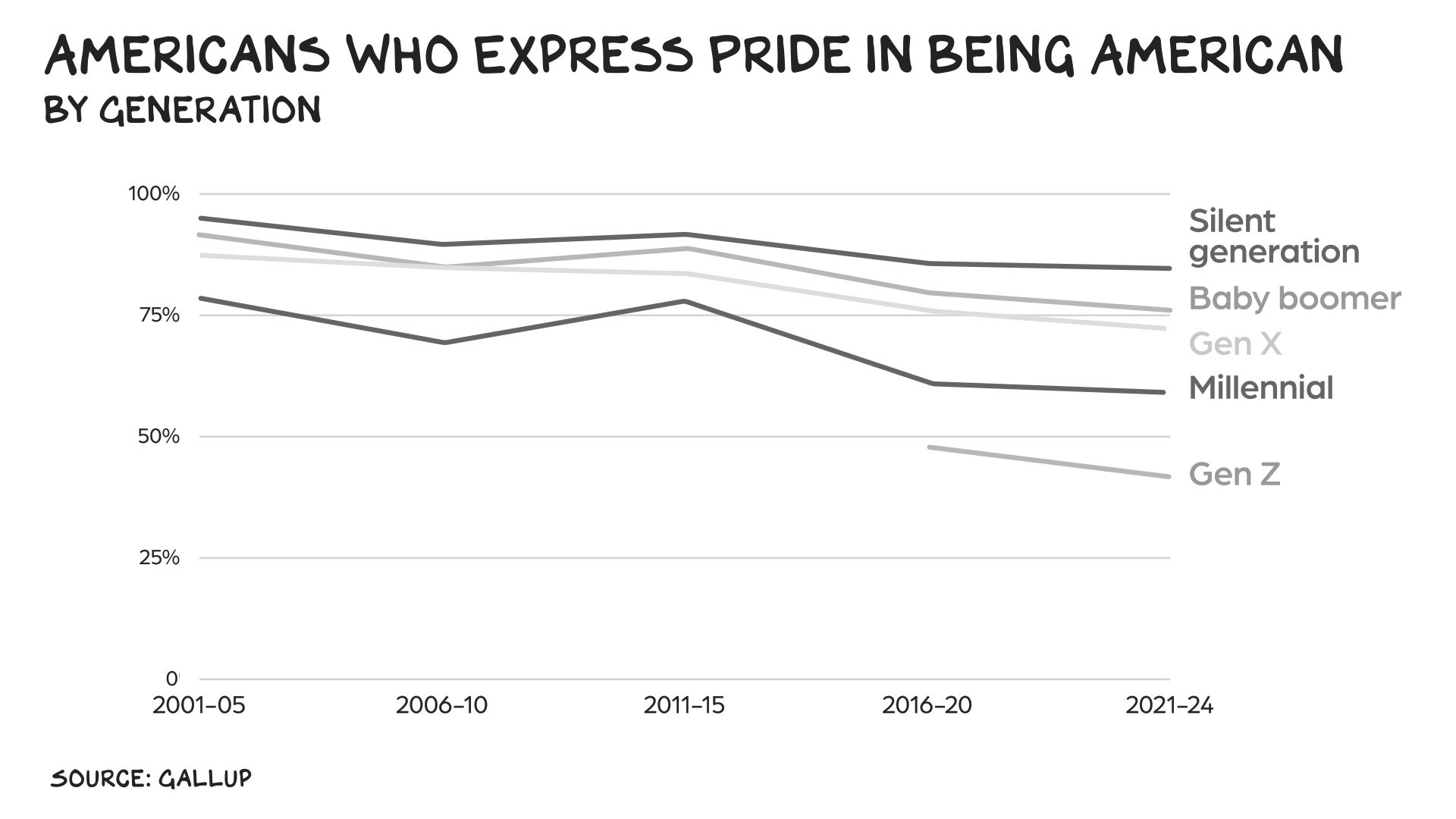
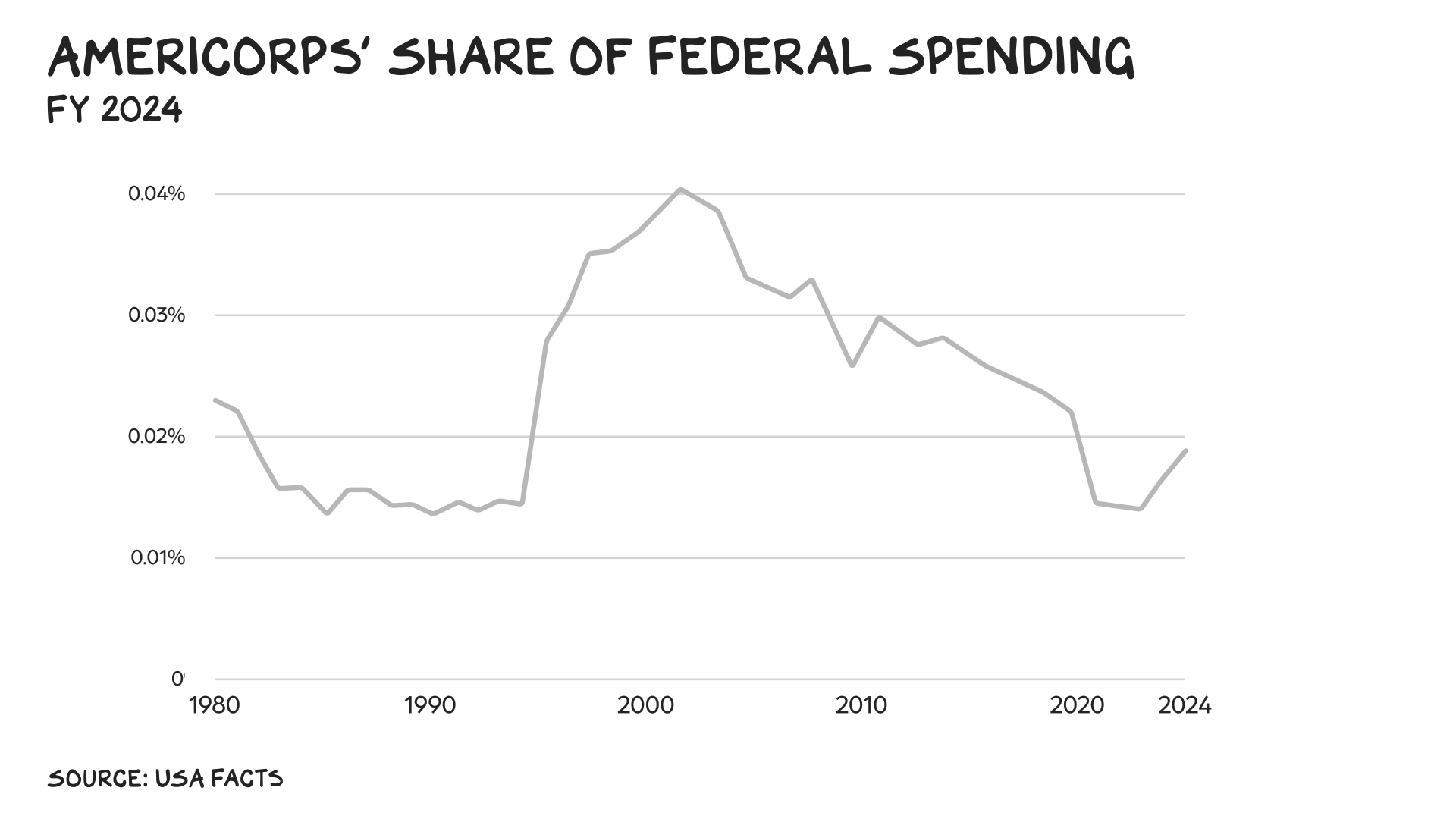
| | Was this newsletter forwarded to you? Subscribe here | | An Office Hours listener asked what I'd say to President Trump if he invited me to the White House. I've struggled my whole life with being right vs. being effective. So, as we're meeting with the president … let's focus on being effective. We don't have much common ground, but we're both fathers. Let's start there. As we'd likely have only a few minutes, we'd need to be focused — one issue max. The one thing I'd advocate for? I'd make a case for mandatory national service, as I believe that even the most polarized societies can find common ground when it comes to their children. (Yeah, I know, the whole denying SNAP benefits to kids. But it's my imaginary meeting, so just go with it.) | The Kids Aren't All Right | I believe young Americans are fed up with a country they're raised to love but that doesn't love them back. Our spending priorities (entitlements), tax policies (capital gains and mortgage interest deductions), and fiscal priorities (bail-outs of incumbents) are the greatest transfer of wealth from young to old in history. Old people have figured out a way to vote themselves more money, and even if the younger generations aren't good at it, they can do math. | The unemployment rate among 16- to 24-year-olds is 10.5% — the highest since the pandemic and, excluding that period, the highest since 2016. Zoomers report feeling more lonely, depressed, and anxious, and less successful, than other generations. It doesn't help that 200-plus times a day they receive notifications on their phone that they're failing, as their cohort vomits fake wealth/success onto them. The most noxious emission in America isn't carbon but shame. Young people aren't facing one crisis but a cascade of them — and that's made worse by adults who enjoyed the shade of trees planted by others but are now clear-cutting forests meant for the next generation. | | Connective Tissue | My parents belonged to the Greatest Generation. Their collective sacrifice won World War II, while their sense of national identity, forged by service, fueled the prosperity and progress of post-war America. On Prof G Conversations, historian Heather Cox Richardson told me "there was a very different sense of what it meant to be an American" then, adding that people prided themselves not on how much money they made, but how they took care of their communities. Writing about the people who came of age in post-war America, journalist Tom Wolfe coined the term the Me Generation. Prosperity created what Wolfe called "the luxury of the self." I know that luxury well. I didn't serve my country — one of my great regrets. Marketplace host Kai Ryssdal, a contemporary and Navy veteran, told me national service would transform America. "We don't know each other anymore," he said. "It's a generational thing." | At the end of Notes on Being a Man, I close with a letter to my sons, urging them to be patriots — to vote, pay taxes, and be evangelists for America and its values. I encourage them to give others the benefit of the doubt and treat them with respect, if only because they're fellow Americans. For my boys' generation, their fellow citizens are strangers. Our connective tissue is fraying. According to Gallup, the youngest Americans are the least patriotic. I believe mandatory national service could help repair the damage by encouraging young people to see themselves as Americans, first and foremost, and to be proud of that identity. | | E Pluribus Unum | National service in Singapore, the most religiously diverse nation on Earth, is called "school for the nation," because of its ability to forge a national identity. A study that looked at Singapore's national service programs concluded that socialization is a key mechanism for transmitting norms and values, while contact with people from different groups reduces prejudice. Those who serve in units that are housed together were 17% less likely to close ranks around their demographic group. By comparison, each year of education beyond secondary school achieves the same effect, but by only 2.5%. | In the U.S., 6% of adults are veterans, while active-duty service members comprise less than 1% of all adults. An estimated 64,000 young Americans and an additional 200,000 seniors volunteer for AmeriCorps, the primary umbrella organization for civilian service programs. We have the programs, but lack scale. Still, we know what works. Democratic Congressman Jason Crow, an Army veteran, favors expanding voluntary national service. On Raging Moderates he said, "When city kids get together with farm kids, and white, Black, Asian, Latino, straight, and gay people roll up their sleeves and build something together … that creates a foxhole mentality that breaks down barriers and connects us." The sentiment is bipartisan. Republican Senator Bill Cassidy has co-sponsored bills to strengthen AmeriCorps and provide tax relief to volunteers. Republican Senator Todd Young co-sponsored the Unity through Service Act. In 2016 candidate Trump said there was "something beautiful" about national service. On that point, we agree. | United We Serve | Enlisting in the military isn't the only way to serve. The U.S. has a long history of civilian national service programs. While the mission of each program varies, Congress has historically identified two goals for national service: meeting the needs of communities and developing the capacities and character of participants. Underinvestment in these programs is an American tragedy. As a 2018 NIH report put it, "Higher levels of civic responsibility, voting, volunteering, employment, respect for diversity, and overall life skills such as decision making and time management are all associated with AmeriCorps participation." We should ramp up AmeriCorps and define service broadly, as our nation's needs are as diverse as our people. How young people serve — being rural firefighters, volunteering in a no-kill animal shelter, helping seniors, working in our national parks, — isn't nearly as important as the service itself. | Priorities | Budgets illuminate national priorities and values. Our three largest expenditures — Social Security, Medicare, and the interest on the debt — are nearly half of the federal budget, mostly benefiting the 18% of Americans who are over 65. The Department of Education and SNAP — spending that overwhelmingly benefits the 30% of Americans under 25 — register 4% and 1.5% of the budget, respectively. To paraphrase Warren Buffet, there's a generational war in America, and my generation is winning. The D in Democracy only works when wealthy (i.e., old) Americans elect even older Americans who then vote themselves more money. | What if instead of using "the future" and "children" for rhetorical flourish, we actually walked the walk and invested in them? A Brookings report estimated that if we expanded existing national service programs to include 600,000 young people, it would cost $19 billion per year; Americans spent 8x that amount on their pets last year. Scaling up to include all 3.9 million members of the high school class of 2025 would increase the cost to $123 billion. That's real money, but it's only about 17% of our nearly $700 billion annual tax gap — the difference between taxes owed and taxes collected. Expanding service opportunities would also generate an estimated 17x return on our investment, according to a 2020 analysis of AmeriCorps programs. | The benefits would be felt across society, as participants would augment nonprofits, as well as state and local government initiatives. Federal and local governments would also benefit from programs that address community challenges early, lessening dependence on other government programs and reducing expenditures in criminal justice, welfare, and public health. Meanwhile, people who complete a national service program would enter college or the workforce with more skills and greater confidence. | | Gap Year | National service benefits everyone who serves, but the benefits are likely more profound for boys — a cohort that's fallen farther and faster than any other group in recent memory. For boys, physical development progresses more rapidly than intellectual or emotional maturity. My friend Richard Reeves has argued in favor of "red-shirting" boys, just as we hold back college athletes for a year so they can develop further on the field. A structured period of one or two years after high school would give boys the opportunity to mature without the pressures of college or a career. It would also give some a second chance. Former IDF boss General Aviv Kochavi called national service a "societal take two" for young Israelis. "It doesn't matter where you came from or what your background is," he wrote. "A mediocre pupil or youth with a criminal past who dropped out of school can leave the past behind and become an outstanding leader." We should give the same opportunity to every young person in America. | If we want our youth to feel invested in their country, then America needs to invest in its youth. | Life is so rich, | | P.S. In our newest Prof G Podcast, China Decode co-hosts Alice Han and James Kynge unpack how the U.S. and China are building massive data centers that are reshaping global energy use and government policy. Listen here on Spotify or Apple or watch on YouTube. | | ____________sponsored content ____________ |
|
| CTV ads made easy: Black Friday edition | | As with any digital ad campaign, the important thing is to reach streaming audiences who will convert. Roku's self-service Ads Manager stands ready with powerful segmentation and targeting — plus creative upscaling tools that transform existing assets into CTV-ready video ads. Bonus: we're gifting you $5K in ad credits when you spend your first $5K on Roku Ads Manager. Just sign up and use code GET5K. Terms apply. | Use code GET5K now |
|
| ____________sponsored content ____________ |
|
| |
|






No comments:
Post a Comment