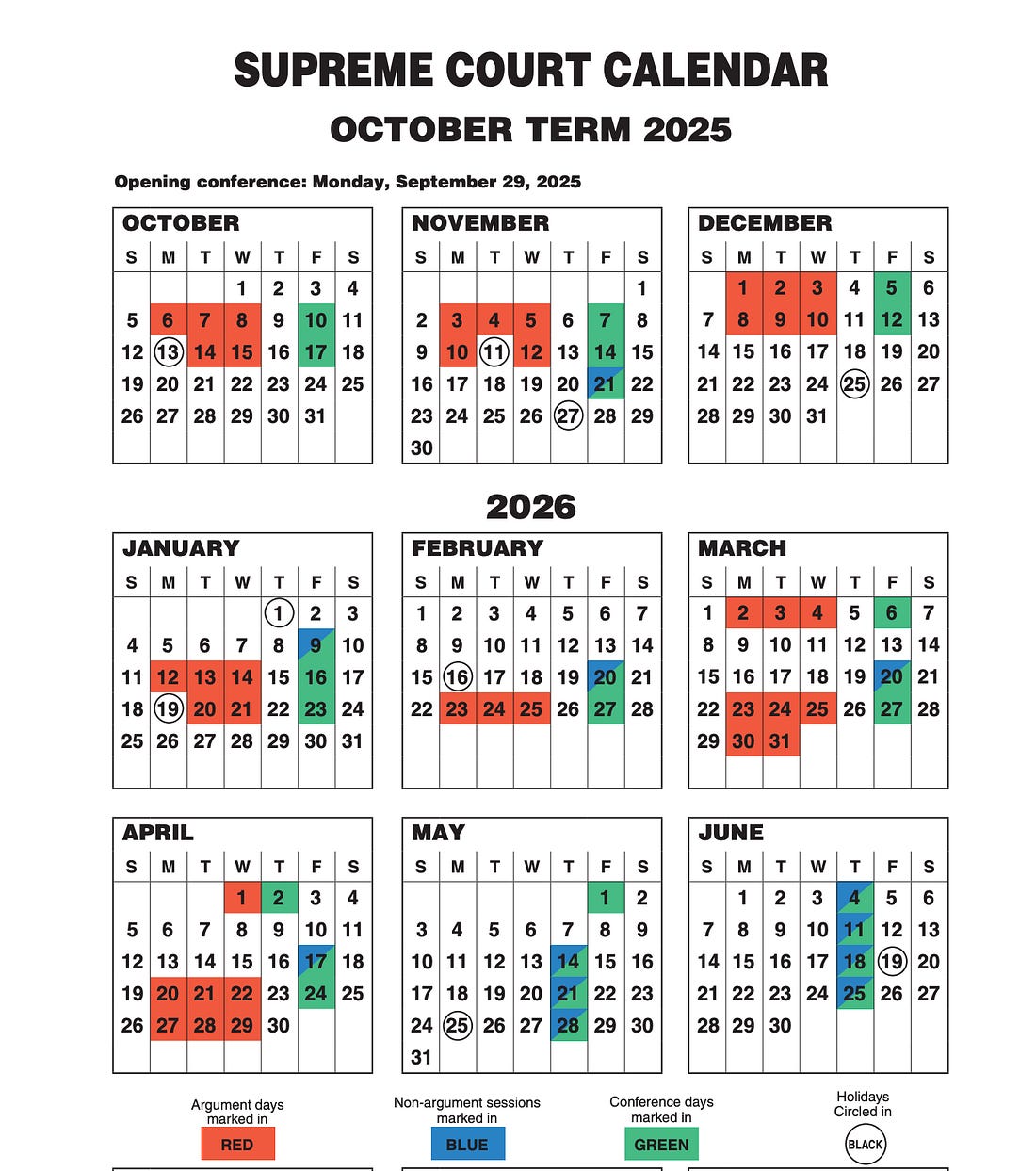
Your paid subscription makes Civil Discourse possible—independent, informed analysis that connects the dots between law, politics, and the truth. In a moment when noise drowns out reason, your support ensures facts and context still have a home. Join a community that refuses to give up on democracy—or on understanding it. The U.S. Supreme Court term for 2025-2026 officially begins today, Monday. The first Monday in October is the day officially set by law for the Court to reconvene after its summer break. That means the Justices will start hearing cases and making decisions on the cases it has on its docket. These cases will be briefed and argued orally before the Court, unlike the decisions off of the Shadow Docket that we’ve been seeing recently. The Court’s calendar indicates the days, marked in red, when it will hear oral argument in cases. The Justices will add in additional days as necessary.
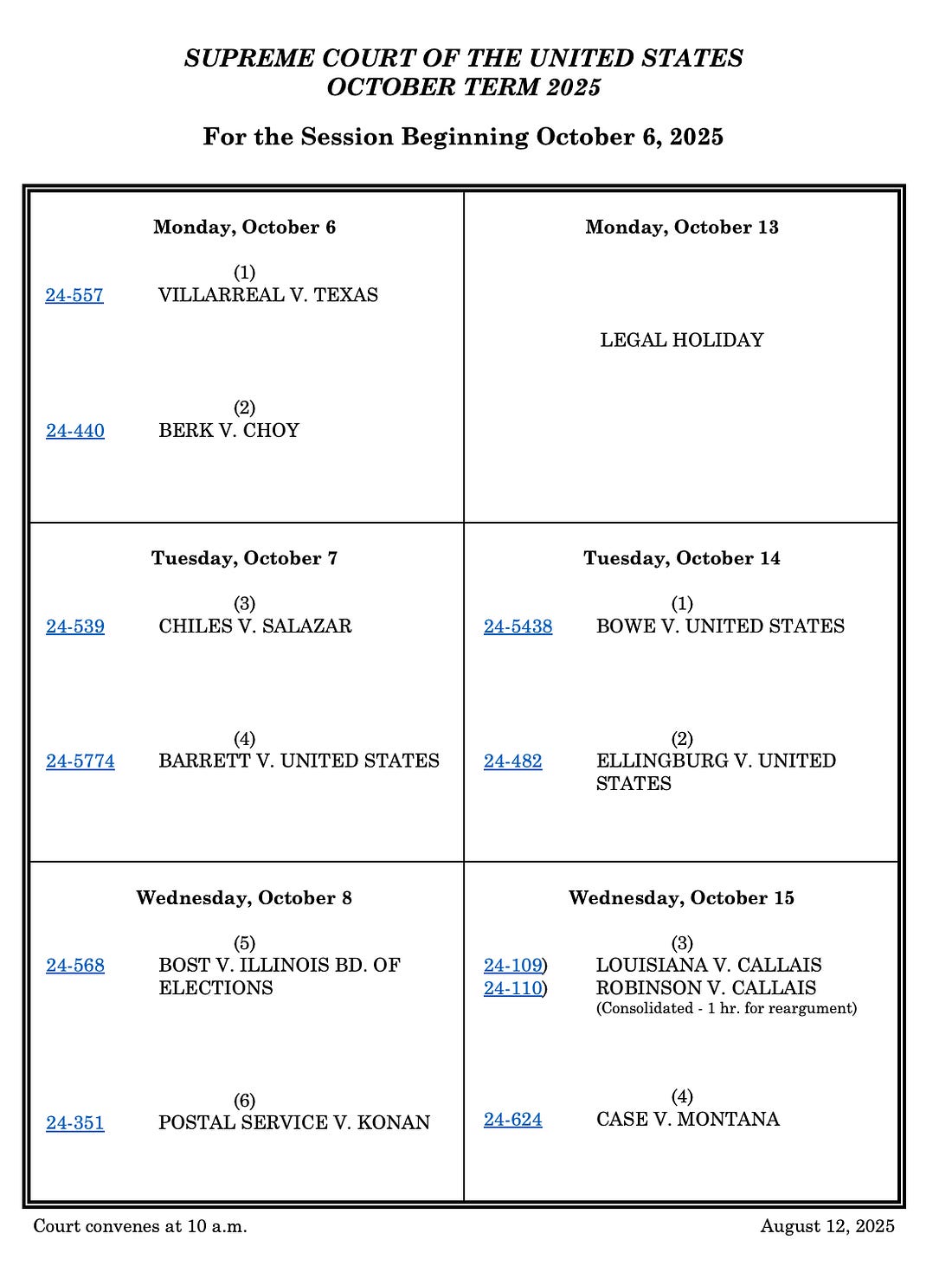
Calendars on the Court’s website show which cases are scheduled for argument on each of the “red” days, so you can listen to the livestream of any arguments that interest you.
This term starts following Justice Clarence Thomas’ recent public comments about the value of legal precedent. He opined that the Court should take a more critical approach to settled precedent, that precedent is not “the gospel” and that some caselaw is based on “something somebody dreamt up and others went along with.” At Thomas’ 1991 confirmation hearing, Alabama Senator Howell Heflin, a Democrat, asked the nominee, “What is the real Clarence Thomas like? What would the real Clarence Thomas do on the Supreme Court?” Thomas responded, “I am the real Clarence Thomas, and I have attempted to bring that person here. … And I try to do what my grandfather said, stand up for what I believe in. … I am simply different from what people painted me to be.” Thomas has become the Justice most willing to toss precedent out the window. If he can attract other Justices to this approach, as he has in recent terms, it could impact cases like the Trump administration’s push to eliminate birthright citizenship and blue state efforts to use the traditional bar in the Posse Comitatus Act to prevent the administration from mobilizing National Guard troops and deploying them on American streets. Happy 20th Birthday to the Roberts Court. Some of the key cases pending this term include: LGBTQ Rights Chiles will be argued this Thursday. Colorado has a ban on conversion therapy. Kailey Chiles, a Christian therapist, sued, arguing the ban violates her First Amendment free speech rights by limiting what she can discuss in conversations with her patients. The issue is whether a law that censors certain conversations between counselors and their clients based on the viewpoints expressed regulates conduct or violates the free speech clause of the First Amendment. Colorado says it does not, because conversion therapy is so dangerous that the state is justified in imposing the limitation. In Little v. Hecox, transgender athletes asked the Court to hold that an Idaho law banning transgender women from competing on women’s sports teams violates the equal protection clause of the Constitution. The law prevented the plaintiff from joining the Boise State University women’s track team. Despite winning in both the district court and the court of appeals, Hecox has asked the Court to permit her to drop her case, explaining that she has lost interest in joining the team and has faced “negative public scrutiny” as a result. A reply brief filed by the state on September 25 makes it clear that they want the Supreme Court to forge ahead regardless of Hecox’s request because “Idaho and BSU still have an interest in enforcing the Fairness in Women’s Sports Act and in reversing the decision below.” The tea leaves suggest they believe the Court will sign off on laws like this if the case proceeds. A similar case, West Virginia v. B.P.J., also adds in claims that laws banning transgender girls from participation in sports violate the prohibition on gender discrimination in Title IX. Last December, the President of the NCAA said there were “less than 10” transgender athletes in college sports. The popular rallying cry for the culture wars nonetheless has caught the Supreme Court’s attention. Voting Rights On October 15, 2025, the Court will rehear Louisiana v. Callais. The issue the Court has newly asked the parties to brief is whether Louisiana’s “intentional creation of a second majority-minority congressional district violates the Fourteenth or Fifteenth Amendments to the U.S. Constitution.” In other words, at least some Justices believe that using the traditional remedy for protecting voters against racial gerrymanders (the Court has previously said it won’t disturb political gerrymanders) is a form of discrimination against white people. After hearing the case last term, instead of deciding it, the Court held it over and specified a new question: Whether the creation of a new district where Black voters have the opportunity to elect a candidate of their choice, in order to remedy discrimination as provided by Section 2 of the Voting Rights Act, violates either the 14th or 15th Amendments. Louisiana, which defended Black voters initially, has now switched course and taken the position that all “race-based redistricting is unconstitutional.” It’s all bad news for Section 2, one of the last remaining substantive protections for voters against discrimination. If the Court rules in favor of white voters, in combination with the Trump administration’s push for unprecedented mid-century map redrawing, Republicans could secure majorities in Congress and other places determined by in-district voting for a generation, without regard to the will of the voters. Add to that, National Republican Senatorial Committee v. FEC, a case stemming from a 2022 lawsuit brought by then-Senator JD Vance. It argues that the Court should reverse a restriction that prevents political parties from coordinating unlimited spending on campaign advertising (a result of Citizens United) with official campaigns. It’s hard to overestimate the opportunity the Court has in these cases to put its thumb on the scale in favor of the Republican Party. Trump’s Efforts to Create an All-Powerful Presidency In Learning Resources v. Trump, the Court will take up the president’s power to impose tariffs under the International Emergency Economic Powers Act (IEEPA). The statute doesn’t mention tariffs, but the administration contends that it nonetheless permits it to impose them, because it says that the president can regulate the importation of foreign goods if there is “any unusual and extraordinary threat” that poses a national emergency. Of course, this flies in the face of Congress’ constitutional powers. This is one of several lines of cases where the administration rejects the ability of the courts to review a president’s decisions. Trump also seeks the power to fire at will in the ranks of executive branch appointees and employees. Under Humphrey’s Executor, the Court carved out an exception for members of quasi-independent agencies established by Congress, like the Fed. In the case of Federal Reserve Board member Lisa Cook, the Court has rejected Trump’s request to fire the Governor, at least until it hears her case on an expedited basis in January. Ahead of Cook, in December, the Court takes up the case of Federal Trade Commissioner Rebecca Slaughter, whom Trump fired earlier this year. The Court declined to stay her dismissal until it hears the case, strongly suggesting a majority of the Justices will permit it. The Court has directed the parties to brief two issues:
The phrasing of the questions suggests the Court, which has ruled overwhelmingly in the Trump administration’s favor since the start of his second term in office, is strongly leaning towards another big win for them here, which would let Trump reshape the federal bureaucracy to an even greater extent that he has already. Executions of Intellectually Disabled Inmates On November 4, the Court will hear an appeal from Alabama, in a case where the state wants to execute an intellectually disabled man for a 1997 murder. Both his IQ scores and expert testimony confirmed his diagnosis, and a 2002 Supreme Court case—so, longstanding precedent—bars his execution, designating it cruel and unusual punishment in violation of the Eighth Amendment. A loss in this case for Joseph Clifton Smith, who prevailed in the lower courts, could open the floodgates for more executions nationwide, something Trump has long indicated he’s interested in. Of course, there are many more cases on the docket, and likely more to come. For instance, if tonight’s decision by federal judge Karin Immergut in Portland, temporarily blocking the administration from deploying federalized National Guard troops from that state, as well as from California and Texas, becomes a long-term injunction, it could get fast-tracked to the Court. And there are more cases pending on the Court’s Shadow Docket, a number of which will impact the scope of presidential power. It will be a pivotal term in the Court, especially heading into the 2026 midterm elections, with election-related issues also likely to emerge. We’re in this together, Joyce You're currently a free subscriber to Civil Discourse with Joyce Vance . For the full experience, upgrade your subscription.
|
Sunday, October 5, 2025
The Week Ahead






Subscribe to:
Post Comments (Atom)

-
On Monday, Leon County Circuit Judge Angela Dempsey rejected Bear Warriors United's request for a temporary injunction to halt the s...
-
Police say information from a Reddit tipster who had a strange encounter with another man on a sidewalk outside Brown University provi...
-
The Trump administration has launched a new federal initiative called the U.S. Tech Force, aimed at hiring about 1,000 engineers and t...


No comments:
Post a Comment