So ends the S&P 500's first month without a daily gain or loss of at least 1% for the first time since July 2023.
Your Evening Briefing
July 31, 2025
US stocks end July on a soft note
The S&P 500 opened 1% higher after last night's blockbuster earnings from Microsoft and Metalit a fire under the entire AI complex. Unfortunately, the day only got worse from there.
US stocks slid throughout the session, ending near their lows. The S&P 500 gave back 0.4%, the Nasdaq 100 fell 0.5%, and the Russell 2000 underperformed with a 0.9% decline.
This ends July as the S&P 500's first month without a daily gain or loss of at least 1% since two years ago, in July 2023.
Healthcare was far and away the worst-performing S&P 500 sector ETF, with drugmakers including Eli Lilly, Pfizer, and Novo Nordisk falling after President Trump sent a letter to 17 pharma CEOs demanding they cut US drug prices within 60 days.
On the positive side, eBay soared 18%, touching an all-time high a day after the online marketplace posted strong Q2 results and analysts issued a pair of price target hikes. Declines were led by Align Technology, which sank a massive 36% after the Invisalign maker missed both top- and bottom-line Q2 estimates.
Elsewhere…
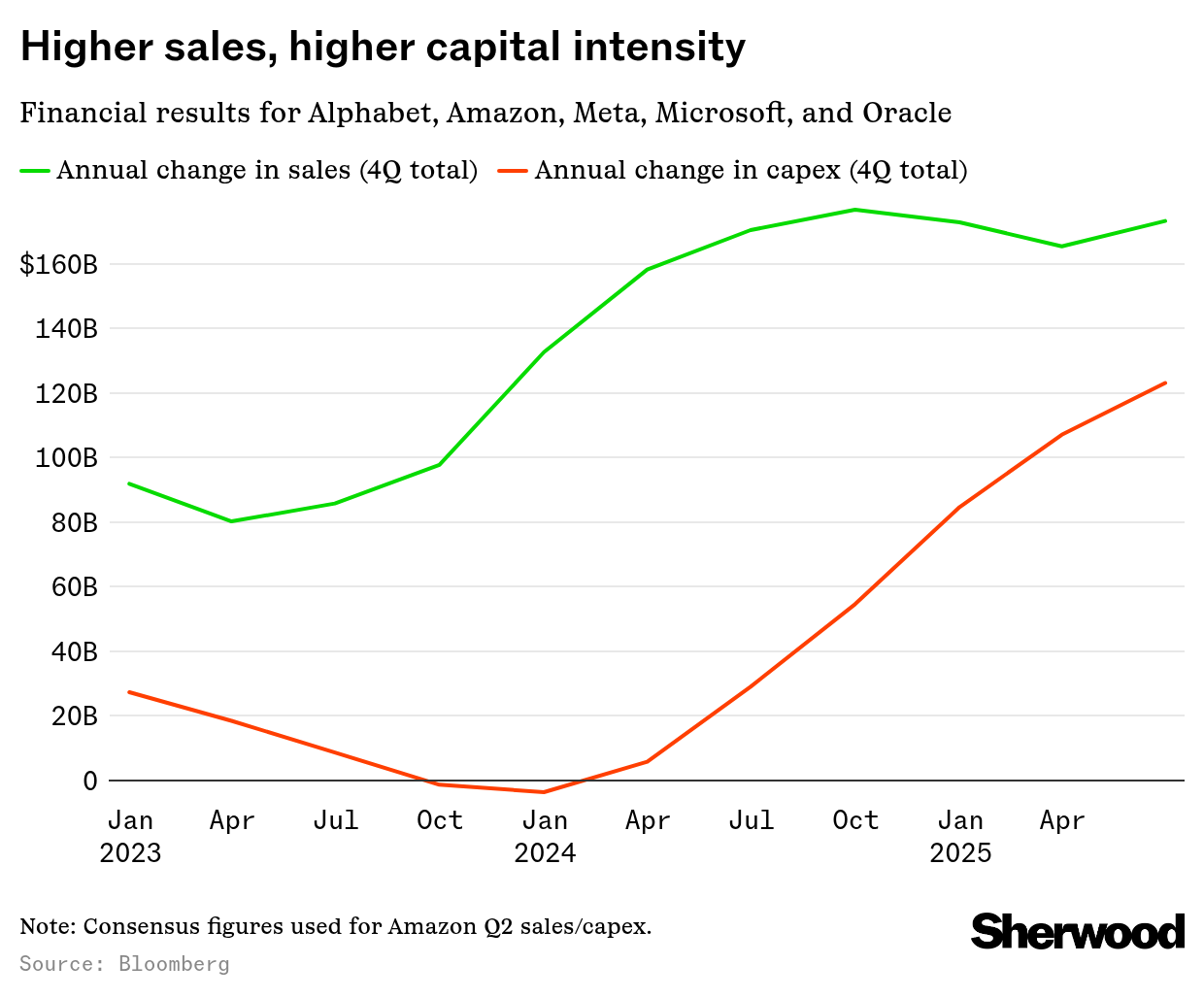
Meta shares jumped another 11% after the social media and AI behemoth topped Q2 estimates Wednesday. Ad revenue — which makes up the majority of its total— leapt 21%.
Microsoft shares rose another 4% after the company's blowout fiscal Q4 earnings, pushing its valuation above $4 trillion for the first time.
Norwegian Cruise Line sailed up 9% after the cruise operator reaffirmed full-year guidance despite so-so Q2 results, citing a rebound in bookings.
Roblox jumped 10% after the gaming platform beat estimates, with total bookingsclimbing to $1.4 billion.
CVS Health climbed as much as 6% before closing flat after the pharmacy retailertopped Q2 estimates and raised its full-year outlook.
SoFi Technologies bounced up 3%, marking its third straight day of big moves after Deutsche Bank and Mizuho hiked their price targets on the stock.
Comcast shares closed up 2.2% after the media and cable giant delivered a strong Q2 earnings beat, fueled in part by the debut of its Epic Universe park and hit Peacock shows.
*Robinhood Markets Inc. is the parent company of Sherwood Media, an independently operated media company subject to certain legal and regulatory restrictions.
Was this email forwarded to you? Don't miss out on future stories — subscribe to The Wrap and get your daily dose of financial news straight to your inbox.
Craving more insights in your inbox? Subscribe to Chartr and Snacks for quality reads.
We care what you think! If you have any feedback or comments, feel free to reply and let us know your thoughts!
Sherwood Media, LLC produces fresh and unique perspectives on topical financial news and is a fully owned subsidiary of Robinhood Markets, Inc., and any views expressed here do not necessarily reflect the views of any other Robinhood affiliate... See more
Tough Love (Why Lovable's Growth Playbook Isn't Yours)
Humans are naturally envious creatures.
And if you're a founder, growth marketer, or you work at a tech/AI startup, it's only natural to be envious of Lovable AI.
The growth trajectory for this Swedish vibe-coding starchild has been staggering and potentially record-breaking, to the tune of $100M ARR in eight months.
While LinkedIn AI gurus are dropping think pieces on Lovable's genius, viral, omni-channel growth approach, it's largely misleading eye candy.
Trying to replicate that for your own company is like being a high school basketball player and thinking you can go to the NBA next year, just because you saw Lebron and Kobe do it. Good luck with that.
Before you try to copy their growth playbook, let's talk about what you actually stand to learn from their story. (Hint: It's got more to do with your product than channels.)
— Gil & Kevin
Brought to you by TLDR - Case Study: How ThreatSpike generated $75K in pipeline per campaign with newsletter ads
Cybersecurity startup, ThreatSpike, had a big problem: traditional ad channels weren't performing. Google, Meta, and LinkedIn were burning cash.
Then they decided to test a new channel: TLDR newsletters. The results?
Reached cybersecurity professionals who actually engaged.
Generated high-intent leads from large enterprises (30k+ employees).
Reliably produced $25K–$75K in pipeline per campaign.
ThreatSpike turned frustration into consistent growth with TLDR newsletter ads.
Stockholm-based Lovable turned a simple, powerful idea into a rocket ship: use AI to let anyone build apps or sites just by describing what they want. The approach, vibe coding, became popular this year as a tool for rapid prototyping, paired with software.
Within eight months of launching in late 2023, Lovable attracted 2.3M active users, saw over 10M projects built, and raised a $200M Series A, valuing the company at ≈ $1.8B. They minted a European AI unicorn at unprecedented speed.
By letting you speak your app into existence with vibes only, it basically turns moodboarding into shipping. A founder described it as holding a "magic key" that opens the door to software without developers.
This level of product-market alignment makes customers' obsession with the product a natural growth lever. Every output becomes a showcase people want to show off. And each user becomes a signal-boosting evangelist.
It's one of those rare cases where an innovation has so many use cases and so much visual intrigue, the product itself is the growth engine no matter what channel it's on or who's looking at it.
Impressive list, but this is more correlation than causation. It's what happens when your viral coefficient (the average number of new users that an existing user generates) is insanely high. Because starting a fire is a littleee easier when your product is a 50-gallon drum of jet fuel.
The Viral Coefficient Driving It All
During Lovable's early hypergrowth from over 20,000 users in late January 2025 to over 500,000 in February, they achieved ~25x user expansion in about a month, implying a peak weekly viral coefficient K ≈ 1.24.
When your viral coefficient is that high, channel selection becomes irrelevant. Post on Product Hunt? Viral. Tweet about it? Viral. Show up at an event? The crowd goes wild.
It's not that Lovable mastered these 12 channels in order to grow. It's that their product is so shareable, user-friendly, visually stunning, and so "holy sh*t look what I made in minutes" that any exposure becomes a growth loop.
And if you're still tempted to mimic their strategy, gut check whether you have as much cash on-hand to fuel your growth.
Unlike most startups, Lovable never had to worry about scraping together cash, due to a sizable $7.5M pre-seed followed by an explosion of early revenue traction. Lovable launched on November 21st 2024. By February 2025 (3 months after launch), they had:
Acquired 30,000 paying customers
Hit $17M ARR
Raised a $15M pre-Series A
Spent $2M to get there (mentioned in an X post from the CEO, Anton Osika)
While Osika doesn't mention exactly how they spent the $2M, even if only 20% of that $2M went to marketing, that's still $133,000/mo in marketing spend out of the gate. Most startups are trying to stretch out $10k over three months of Meta ads. 🥲
When you have that kind of capital, you can afford to have a presence everywhere at once. You can hire Discord community managers, video content editors, SEO writers, and still have budget left for paid ads.
Why Your Bicycle Can't Handle a Jet Engine
Lovable rides a jet engine fueled by three things:
Insane product-market fit that creates outputs people compulsively share
Early revenue and venture funding that enables simultaneous channel execution
Perfect timing in the AI gold rush where "I built this with AI" still grabs eyeballs
There's a good chance your startup doesn't have all of these to the degree Lovable does. Which means copying their channel playbook isn't particularly useful.
The Actual Takeaways Here
Strip away the hype and oversimplification, and here's what matters:
Build virality into your product: To the extent your product/service supports it, ask yourself, "Is my product something people actually want to show others? Can we build in network effect dynamics?"
Be realistic about resources: If you can't spend $100K+/month on growth, you probably can't fund a breakneck 12-channel growth strategy.
Recognize survivorship bias: Remember, for every Lovable, there are 1,000 startups that tried to "be everywhere" and burned out.
Learn from Lovables individual channel strategies: None of this is meant to knock Lovable. They are clearly very talented marketers and you can still learn from them. Building in public on X might be a great strategy for you.
The Channel Focus Reality Check
In the incredibly likely event your product doesn't have Lovable's inherent virality, here's your channel playbook:
Test 3-5 channels with small budgets ($3-5K each)
Identify the one with the best unit economics
Scale that channel until you hit diminishing returns
Only then consider adding channel #2
It's not as sexy, but a steady, sustainable, scalable growth engine is how the majority of successful startups actually grow (it's also the key focus of the Demand Curve Growth Program).
Bottom Line: Product Over Everything
Lovable's story is seductive (and potentially dangerous) because it suggests you can brute force your way to product-market fit. "Just be everywhere all the time! Master ALL the channels! Growth will surely follow!"
That's bass-ackwards. Lovable earned the right to be everywhere, because their product was everywhere-worthy. They mastered all channels because every channel bowed down to it.
Your job isn't to copy Lovable's channel tactics. It's to build something users love and share as much as Lovable. Until then, a focused channel strategy likely beats cosplaying as a hypergrowth startup.
😍 Loved it: Forward to a friend or reply—a simple 😍! It really helps.
🤷♀️ Meh: You can unsubscribe here or manage your subscription here.
🤔 I'm new here: You can join the party here. 🤩 Give me more: Check out all previous tactics in our Growth Vault.
Something fun
"Mic'd Up" but make it for sleep talkers. Hilarious testimonial concept from IKEA
If you missed it
Every month without real growth is another month wondering if you should've kept that corporate job. Time to flip the script. Growth Program 2.0 shows you how to get unstuck and start compounding your growth. 50% off if you join the waitlist today →