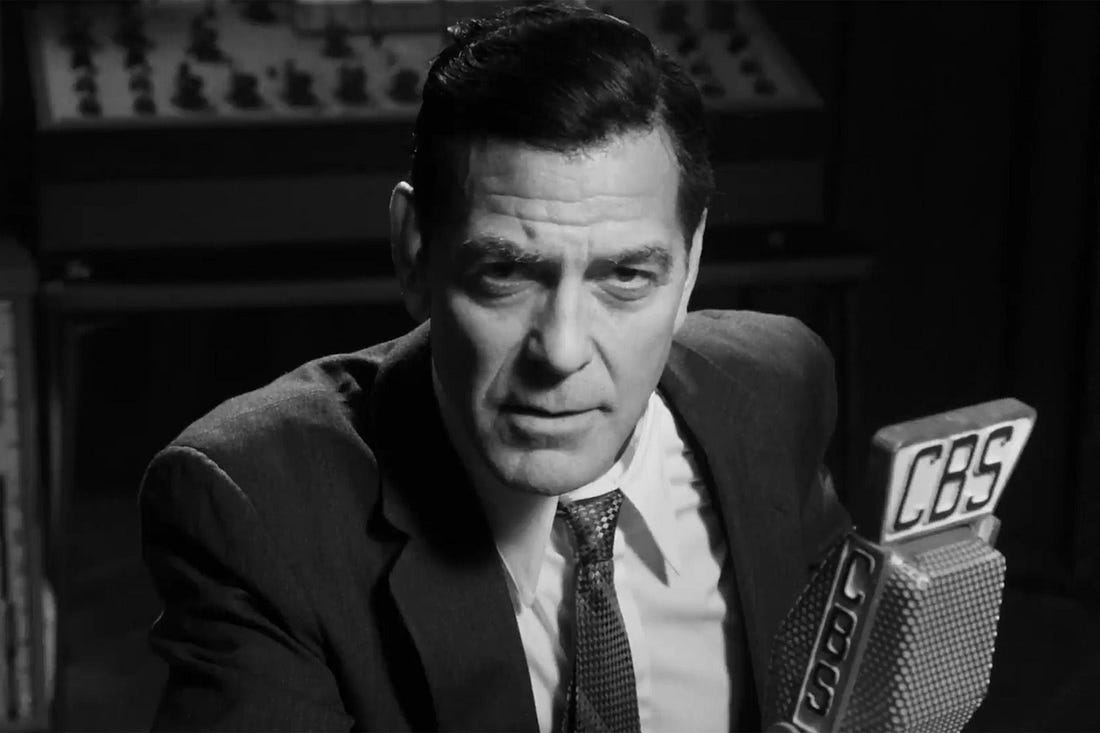
At the end of the play Good Night, and Good Luck, George Clooney adds a line that Edward R. Murrow never said, and wasn’t in the film version. He added it because it resonates in today’s political climate, or at least the climate in a Broadway theater:
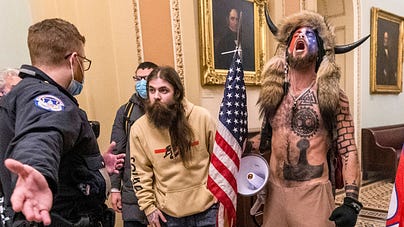
I’ve been asking myself that question for a long time. And I have concluded that I am prepared to do very, very little. Immigration is the most important domestic issue to me. When I heard Bruce Springsteen’s “Streets of Minneapolis,” I cried. I can’t imagine how wrecked I would have been if he’d written a good song. 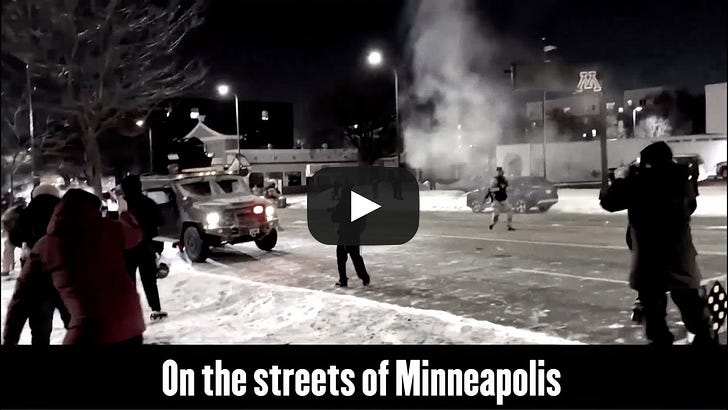 When I saw ICE kill protesters in Minneapolis, I felt enraged, heartbroken, and sure that I’d never go to an ICE protest. When I read that journalists got arrested for covering the protests, I felt admiration, pride in my profession, and certain that I won’t cover any ICE protests. Is the end of American democracy something I’d die for? Go to jail for? Go outside in a Minneapolis winter for? Sure, I’d write a Substack about it, but would I write a Substack about it after other Substack writers got arrested for criticizing the government? Would I write a Substack about it if this website were even slightly harder to navigate? I am so grateful to have been born in America. Every July 4th, I read the Declaration of Independence and listen to Shooter Jennings’ “4th of July.” But when I see videos of people storming the Capitol on January 6, I think, “They care about this country a lot more than I do.” Sure, they care about turning it into a hellhole. But they care more about turning it into a hellhole than I do about not turning it into a hellhole. As awful as things are, I have not once been inspired to put on a bison-horned fur Viking helmet and poop on the Speaker of the House’s desk. The only thing that might get me to do that is if the government poisoned my water with methamphetamines and laxatives.
People sometimes naively ask why Jews didn’t leave Germany before the Holocaust. But no one ever asks, “Why didn’t the Jews go to protests and boycott Bayer aspirin and really show that Hitler fellow?” We celebrate the people who stood up to injustice, but only when they win. Charles de Gaulle and Nelson Mandela are heroes. But there’s no statue of Tank Man in Tiananmen Square. There’s no national holiday for the Biafran separatists in Nigeria, whom I only know about because of Jello Biafra. No one remembers him either. And he’s still alive.
Like all good liberals, I love the poem by Martin Niemöller, the German Lutheran pastor who spent seven years in concentration camps for opposing the Nazis:
But it’s not really true. They came for Niemöller because he did speak out. Had he not organized pastors to fight Hitler’s unification of all churches into the Reich Church, he would have spent the war at home, possibly learning more complicated meter and rhyme techniques. The vast majority of Germans who didn’t speak out were fine. The quiet ones usually are. FDR came for the Japanese Americans and stopped there. King Ferdinand and Queen Isabella were content to torture Jews and Muslims. Authoritarians rally the majority by blaming some minority. Harvard professor Erica Chenoweth coined the “3.5 percent rule,” in which she claims that “no government has withstood a challenge of 3.5 percent of their population mobilized against it during a peak event.” I’m the guy who joins in when we get to 3.6 or 3.7. And I’m not convinced that 12 million Americans in the streets, which is three times the 2017 Women’s March, would do it. The 3.5 percent rule didn’t work in Iran this year or in Bahrain during the Arab Spring. And the 3.5 percent rule only applies to protests that aim to topple a government or break off into a separate country. Not “ask your personal thug army to stop wearing masks” or “enough with the meme coins.” When my 16-year-old son went to the ICE protest in L.A., the crowd spent much of the time chanting, “fuck the police,” “fuck capitalism,” and “free Palestine.” It would not have been all that hard to get them to chant for Ticketmaster to show the full price before you pick a seat. So the question is a very simple one. Not if I’m a free rider on the revolution. We have seen that answer. No. The question is: Am I prepared to risk the consequences of failure? We don’t know what we’re capable of until we face the situation. And we do not know how far our country will shuffle into authoritarianism, or if it will be reversed. But I did suffer through a lot of years in Hebrew School, in which I learned that survival means adaptation. You fight only when you must or have a good chance of winning. So for now, I’ll adapt the phrase Jews said every Passover. Next year, in Washington. Thank you for paying to read my column. Wait: This is for the people who didn’t pay? Then I owe you nothing. You are the ones contributing to the end of my career. If you want to pay an exorbitant amount of money to get one extra post a month – which often won’t even be that good – upgrade to a paid subscription here:
|
Saturday, February 7, 2026
What Am I Prepared To Do To Stop Fascism?






Subscribe to:
Post Comments (Atom)
What Am I Prepared To Do To Stop Fascism?
Very, Very Little ͏ ͏ ͏ ͏ ͏ ͏ ͏ ͏ ͏ ͏ ͏ ͏ ͏ ͏ ͏ ͏ ͏ ͏ ...
-
Four Ohio cities ranked in the nation's top 100 best cities for single people, according to a WalletHub survey that considered fact...


No comments:
Post a Comment