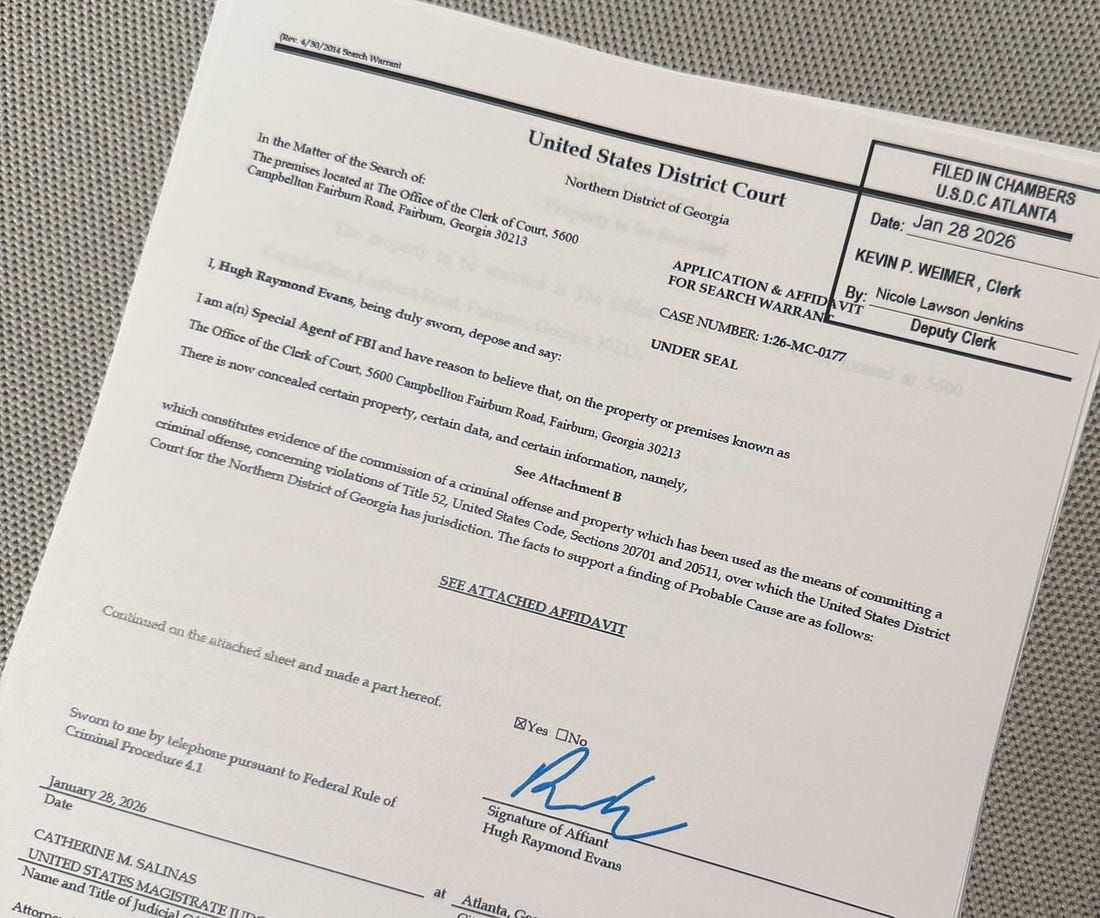
Today, the affidavit submitted when the Trump administration got its warrant to seize ballots from Fulton County, Georgia, was unsealed. I was expecting, well, probable cause. Because that’s what it takes to get a search warrant. But I didn’t find it in the 19-page affidavit the agent submitted along with the application for a search warrant.
The government says it’s investigating two crimes: Title 52 USC 20701, a misdemeanor records retention violation, and Title 52 USC 20511, which criminalizes “knowingly and willfully” depriving a state’s residents of a fair election by miscounting the vote. We discussed them in some detail following the search here. At the outset, there appears to be a statute of limitations issue. The government has five years from the time they were committed to prosecute these crimes. The election was in 2020. It’s now 2026. Math was never my strong suit, but I don’t see how that can work. There is no explanation of this apparent deficiency in the affidavit. With a marker down for that legal issue, we move on to probable cause. The law in the Eleventh Circuit (where Georgia is) is clear about what probable cause for a search warrant should look like. United States v. Hyppolite, a 2015 case, is frequently cited by lawyers to explain that the standard “is met when the facts and circumstances within the officer’s knowledge, of which he or she has reasonably trustworthy information, would cause a prudent person to believe, under the circumstances shown, that the suspect has committed, is committing, or is about to commit an offense.” The government has to demonstrate a reasonable basis to believe that a crime was committed and that evidence of the crime will be found at the location to be searched. And importantly here, the government can’t get to probable cause by ignoring evidence that cuts the other way. The Eleventh Circuit has held that a “warrant affidavit violates the Fourth Amendment when it contains omissions made intentionally or with a reckless disregard for the accuracy of the affidavit . . . if inclusion of the omitted facts would have prevented a finding of probable cause,“ and that “Whether the omitted statement was material is determined by examining the affidavit as if the omitted information had been included and inquiring if the affidavit would still have given rise to probable cause for the warrant.” Alarm bells should be going off long about now, because the affidavit doesn’t disclose that the man who set off the investigation, a Trump administration employee named Kurt Olson, is “a leading election denier” who “relied heavily on claims about ballots that have been widely debunked.” And it doesn’t get any better from that point on. NPR reported that “The affidavit relies on misleading and already-disproven claims about the 2020 election,” before reminding readers that Fulton County ballots were counted three times following that election, confirming the accuracy of the result. You would expect that the affidavit would rehearse those well-known facts about the Big Lie of 2020 and explain why, moving beyond those previously discredited theories, there is probably cause to support a search. It doesn’t. Instead, the affidavit seems to discount the very probable cause that it’s supposed to be establishing. For instance, in a section titled “Seven Hills Strategies Report,” we learn that the state election board brought an “independent, non-partisan monitor” called Seven Hills Strategies in to watch Fulton County ahead of the 2020 election. Then, the following August, “pursuant to a request from the General Assembly, the State Election Board appointed a Performance Review Board.” The affidavit relates the results of that review: “Secretary of State Investigators who investigated complaints regarding the November 2020 General Election in Fulton County elections had similar findings to the Seven Hills Strategies’ report—no evidence of fraud, dishonesty, or intentional misconduct, but persistent disorganization that made it difficult to get to the bottom of certain claims. Our review reaches a similar conclusion—we do not see any evidence of fraud, intentional misconduct, or large systematic issues that would have affected the result of the November 2020 election.” While Fulton County is majority Democratic, both the General Assembly and the State Election board are led by Republicans, which makes their conclusion that there was no intentional fraud or misconduct all the more compelling—it suggests that there is no probable cause. After reading the affidavit, there’s no certainty that a crime was committed, let alone that there is probable cause for a search. Nor are the people allegedly responsible for these supposed crimes identified in the affidavit. That’s not an impediment to getting a search warrant. Prosecutors frequently investigate a crime before they are certain of the identity of the people who committed it. But here, with established allegations and clarity about who ran the vote counts, it’s surprising to see it omitted. Almost as if this is less about bringing a meritorious criminal prosecution against specific individuals and more about casting suspicion over Fulton County’s voting system and ability to conduct a fair election. It feels less like a step towards a successful criminal prosecution and more like targeted intimidation and voter suppression. (Failed prosecutions are nothing new in this administration, from the dismissed case against former FBI Director Jim Comey to news tonight that a grand jury in the District of Columbia rejected an indictment of six members of Congress who posted a video reminding people serving in the military and the intelligence community that they should refuse illegal orders.) After rehashing the old allegations about ballot handling that have either been disproven or explained as human error, the affidavit takes a stab at setting up probable cause in paragraph 10: “If these deficiencies were the result of intentional action, it would be a violation of federal law regardless of whether the failure to retain records or the deprivation of a fair tabulation of a vote was outcome determinative for any particular election or race.” “If” is doing a lot of heavy lifting in that sentence. “If” a defendant intentionally killed someone, it could be murder. But it could also be manslaughter, self-defense, or a justifiable killing. “If” is not probably cause. In the conclusion section of the affidavit, the best the agent can offer is another “if.” “If,” he writes, “these deficiencies were the result of intentional action, the election records identified in Attachment B are evidence of violations of Title 52 U.S.C. §§ 20511 and 20701.” If wishes were horses, beggars would ride. On top of everything that was left out of the affidavit, the whole debunked big lie issue, it’s a mighty slender thread to base probable cause on. Given the careful review that’s customary for search warrant affidavits, it’s surprising that this made it out of both the FBI office and the US Attorney’s office, and onto a federal judge’s desk. Donald Trump recently said that Republicans should nationalize elections, take control of them. The Fulton County “investigation” seems like a manifestation of that desire to make elections less about the will of the people and more about the will of politicians. Instead of letting the US Attorney in Atlanta handle the matter, the US Attorney from St. Louis has parachuted in, filing a notice in court today that the case is his. That, along with Tulsi Gabbard’s involvement in the search and Trump’s call at her behest with the agents who executed the warrant, makes it likely that, as we concluded following the search, Fulton County is just the tip of the iceberg. Your paid subscription makes Civil Discourse possible—independent, informed analysis that connects the dots between law, politics, and the truth. In a moment when noise drowns out reason, your support ensures facts and context still have a home. Join a community that refuses to give up on democracy—or on understanding it. We’re in this together, Joyce You're currently a free subscriber to Civil Discourse with Joyce Vance . For the full experience, upgrade your subscription.
|
Tuesday, February 10, 2026
Fulton County: What's In The Warrant?






Subscribe to:
Post Comments (Atom)
Fulton County: What's In The Warrant?
Hint: Everything but probable cause ͏ ͏ ͏ ͏ ͏ ͏ ͏ ͏ ͏ ͏ ͏ ͏ ͏ ͏ ͏ ...
-
Four Ohio cities ranked in the nation's top 100 best cities for single people, according to a WalletHub survey that considered fact...
-
Trumpism = sabotage, plunder, and betrayal ͏ ͏ ͏ ͏ ͏ ͏ ͏ ͏ ͏ ͏ ͏ ͏ ͏ ͏ ...


No comments:
Post a Comment