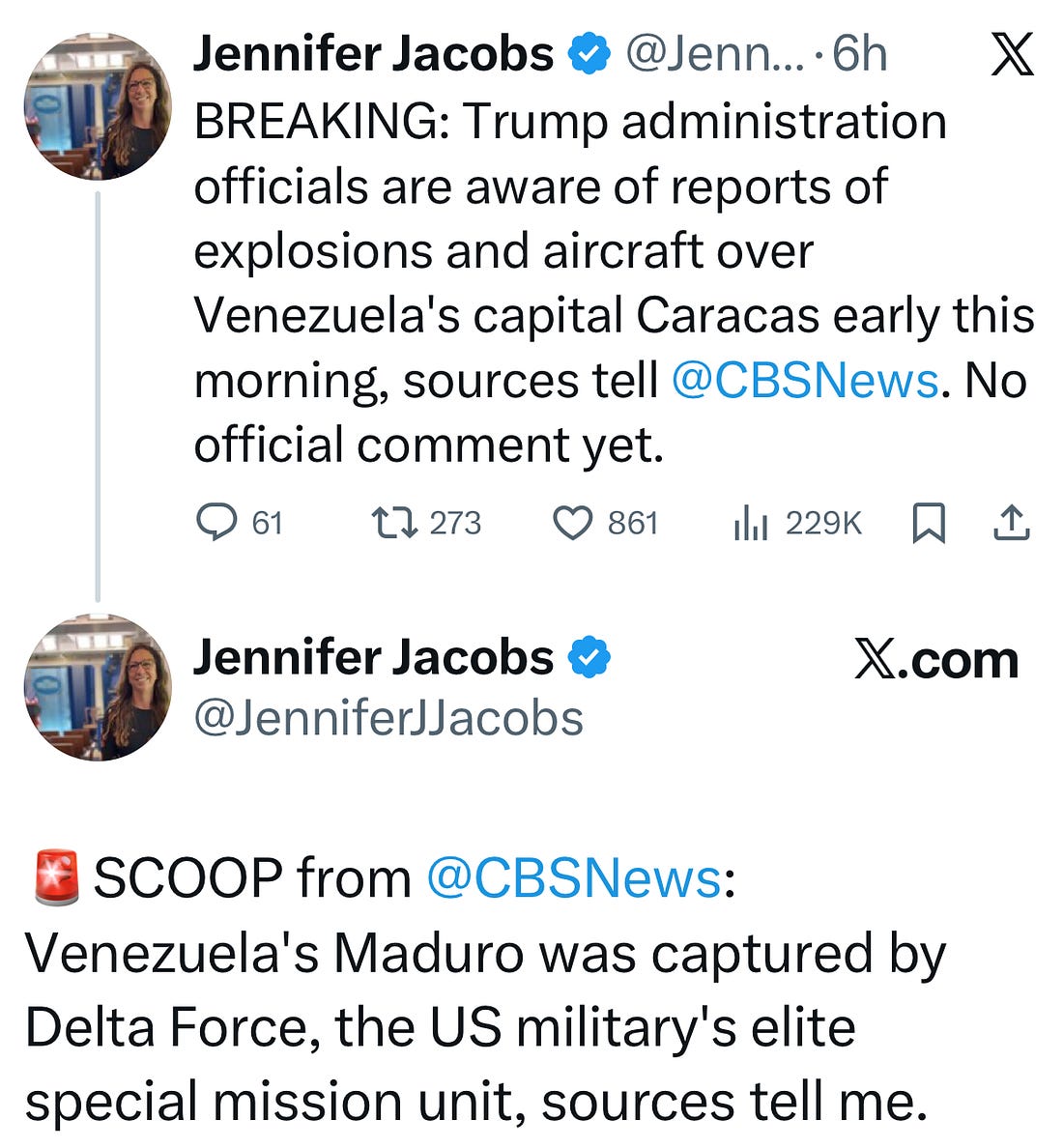
As you’re likely aware by now, overnight, the Trump administration, without alerting Congress first, went into Venezuela and arrested its President, Nicolás Maduro, on charges stemming from a newly announced indictment in the Southern District of New York. Trump will hold a press conference from Mar-a-Lago at 11am ET. In advance, here is a quick outline of the legal landscape and the issues we need to become familiar with to understand what is happening. Some hot takes here, in a complicated area, to provide that context quickly. Overnight, news and video emerged showing what appeared to be explosions in Venezuela’s capital, Caracas.
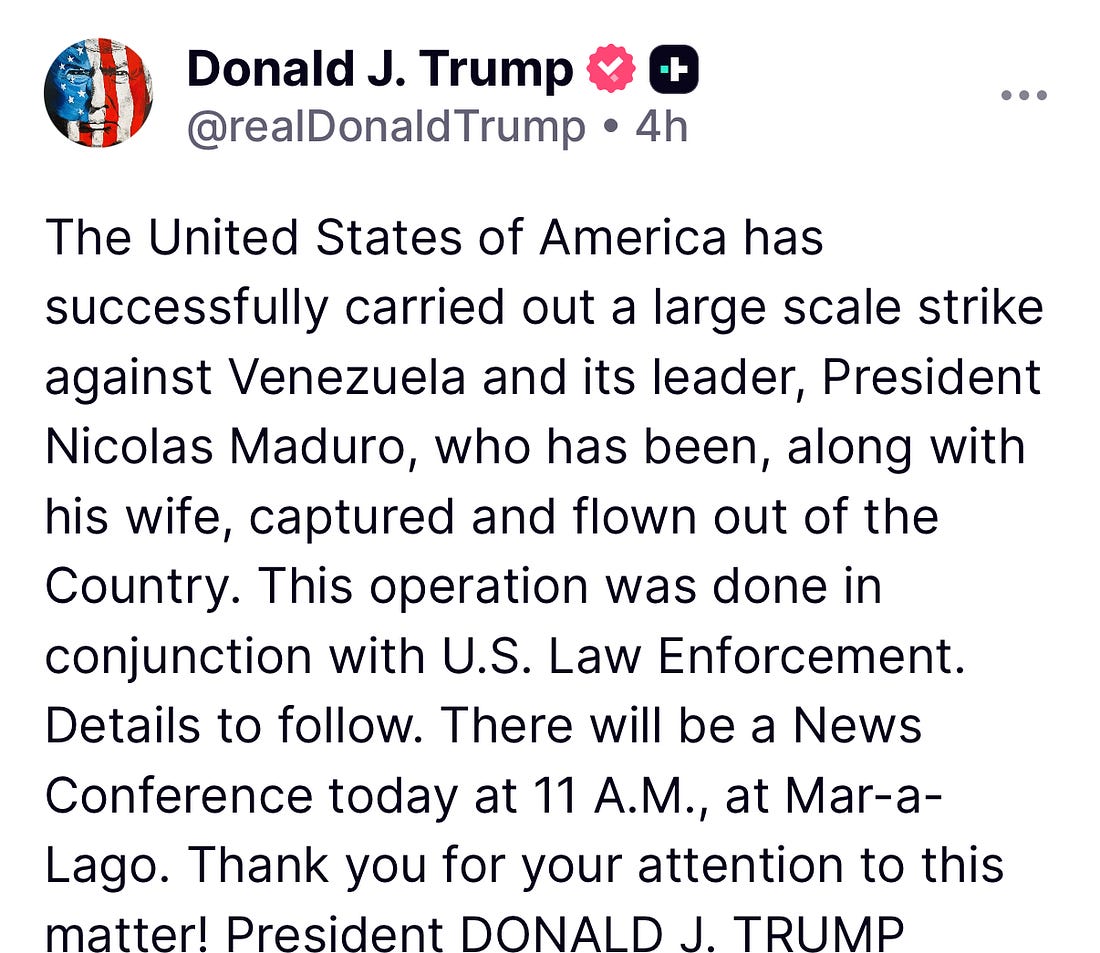
At 3:21 am, Trump confirmed the strike.
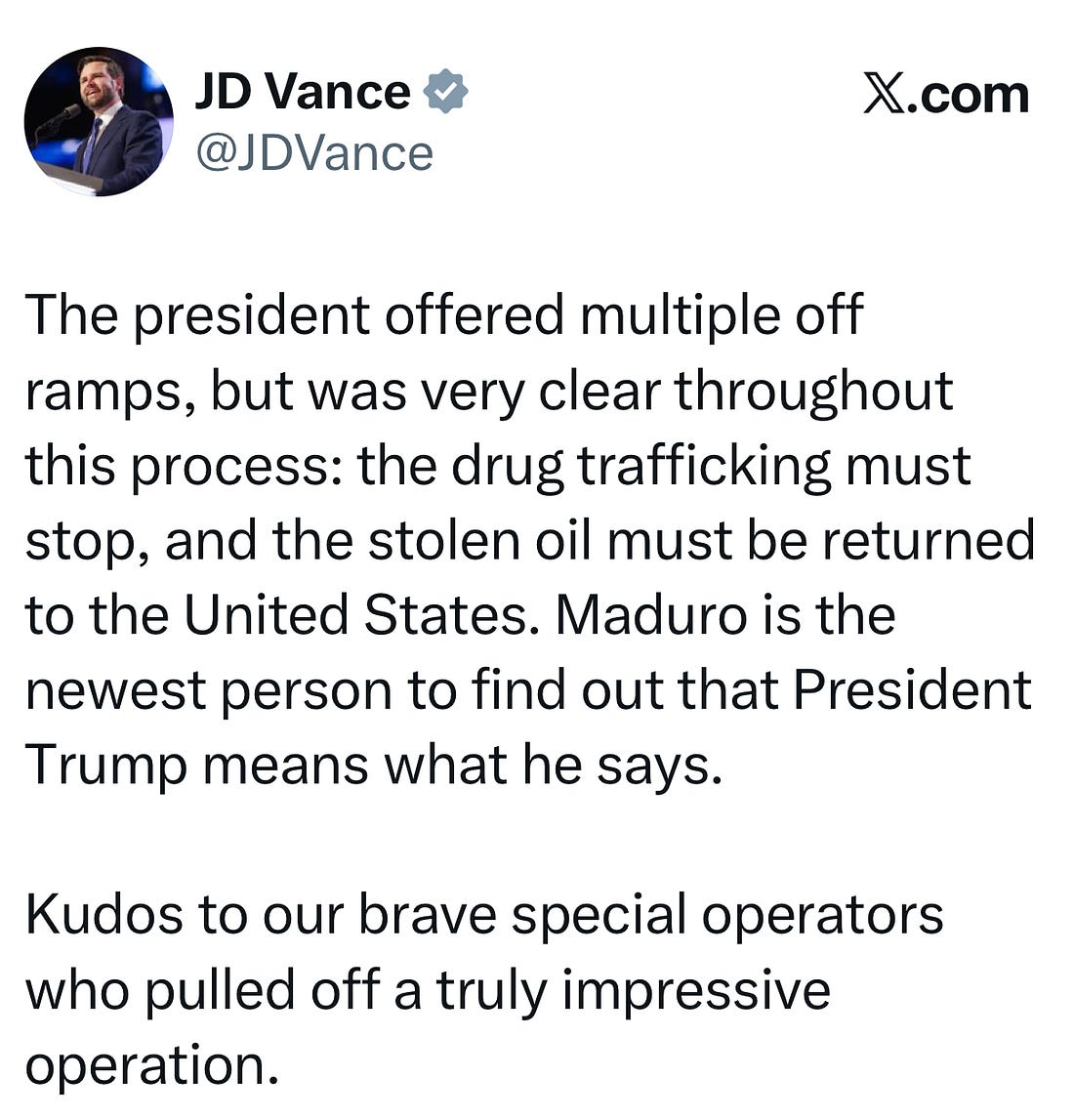
Venezuelan President Nicolas Maduro has been on Trump’s radar screen all year, starting with the declaration that the Venezuelan gang, Tren de Aragua, was a terrorist organization attacking the U.S., which became Trump’s argument to support deportations to CECOT prison and subsequently, for kinetic strikes against what the administration alleges are narcoterrorists transporting illegal narcotics by sea. Maduro’s 2024 reelection, with a narrow margin of around 1.5%, was questioned by the opposition. He is an authoritarian leader, Opposition leader Maria Machado dedicated her Nobel Peace Prize to Trump. Vice President JD Vance. offered more explanation.
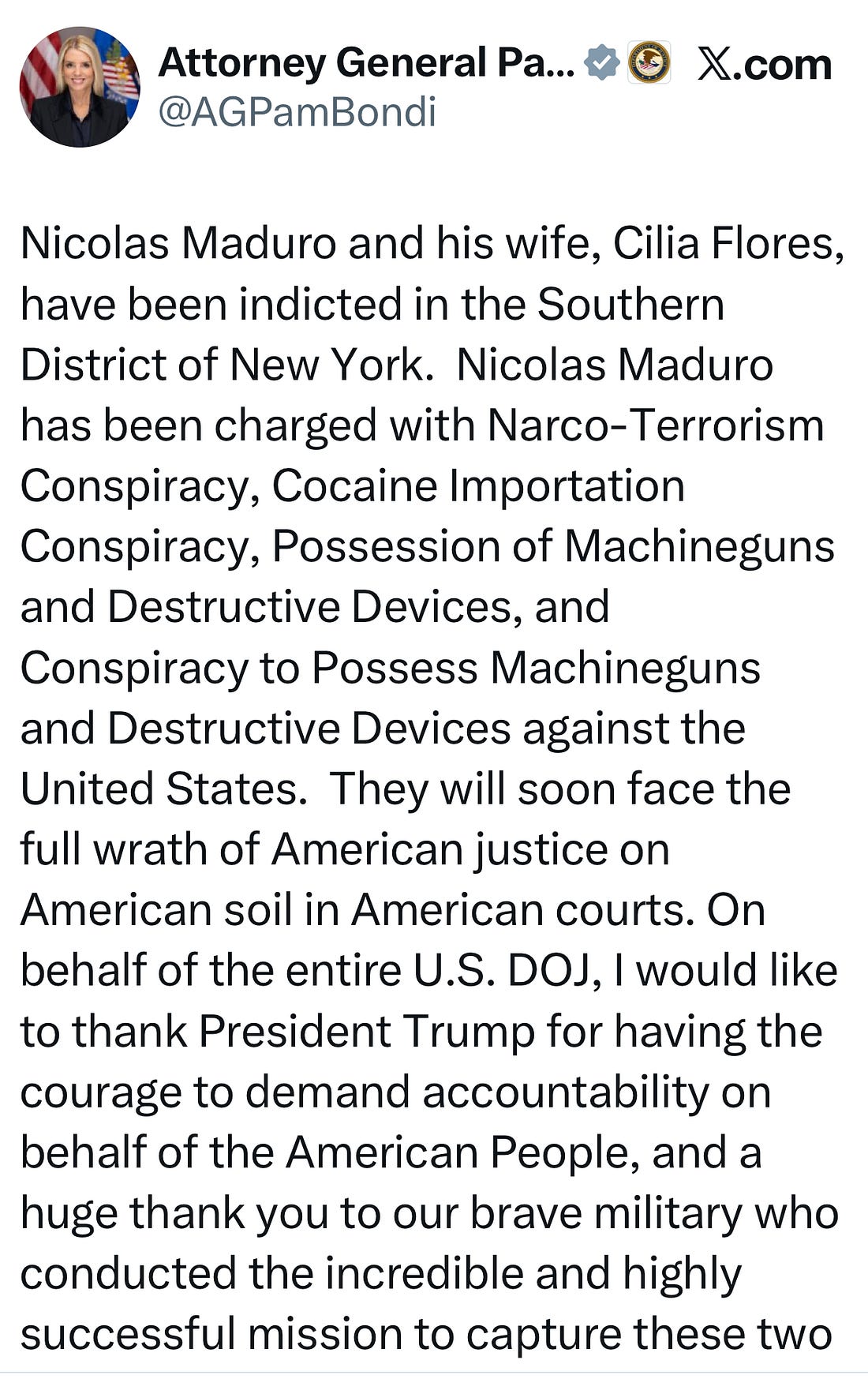
Maduro and others were indicted in 2020 by the Southern District of New York when Bill Barr was Attorney General. This morning, Pam Bondi announced an indictment. It’s not yet clear whether that is a new indictment or a related one. Since Maduro’s wife was taken along with him, and she was not named in the original indictment, it’s likely that at a minimum, the old indictment has been superseded (amended).
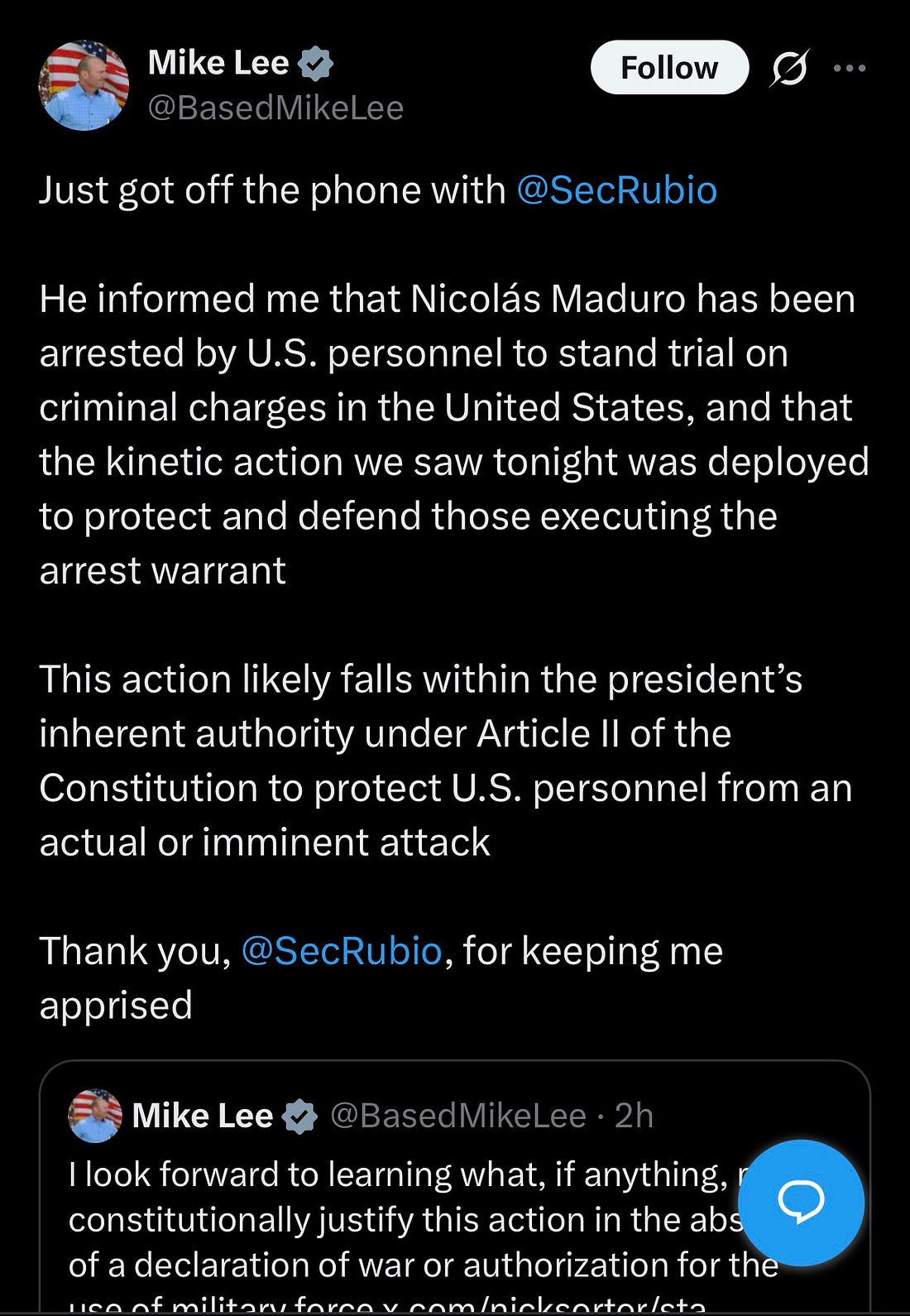
Is it legal for the president to go into Venezuela without Congressional authorization? Congress holds the war power. Utah Senator Mike Lee initially seemed skeptical, but seemed to subsequently be appeased by an explanation from Secretary of State Marco Rubio. The explanation, which we’ll hear more about as this develops, seems to be that this was not an attack—new hostilities—but a limited strike designed to arrest someone under indictment, with “unit support” to protect those affecting the arrest.
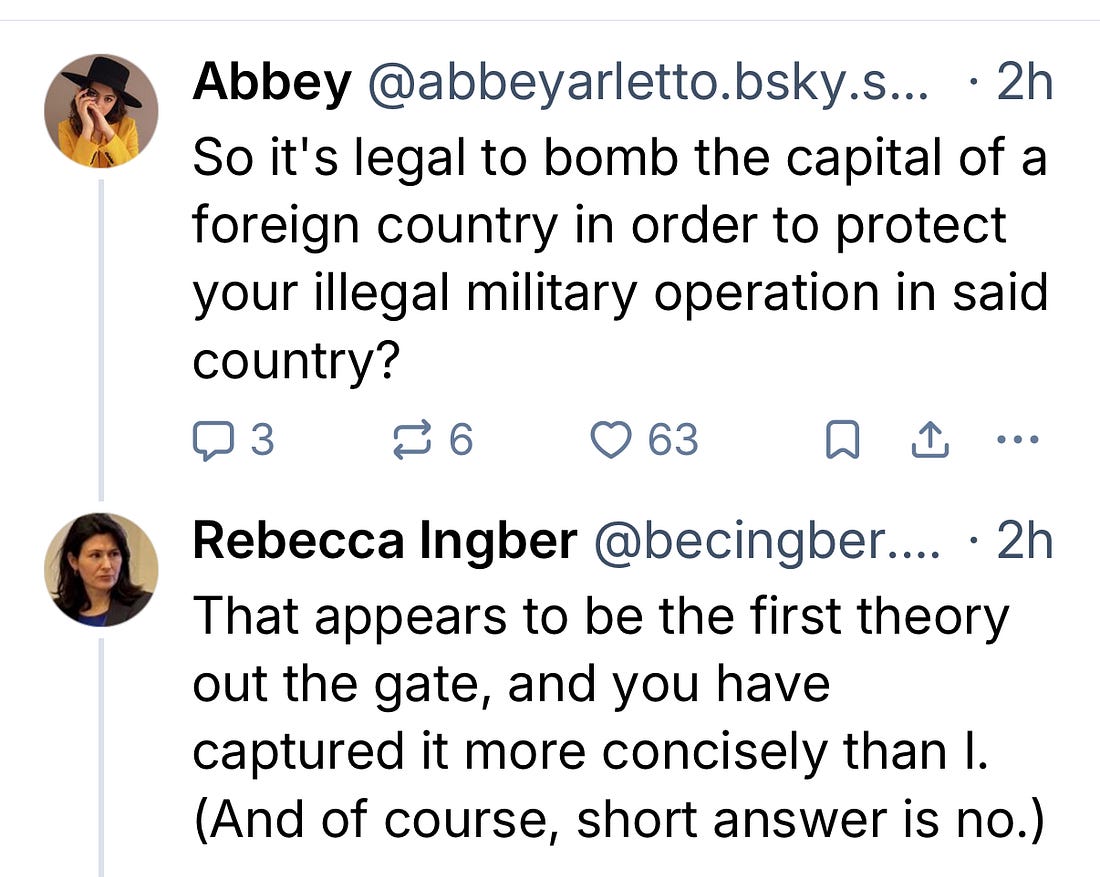
Rebecca Ingber, a law professor and expert in international law weighed in on social media this morning to explain she expects the administration to argue that the justification for the action will involve the President’s Article II power to affect the arrest and related ability to protect those making it.
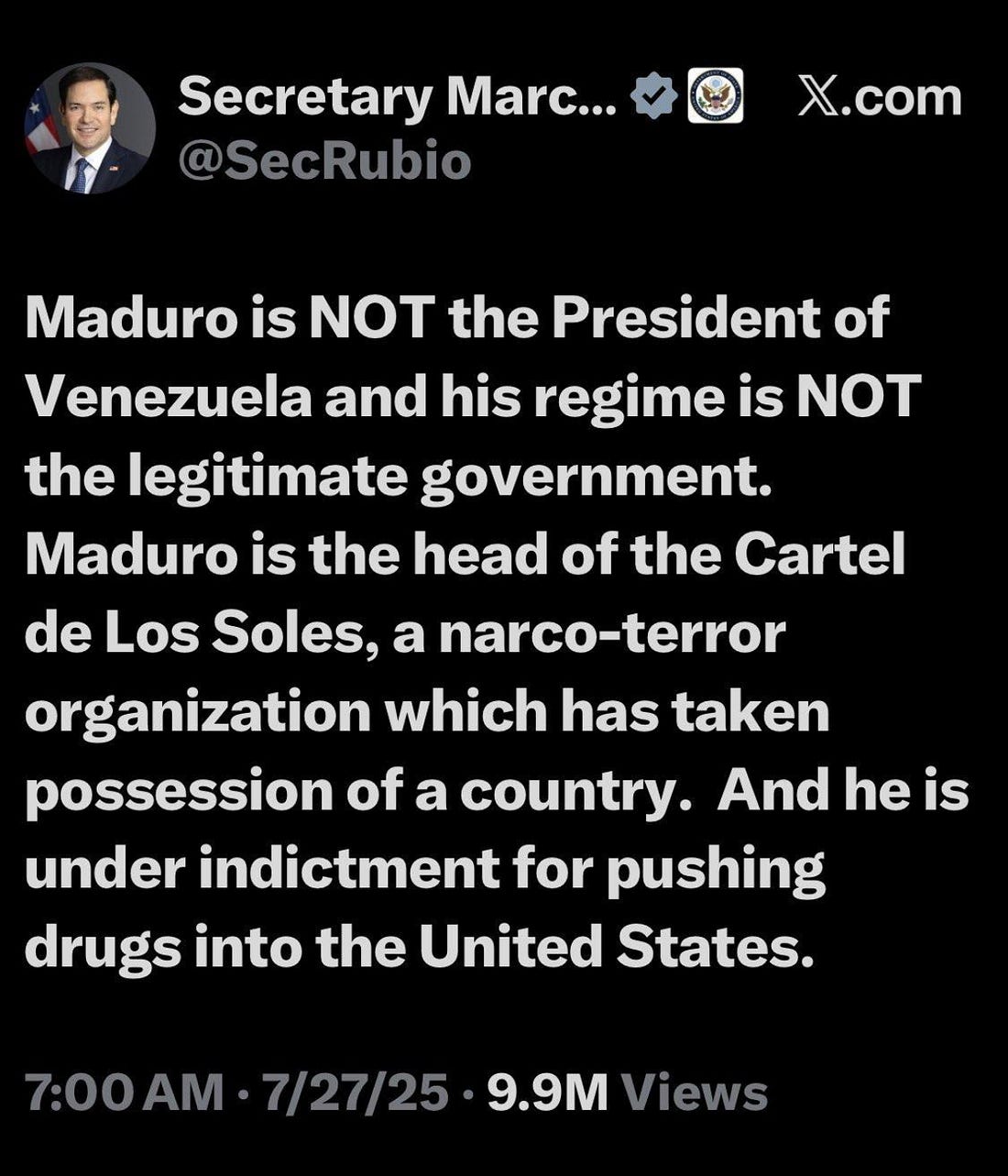
This argument is complicated by the fact that Maduro is the leader of his country, so it’s not just a normal arrest. There will be arguments that he is not a legitimate leader because of the questioned election. It is up to the president to decide which governments to recognize as legitimate and this post from Marco Rubio last July suggests where this is headed.
But the subtleties of international law seem to be lost in the midst of warmongering and the administration’s desire to take down an alleged narco terrorist. The situation is further complicated because this Justice Department is no longer operating in a way where we can assume its prosecutions are solid. The evidence will be carefully scrutinized because we are now firmly in an era where the Justice Department has permitted itself to become a political tool the president can use at will. Trump certainly welcomes the distraction from the botched Epstein Files release, and there are suggestions that this is ultimately about Venezuela’s oil. Venezuela has the world’s largest oil reserves. There are also questions about the legitimacy of Trump’s claims he’s focused on a war against narcoterrorism in light of his December pardon of former Honduran President Juan Orlando Hernández. Hernández was convicted by a jury and sentenced in 2024 to 45 years in prison for using his position to help drug traffickers import more than 400 tons of cocaine into the U.S., accepting bribes that advanced his political career, and providing protection from prosecution to violent drug cartel leaders. There will be a lot of questions. There is at least some precedent for this kind of action. George H.S. Bush arrested Panama’s leader, Manuel Noriega, thirty-six years ago today. Bush sent the military into Panama in late 1989, toppling Noriega's government. The administration has been referencing that incident, known as Operation Just Cause, since July, and intimating that Maduro’s time in office was coming to an end. The New York Times is continuing to post live updates here. A primary question is how Congress will react. Will they accept the administration’s justification? Will they stand on their institutional war powers? Democratic Senator Andy Kim tweeted this morning that: “Secretaries Rubio and Hegseth looked every Senator in the eye a few weeks ago and said this wasn’t about regime change. I didn’t trust them then and we see now that they blatantly lied to Congress.” Republican Tom Cotton countered that the administration is not obligated to provide notice in an arrest situation. Human rights expert Alonso Gurmendi has a thread on Twitter tracking the reaction of foreign countries.
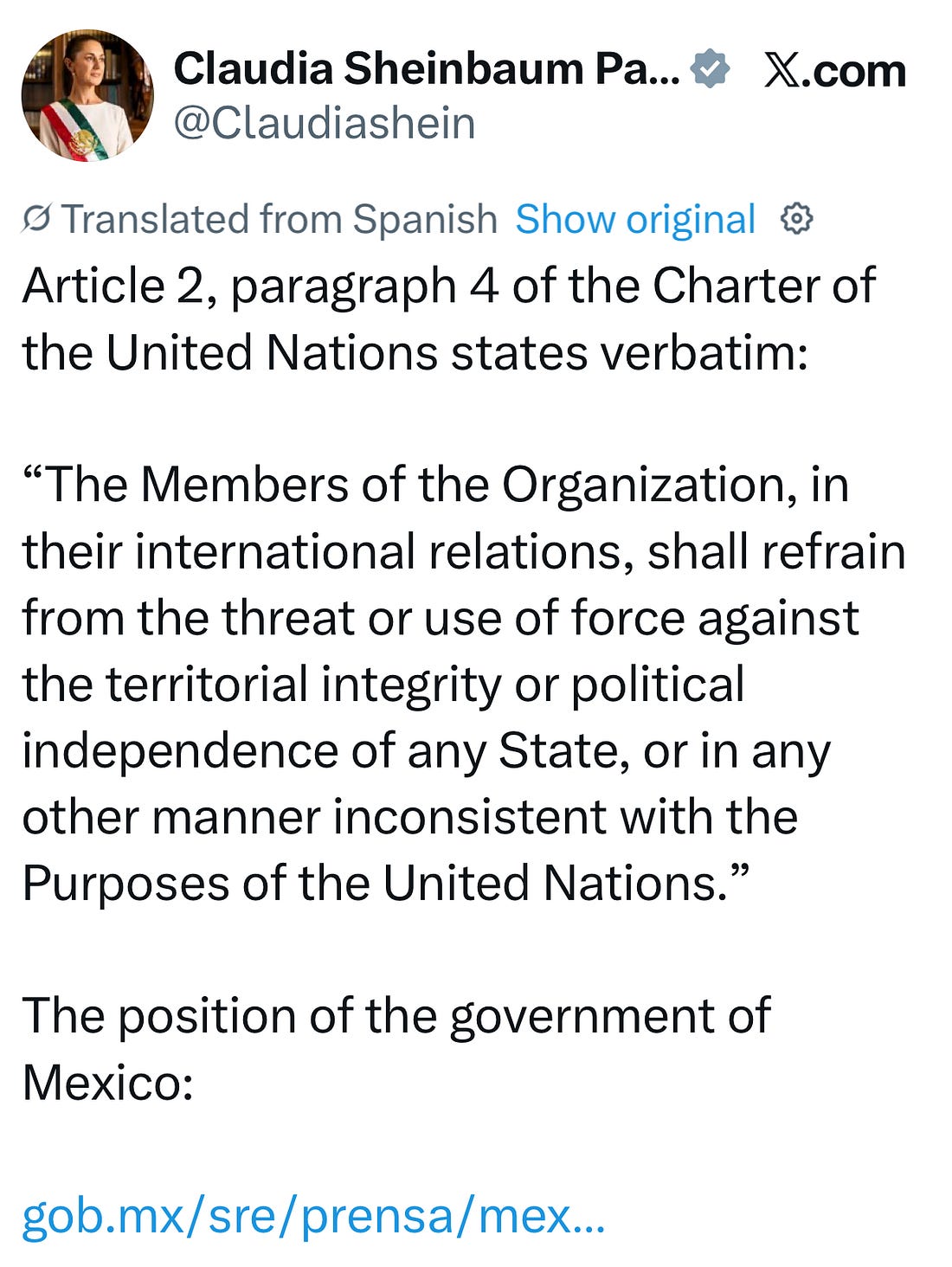
The President of Mexico:
As we focus here on the legality of the strike, remember that all of this is early; these are hot takes and they are going to evolve as more information becomes available. But we now have some context from what we will hear from Trump in this morning’s news conference and what follows today and on the Sunday shows tomorrow. It is likely concerns that this is about oil—Maduro and his predecessor Hugo Chavez nationalized oil fields in the country and Trump has repeatedly railed against “stolen oil”—will continue to surface. On Fox News this morning, Trump said, “Fox News “when you do oil everything follow.” Regardless of motivation, there are larger concerns about how this impacts regional, and global—given Venezuelan oil—stability. The New York Times, in an early morning opinion piece from the editorial board, made a key point about regime change for us to consider as this unfolds: “If there is an overriding lesson of American foreign affairs in the past century, however, it is that attempting to oust even the most deplorable regime can make matters worse. The United States spent 20 years failing to create a stable government in Afghanistan and it replaced a dictatorship in Libya with a fractured state. The tragic consequences of the 2003 war in Iraq continue to beset America and the Middle East. Perhaps most relevant, the United States has sporadically destabilized Latin American countries, including Chile, Cuba, Guatemala and Nicaragua, by trying to oust a government through force. Mr. Trump has not yet offered a coherent explanation for his actions in Venezuela. He is pushing our country toward an international crisis without valid reasons. If Mr. Trump wants to argue otherwise, the Constitution spells out what he must do: Go to Congress. Without congressional approval, his actions violate United States law.” We’re in this together, Joyce Thanks for being here and for reading Civil Discourse. If it helps you understand today’s issues, I hope you’ll share it with friends and consider subscribing if you don’t already. You're currently a free subscriber to Civil Discourse with Joyce Vance . For the full experience, upgrade your subscription.
|
Saturday, January 3, 2026
Trump Strikes Venezuela; Arrests President Maduro






Subscribe to:
Post Comments (Atom)
Protect Your Identity, Ukraine Military Shakeup, Auction House Horror Discovered
Stolen passwords drive record identity theft, Ukraine's military leadership faces a shakeup, and a foreclosure buyer makes a grisly di...

-
On Monday, Leon County Circuit Judge Angela Dempsey rejected Bear Warriors United's request for a temporary injunction to halt the s...
-
Police say information from a Reddit tipster who had a strange encounter with another man on a sidewalk outside Brown University provi...
-
The Trump administration has launched a new federal initiative called the U.S. Tech Force, aimed at hiring about 1,000 engineers and t...


No comments:
Post a Comment