In partnership with | | | | | | The 99th annual Thanksgiving Day Parade featured 18 giant helium balloons. Macy's, which designs the balloons and sponsors the parade, is the country's second-biggest helium consumer after the U.S. government. |
|
|
|
| | | Scott's most recent book, Notes on Being a Man, hit No. 1 on Amazon and The New York Times bestseller list. It also sparked controversy online for how it connects masculinity and money. | Today's Markets newsletter features a research-driven conversation between Scott and Ed around one central question: How important is money to being a man? |
|
| | The Economic Reality of Modern Masculinity | Scott writes that masculinity comes down to being a "protector, a provider, and a procreator." He's gotten some pushback on that. | One thoughtful criticism came from a male therapist, Reuben Brody, who argued that this view oversimplifies masculinity and risks making men who don't want to or can't be primary providers or parents feel like they're falling short. |
| | |
| | | | A fair criticism of the book is that I reverse engineer what's worked for me into advice for everybody. Developing economic security and having a family has been immensely rewarding for me, but those might not be priorities for some people. | However, I stand by the notion that in a capitalist society, money plays a larger role in masculinity than we'd like to believe. I'm not suggesting you need to work for Goldman Sachs, but you need a plan. You need to have the discipline to spend less than you make, pursue certification, demonstrate grit, work hard, such that at some point you might be in a position, should you choose to, to be able to support or at least be a large contributor to the family. | Beyoncé could work at Burger King and marry Jay-Z. The opposite is not true. Men are disproportionately and unfairly evaluated based on their economic viability. Women are unfairly and disproportionately evaluated on their aesthetics. That is not the way the world should be. It is the way the world is. |
| |
| | |
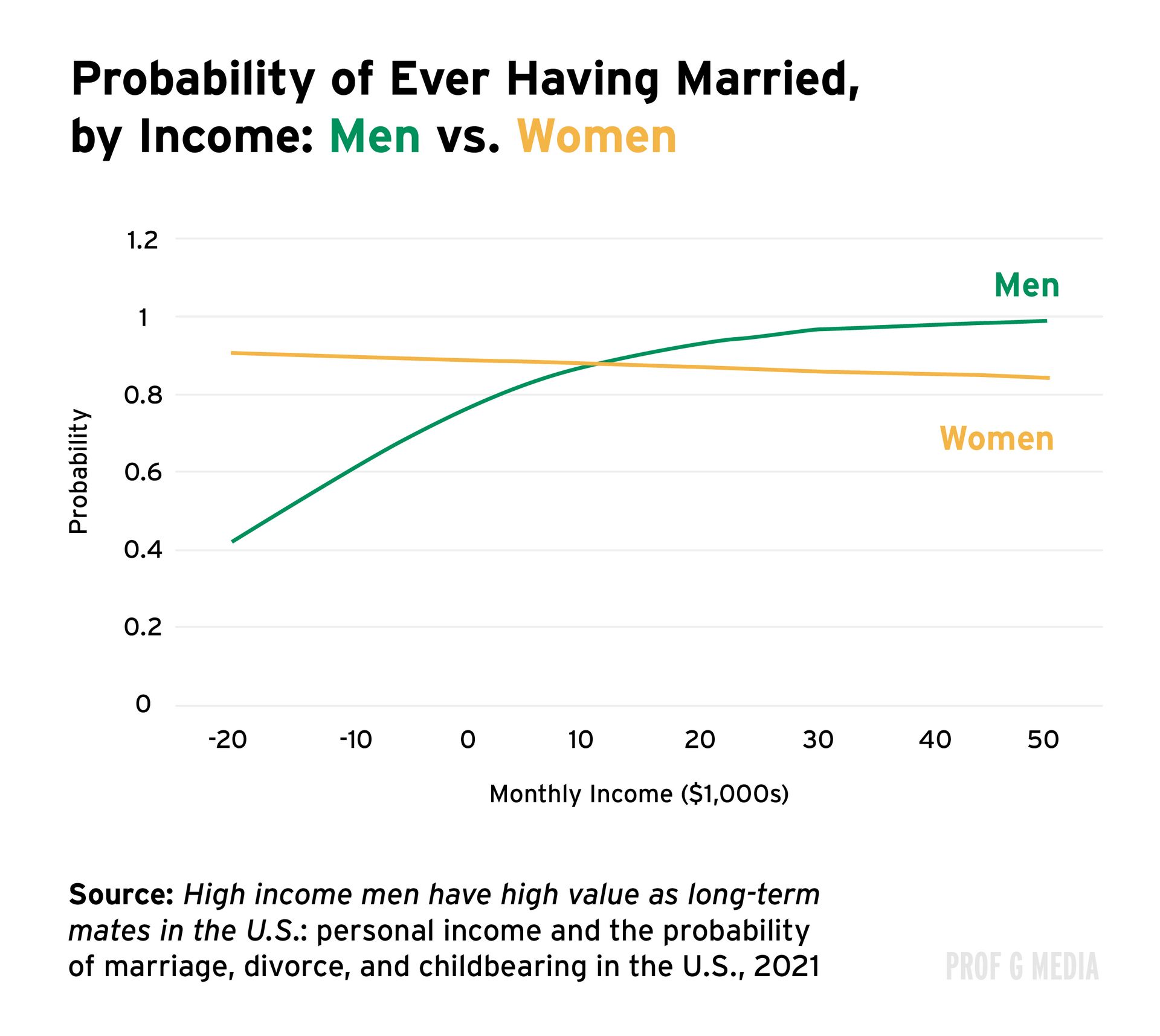
| Research confirms this. In studies of online dating, men who have higher incomes receive 10x more profile visits than men who have lower listed incomes. This dynamic doesn't show up with women. | Furthermore, men in the highest-income category are 57% more likely to get married than men in the lowest-income category. Income is unrelated to marriage for women. | | There isn't just a correlation between money and marriage for men, there is actual data that indicates a causal relationship between men having money and being married. As Lyman Stone, the director of research of the consulting firm Demographic Intelligence, pointed out, when women win the lottery, their marriage rates don't change. But when men win the lottery, they get married. | Money also impacts divorce rates. One study of marriages found that the more time the husband spends unemployed, the higher the likelihood that the couple will get divorced. A woman's employment, or lack thereof, however, has no impact on the likelihood of divorce. |
| | |
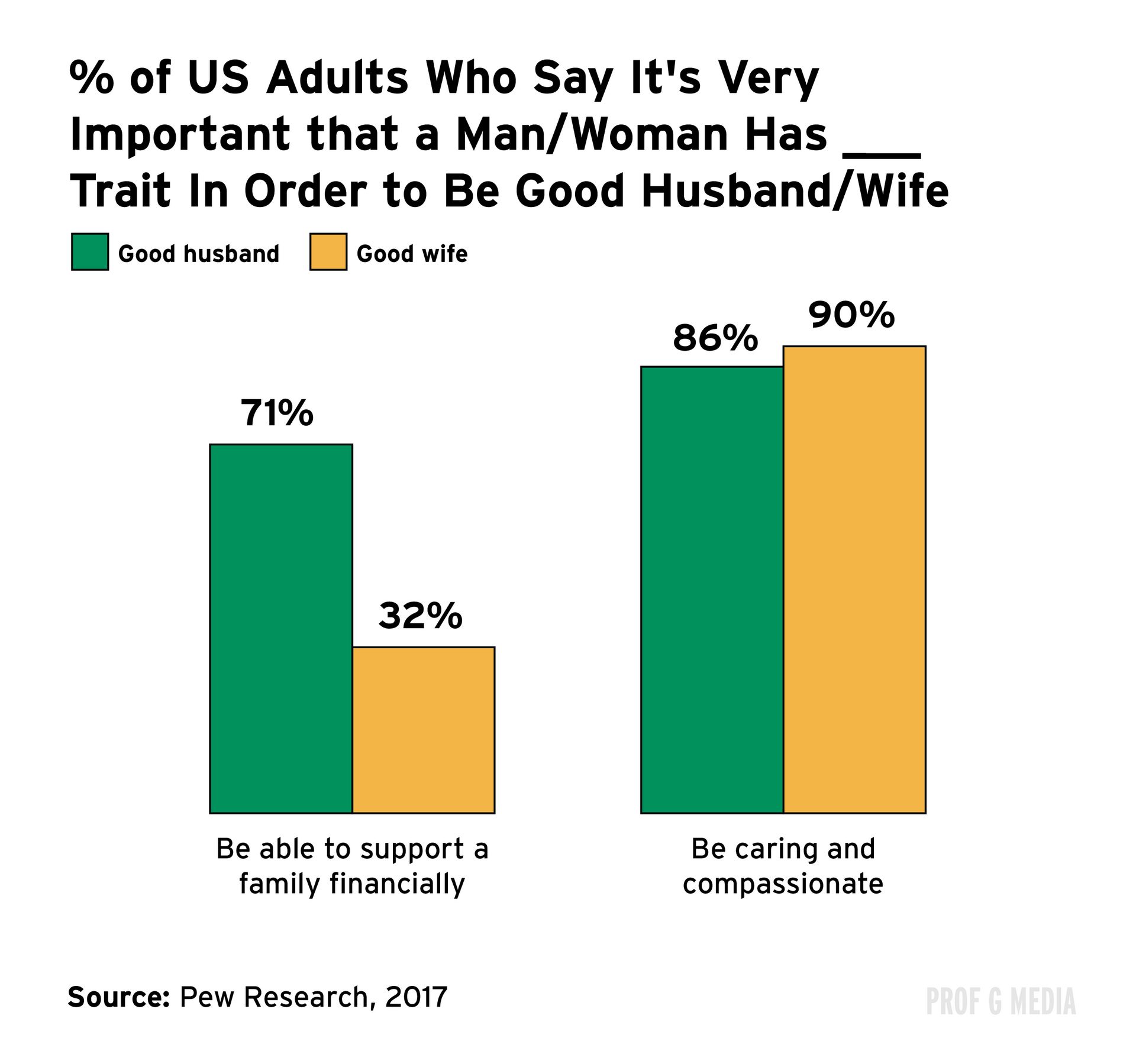
| | | | America has become the best place in the world for people with money and the worst place in the world for people without it. | The pragmatic, sober reality is the following: If you're in the top 1% of income-earning households, on average, you will live 12 years longer than people in the lowest 1%. Money in the United States has literally become life. | So, the temptation to try and find a partner who has economic viability is only increased. | At the same time, men have to get past themselves and realize that there are different ways to be a provider. | You can be a provider by dialing up support at home and increasing emotional support. | When my partner got a job at Goldman Sachs and was making more money than me, I stepped up at home and tried to be really supportive of her, because at that moment she was better at the whole money thing. | As women have ascended economically, men have not matched that ascent domestically or emotionally at home. | |
| |
| | |
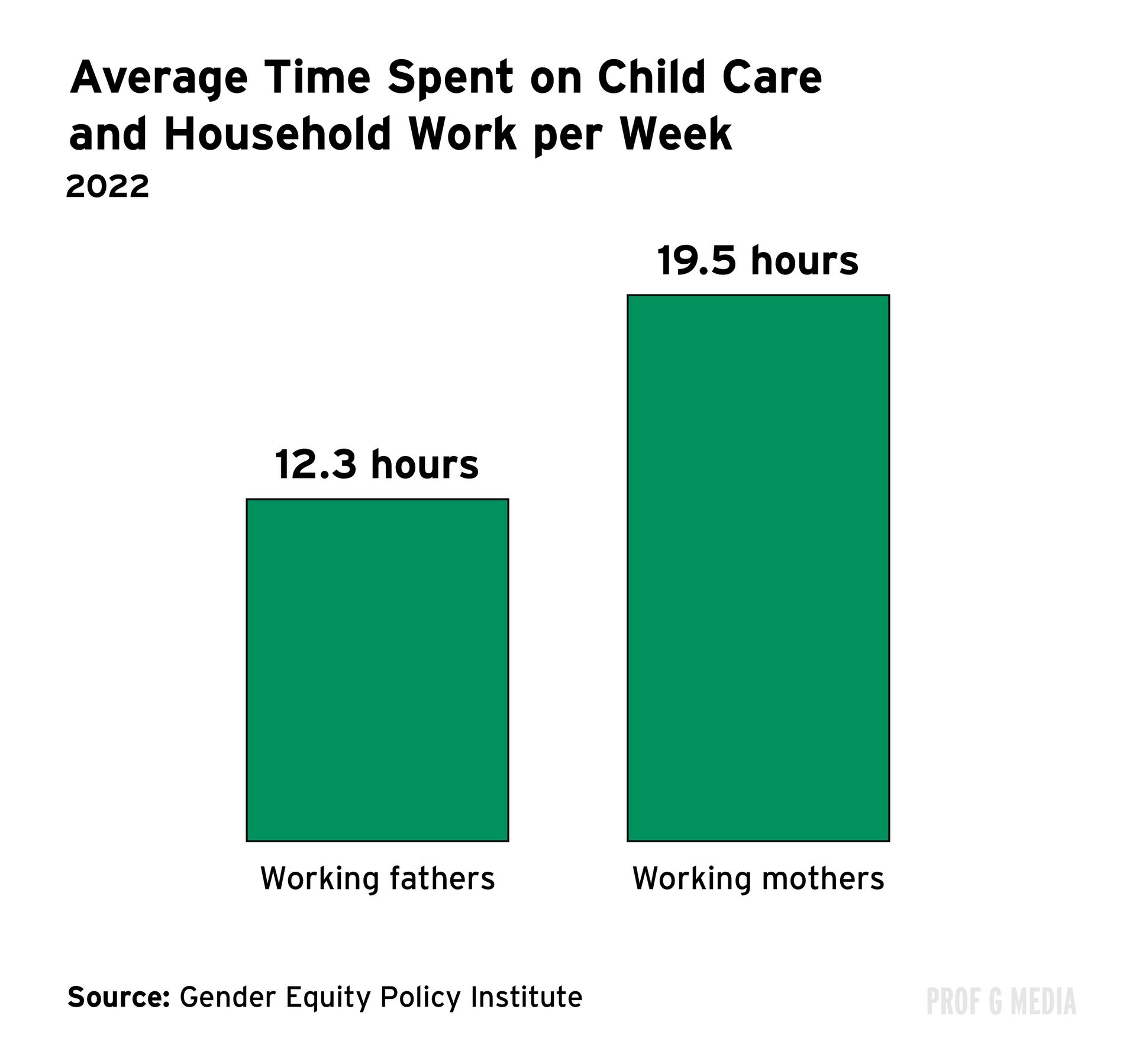
| The data bears this out. Working men and women report similar pressure to provide financially, yet working mothers still take on far more child care and housework than working fathers. | On top of that, studies show a persistent gap in how parenthood affects career growth: Being a mother typically reduces women's earnings, while fatherhood can raise men's earnings. There's even a name for this disparity: the mommy track. | |
| | |
| | | | The magic of money isn't what it does in terms of your sexual currency. The magic of money is what it does to you as a potential partner. | It's not that women want you because you have a Lamborghini. It's that if you have money, it probably means that you are more self-actualized. You're more confident. You believe in yourself. You're more stable. You feel less like a victim. | I think women want a man who is mature and who can make them feel safe, and money turns out to be a pretty good indicator of those attributes. |
| |
| | |
| The Manosphere Problem | Small but vocal online subcultures have developed as offshoots of the incel movement. Many of them teach that money is the primary determinant of a man's value — that status and "provider capacity" are all women look for. For unattractive men, money is the only reliable way to compensate for low attractiveness. | At the core of this thinking is the claim that women are primarily economic actors seeking security and lifestyle upgrades. They say marriage is an economic risk for men, and commitment is a financial trap. | Versions of its logic show up in commentary from well-known figures: | Andrew Tate: "Women want money and use love to get it." Nick Fuentes: "[Women] expect so much from the men. They want the man to be rich and provide." Tucker Carlson: "Study after study has shown that when men make less than women, women generally don't want to marry them. Over big populations this causes a drop in marriage, a spike in out-of-wedlock births, and all the familiar disasters that inevitably follow."
| This is why it's important to draw a distinction between zero-sum interpretations of masculinity and a more grounded view of how money, gender, and partnership actually intersect. |
|
| | | | People in the black-pill movement think women just want to use you for your money. But it's not actually just the money. It's what the money can give to you on a personal level and how it can make you feel and project more of what it means to be a man. | Maybe it's unfair in terms of how difficult it is to make money today. But I actually don't find it unfair that the man needs to demonstrate an ability to provide. I think it inspires you as a man to get your sh*t together and to work really hard. | The guy who's in vocational training and actually building a savings plan is, I would bet, more attractive to women than the guy who made a million bucks on crypto because he got lucky. | I would imagine that a woman would be more attracted to the maturity and discipline required to build real, durable wealth, and I feel like that's something that young people don't understand. |
| |
| | |
| | | | This black-pill movement is a bunch of grifters trying to convince young men that their lack of success in the mating market isn't their fault, it's someone else's fault. I mentor young men and I know when I've lost them because they start blaming immigrants for their economic problems and women for their romantic problems. | There are a lot of women out there that would date a guy who was at least making an effort. But you have to work on yourself. Go be an apprentice, hit the gym two or three times a week, be a little bit more well read, develop a kindness practice, go to church, do volunteer work. | It just breaks my heart that these bigots, nihilists are convincing some young men that it's somehow OK and even aspirational to give up on relationships. | I have traveled 180 days a year for 30 years, and it's usually on someone else's dime, so I stay at beautiful places. I usually get upgraded to some ridiculously fat f*cking suite that costs 12 or 15 grand a night. Inevitably. | And you know how much value registers when you're alone in that suite? It's meaningless. | If I can't share it with somebody, it has no value. I mean, literally, it's like it didn't happen. Who cares? | The real goal is to go to sleep with someone who you have built a life with together. It could be at some tacky hotel in Disney World that you saved up all year on, but that is so much more rewarding than being alone in a $12,000 suite at the Aman. |
| |
| | |
| | ____________sponsored content ____________ |
|
| Stop strangers from finding you online | Truth is, with just a simple Google search, anyone can find out where you live. Whether it's a stalker or scammer, or even selling your data, your personal info is out there, and that's just scary. Every day, more of your information is collected, shared, and exposed without your knowledge. | But there's a way to fight back: Incogni. It doesn't just remove your name from Google results. Incogni works quietly in the background to wipe your personal data from people-search sites, data brokers, and hidden databases you may not even know exist. | Here's what people have to say about Incogni: | "I was getting literally 10 spam calls per day on my new cell phone number. Incogni scrubbed my data and after 4-5 weeks the calls literally stopped like they hit a brick wall!" — Jamey | Your personal data is being collected and sold every time you go online. Take action now to protect your privacy. | Get 55% off Incogni using code PROFG |
|
| ____________sponsored content ____________ |
|
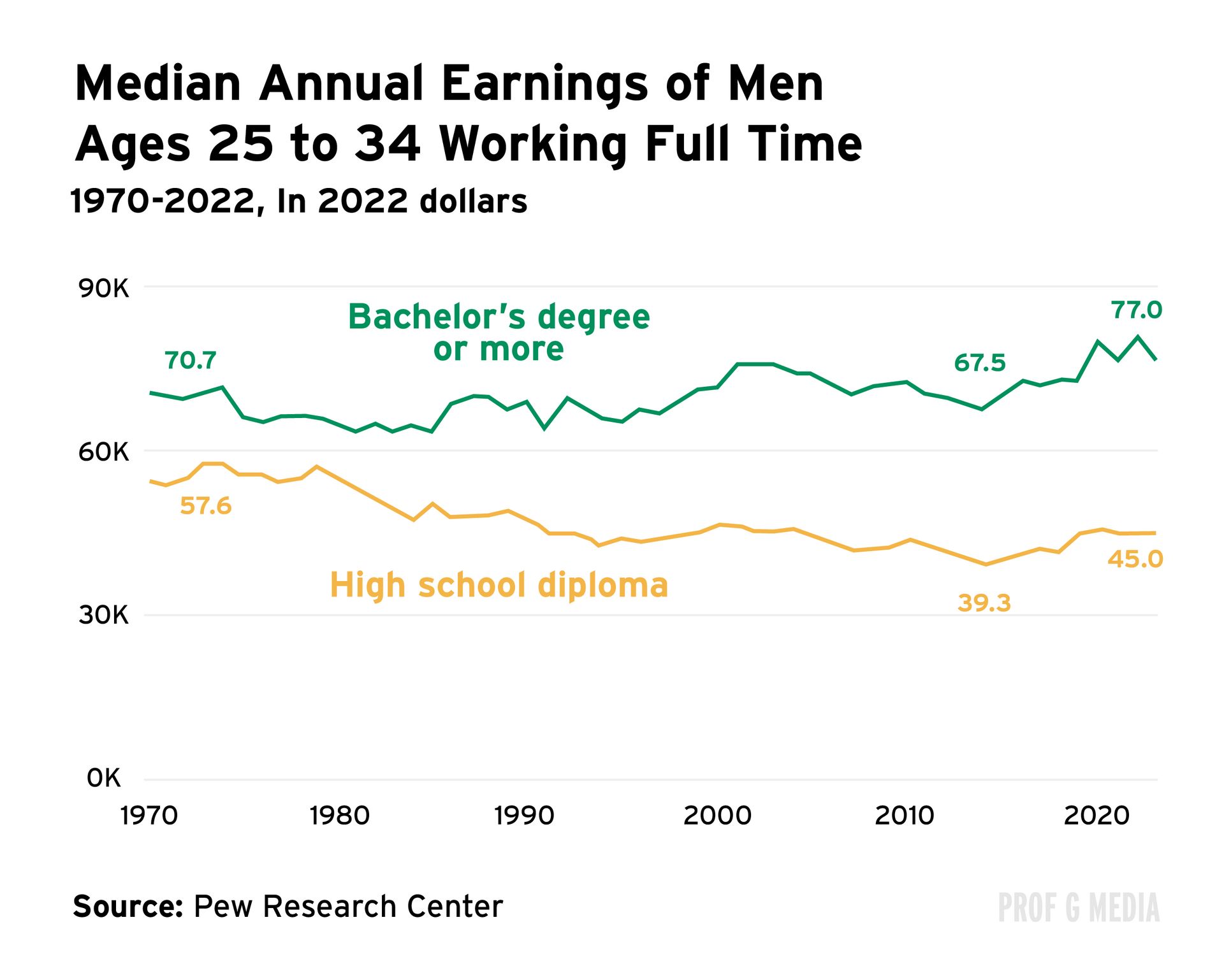
| | Critiques and What It Really Means to Be a Man | A key motivator behind Scott's book was data showing that young men are becoming poorer and increasingly disconnected from society. | Fewer men are graduating from college — only 40% of bachelor's degrees last year went to men. That's less than the percentage of degrees awarded to women in 1970. | The men who don't attend college are falling farther behind. Men without college degrees now earn less, in inflation-adjusted terms, than they did in 1973, per the latest Pew Research data. Young women are earning more. | |
|
| | | | A really valuable piece of feedback I've received from the book is that, all right, protector, provider, procreator — aren't women also protectors? Isn't that a key component of femininity? | Where I think I'm evolving to on this is that masculinity and femininity all overlap around just trying to be a better human. | And that maybe where I made a mistake here is trying to define stark lines between people born as males or females. | But if I had to define an aspirational form of masculinity, it comes down to this notion that Richard Reeves taught me, and that is surplus value. | A lot of males go their whole life and never become men. In my view, the metric is not a religious ceremony or age or experiences or money. It's: Do you create more value than you absorb? | Are you providing more comfort than's been given to you? Are you providing more love and more care for other people than has been provided for you? Do you have the ability to really see people where they are, understand them? Are you a better father to your son than your father was to you? | Once you are adding surplus value, that's when you become a man/better human. |
| |
| | |
| | Solutions | Solving the crisis of young men and masculinity comes down to three core points. | 1. Expand male mentorship for boys growing up in single-parent homes. Positive male role models provide structure, accountability, and a vision of healthy masculinity that isn't shaped by online extremists or grievance communities. | 2. Put more economic power back into the hands of young people.
Universal child care, a higher minimum wage, and breaking up Big Tech would create more jobs, reinvigorate upward mobility, and make it easier for young people to form partnerships and families. | 3. Teach young men that they have more agency than they think. Young men cannot be victims. They have to be kind, work out, build skills, and take risks. Stop outsourcing responsibility to conspiracies about women or immigrants. |
|
| | | | To the young man who feels that he's not worthy of love because he feels he can't make enough money, the first thing I would say is to forgive yourself. Recognize that it isn't the same economy that I entered when I was your age. | But to try and figure out a way to add value. You have a smartphone — drive for Uber or work for TaskRabbit, or find a job in the service sector. | Start working out. Physical fitness has been shown to be as good or better than pharmaceuticals for supporting your mental health. It's not: Work out so that you're ripped and women are into your body. It's: Work out so that you are mentally fit. | Put yourself in the company of others as often as possible. Get out of the house, meet people. Action absorbs anxiety. | If you feel bad about yourself, go volunteer somewhere. You're gonna find that you can add value to the world. | Finally, start getting used to rejection. In jobs, in friendships, and in relationships. The only thing the most successful people have in common is that they have endured hundreds of nos. That's the key. Put yourself in situations where you're going to hear no and develop calluses and the skills such that you get to a great yes. |
| |
| | |
| | | Sign up for Scott's 2026 Predictions livestream on December 4. |
| | |
| | Want to ask the Prof G team anything? Now's your chance. For a couple of episodes this December, the Prof G Media team is taking over Office Hours. Drop a question in our Reddit thread or send a voice memo to officehours@profgmedia.com |
| | |
| | | How to sound like an expert in any AI bubble debate Why are young men embracing the quarter-zip lifestyle? Remote-work cities show signs of strain
|
| | |
| |
|










No comments:
Post a Comment