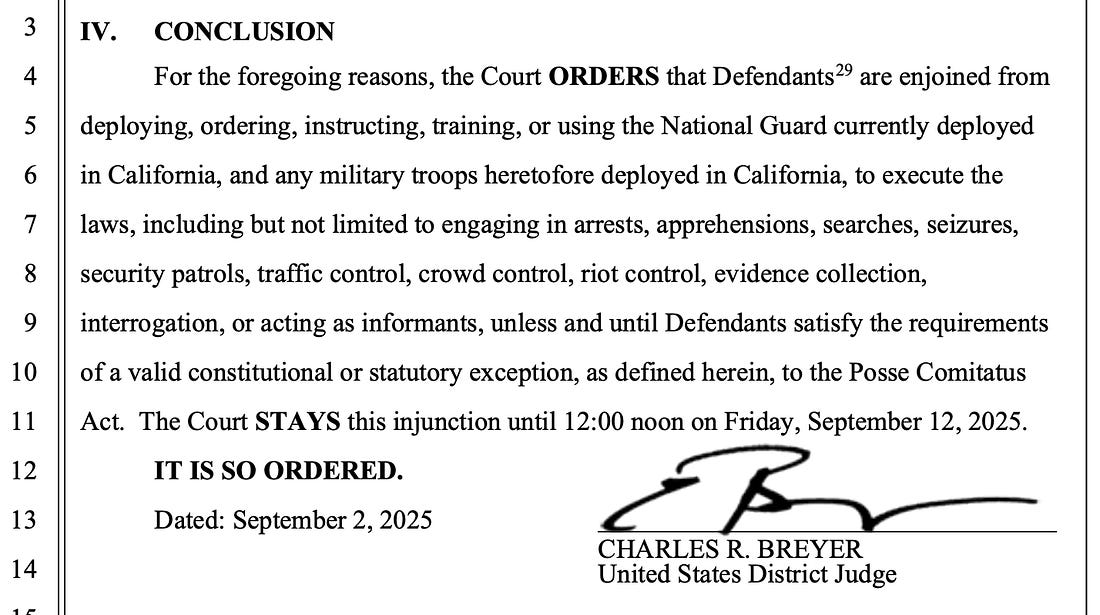
Today in California, in Governor Gavin Newsom’s lawsuit against Donald Trump, Judge Charles Breyer ruled against the administration. The issue will go to the Ninth Circuit Court of Appeals and to SCOTUS, where a final decision will likely be made unless they decline to hear the case and leave a lower court ruling in place. Judge Breyer held that the Trump administration could not use the military for immigration raids or law enforcement operations in California and that Donald Trump’s deployment of National Guard troops in Los Angeles earlier this year, over Newsom’s objection, was a violation of the Posse Comitatus Act (PCA), which we have discussed previously. Police powers are reserved to the state, and absent an emergency, the federal government has no role in state and local law enforcement unless invited. Breyer wrote: “Moreover, President Trump and Secretary Hegseth have stated their intention to call National Guard troops into federal service in other cities across the country—including Oakland and San Francisco, here in the Northern District of California—thus creating a national police force with the President as its chief.” He enjoined the government from further violations of the PCA. “Congress spoke clearly in 1878 when it passed the Posse Comitatus Act, prohibiting the use of the U.S. military to execute domestic law,” Breyer started his opinion. “Nearly 140 years later, Defendants—President Trump, Secretary of Defense Hegseth, and the Department of Defense—deployed the National Guard and Marines to Los Angeles, ostensibly to quell a rebellion and ensure that federal immigration law was enforced. There were indeed protests in Los Angeles, and some individuals engaged in violence. Yet there was no rebellion, nor was civilian law enforcement unable to respond to the protests and enforce the law.” Judge Breyer enjoined the federal government from “deploying, ordering, instructing, training, or using the National Guard currently deployed in California, and any military troops heretofore deployed in California” to make “arrests, apprehensions, searches, seizure, security patrols, traffic control, crowd control, riot control, evidence collection, interrogation, or acting as informants” unless the government establishes “a valid constitutional or statutory exception” to the PCA. The court gave the government 10 days to appeal before the injunction goes into effect.
Newsom released a statement in response to the decision, saying in part, “Today, the court sided with democracy and the Constitution. No president is a king — not even Trump — and no president can trample a state’s power to protect its people.”
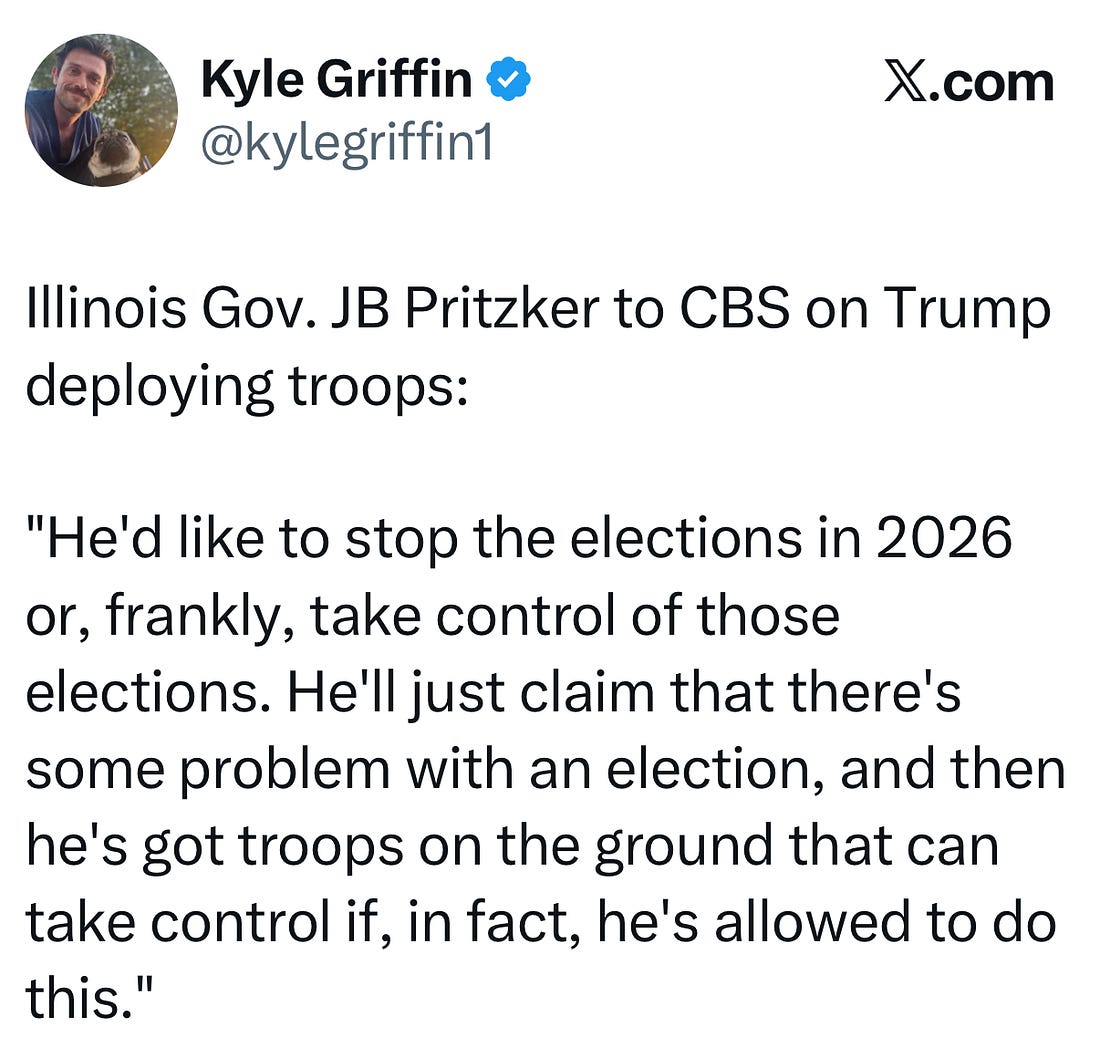
Increasingly, there is concern that Trump’s ultimate goal with these deployments involves the 2026 election. Illinois Governor JB Pritzker expressed that view earlier this week, suggesting that Trump would like to take control of the elections, which are administered independently by each state.
Trump has given every reason to believe he is serious about trying to interfere and that there will be a concerted effort to do so. There are a lot of complicated legal questions involved. Today, we begin the important work of being the sort of citizens the moment demands and educating ourselves about those questions. We will be doing this consistently for the next year, plus. We start tonight with a look at an important law that prohibits the placement of federal troops at the polls in all but the most extreme emergencies. The bottom line: Trump will not be able to deploy federal or federalized troops at polling places, whether in an effort to intimidate voters or to use them to seize voting machines or for other purposes. This law is not a total inoculation from interference by a president who wants to violate citizens’ voting rights, but it’s one important part of a package of legal protections and strategies we’ll be exploring between now and the election, so we can develop a well-rounded awareness of our rights as Americans and voters. Before we discuss the law, we should recognize that protecting elections when voting starts will likely have at least three key components:
Now, the law. 18 U.S.C. § 592 explicitly prohibits any U.S. civil, military, or naval officer from bringing, keeping, or having control of troops or armed men at any polling place during an election. The statute reads as follows: Troops at polls Whoever, being an officer of the Army or Navy, or other person in the civil, military, or naval service of the United States, orders, brings, keeps, or has under his authority or control any troops or armed men at any place where a general or special election is held, unless such force be necessary to repel armed enemies of the United States, shall be fined under this title or imprisoned not more than five years, or both; and be disqualified from holding any office of honor, profit, or trust under the United States. Note that this is a criminal provision, but this is also the type of conduct that—if it occurred and couldn’t be resolved— would lead lawyers to immediately seek injunctions in court, allowing elections to continue unimpeded. The law is meant to prevent any domestic political use of the military to influence or intimidate voters. Since we know Trump likes to poke holes in the rule of law by creating exceptions or making decisions and then claiming no court has the power to “second guess” him, it’s important to note that the “armed enemies” exception is not a loophole for domestic issues or unrest, along the lines Trump has raised in California with ICE raids or with more generalized (but false) complaints about skyrocketing crime. It is meant for armed foreign invasions and is a specific allowance for a national security emergency involving an armed invasion. The phrase "necessary to repel armed enemies" is an extremely narrow and rarely—if ever—applicable exception that allows federal troops at polling places only in the event of an armed invasion by a foreign power. The primary purpose of the law is to counter precisely what Pritzker and others fear Trump intends to do and keep the U.S. military separate from the electoral process. It’s separate from Posse Comitatus, which focuses on the use of federal troops for law enforcement purposes, but the two work together to make it difficult for the federal government to use the military to intimidate voters or interfere in state elections. Maintaining order at polling places is generally the responsibility of state and local governments. They may use local law enforcement or, in some unusual cases, the state National Guard, but not federal troops, unless the narrow exception in § 592 is met. The Constitution creates a system where states, not the federal government, and assuredly not the president, run federal elections along with state and local ones. The Elections Clause, in Article 1, Section 4 of the U.S. Constitution, provides that “The Times, Places and Manner of holding Elections for Senators and Representatives, shall be prescribed in each State by the Legislature thereof; but the Congress may at any time by Law make or alter such Regulations, except as to the Places of [choosing] Senators.” The federal government does have some authority over elections, including safeguarding the safety and integrity of congressional elections through provisions like the Voting Rights Act. But that can open the door, and Trump seems intent on cracking it wide open, with efforts to establish national identification rules or ones that end mail-in voting. To prevent efforts to adopt rules that make it harder for eligible Americans to vote and have their votes count, we must understand the rules and pay attention to what is happening. It’s important to see the potential tie-ins between activating the military based on claims that states can’t handle their own law enforcement and the upcoming elections. Thanks for being here with me at Civil Discourse and for committing to doing that work. If you think taking on responsibility for our own civics education is important, I hope you’ll become a subscriber if you aren’t already, and keep raising these issues and educating those around you. We’re in this together, Joyce You're currently a free subscriber to Civil Discourse with Joyce Vance . For the full experience, upgrade your subscription.
|
Tuesday, September 2, 2025
Can Federal Troops Be Stationed At The Polls In 2026?






Subscribe to:
Post Comments (Atom)
Hopium Ad And Video Roundup - Brown (Ohio), Trone Garriott (IA-3), Harvie (PA-1), Conley (NY-17), Lacore (SC-1)
Brian Poindexter (OH-7) joins us live at 2pm ET today ͏ ͏ ͏ ͏ ͏ ͏ ͏ ͏ ͏ ͏ ͏ ͏ ...

-
On Monday, Leon County Circuit Judge Angela Dempsey rejected Bear Warriors United's request for a temporary injunction to halt the s...
-
The Trump administration has launched a new federal initiative called the U.S. Tech Force, aimed at hiring about 1,000 engineers and t...
-
Police say information from a Reddit tipster who had a strange encounter with another man on a sidewalk outside Brown University provi...


No comments:
Post a Comment