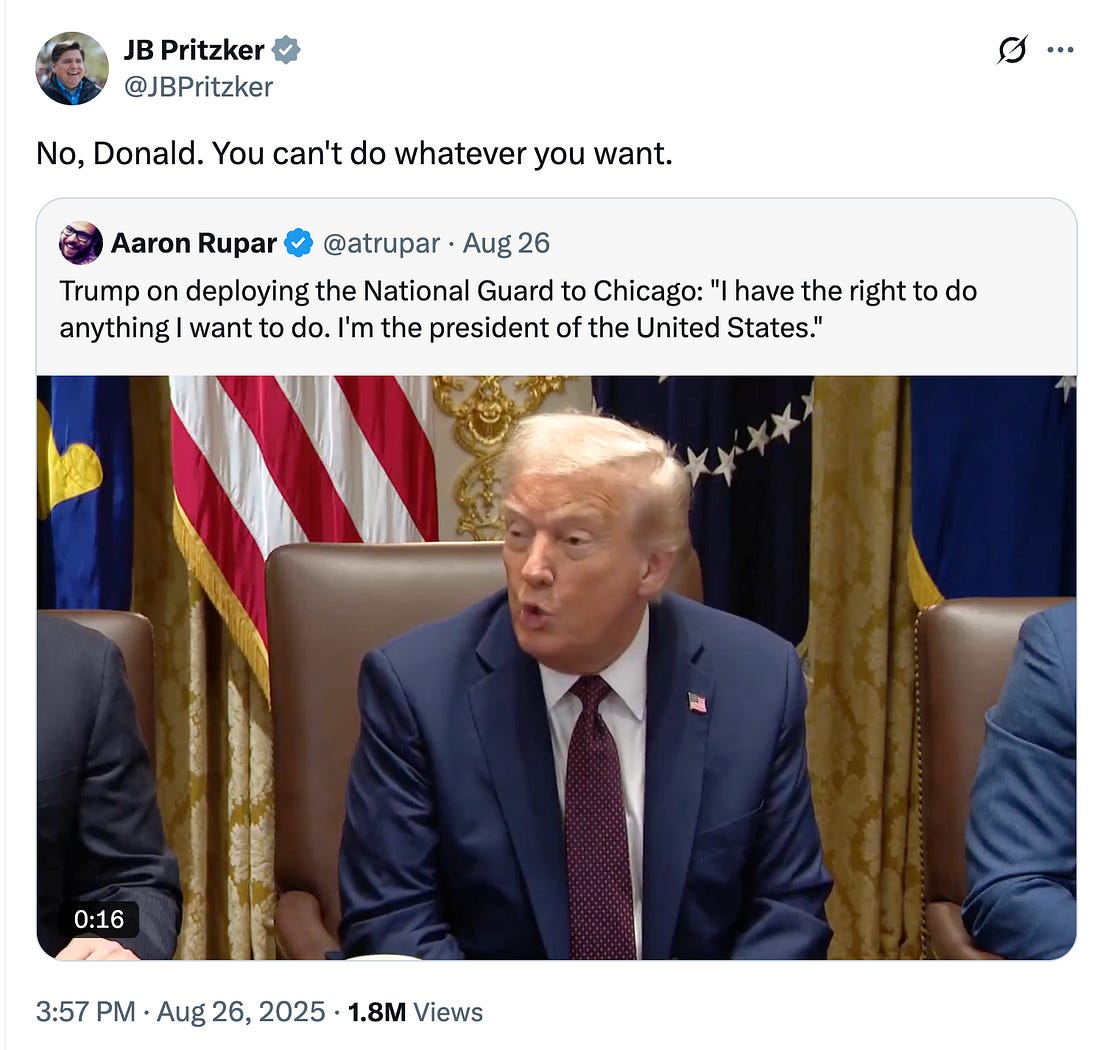
Trump continues to pursue an imperial presidency. During a cabinet meeting on August 26, 2025, Mr. Trump said, “I have the right to do anything I want to do,” in response to a question about deploying the National Guard to Chicago without Governor JB Pritzker’s approval. That statement seems to reflect his overall assessment of his power as president, fueled by a Supreme Court that has said he is virtually unaccountable for even criminal conduct committed while in office. Trump made similar statements about presidential power on multiple occasions during and after his first term in office. For instance, in July 2019, he told participants at a summit for teens, “I have an Article 2 where I have the right to do whatever I want as president.”
Governor Pritzker pushed back on X: “No, Donald. You can’t do whatever you want.” Last week, the courts agreed, for the most part. This week, we head back to the courts for more. Missouri Gerrymander Missouri’s Republican Governor, Mike Kehoe, is bringing lawmakers back to the state capitol this week so that they can, Texas-style, gerrymander another Republican seat in Congress, per Trump’s orders. The legislature will also debate placing a constitutional amendment on the 2026 ballot to make it more difficult to use Missouri’s initiative petition process to amend the state’s constitution. “This is about clarity for voters and ownership of our future,” the Governor said. There is sure to be litigation; the only question is when. Deportation of Unaccompanied Guatemalan Children. Late Saturday, lawyers at the National Law Immigration Center, along with the Young Center for Immigrant Children’s Rights, filed a complaint on behalf of 10 juvenile plaintiffs between the ages of 10 and 17. On Friday, according to the complaint, “several media outlets reported that Defendants [federal agencies and officials] are planning to imminently remove hundreds of Guatemalan unaccompanied minors to Guatemala.” Congress created a special statutory scheme to ensure that, because of their vulnerability, unaccompanied minors receive enhanced protection and care whenever the government seeks to remove them from the United States. The plaintiffs argue that summary removal plainly violates this statutory scheme. Once a child is designated as an unaccompanied minor under 6 U.S.C. § 279(g)(2), there are numerous legal protections to ensure they receive due process and can pursue any form of relief from deportation they are eligible for. The complaint alleges that, “Defendants have not provided notice to unaccompanied minors subject to summary removal and have not provided them an opportunity to contest their summary removal … Defendants have simply removed minors’ pending cases from the immigration court docket in preparation for their summary removal.” The complaint sought an injunction on behalf of the 10 individual plaintiffs in the case and asked the judge to certify a class (the result of last term's Trump v. Casa case, in which SCOTUS put an end to the use of nationwide injunctions to prevent challenged deportations), as well as other relief designed to prevent the children from being summarily deported. The plaintiffs alleged the government’s actions violate:
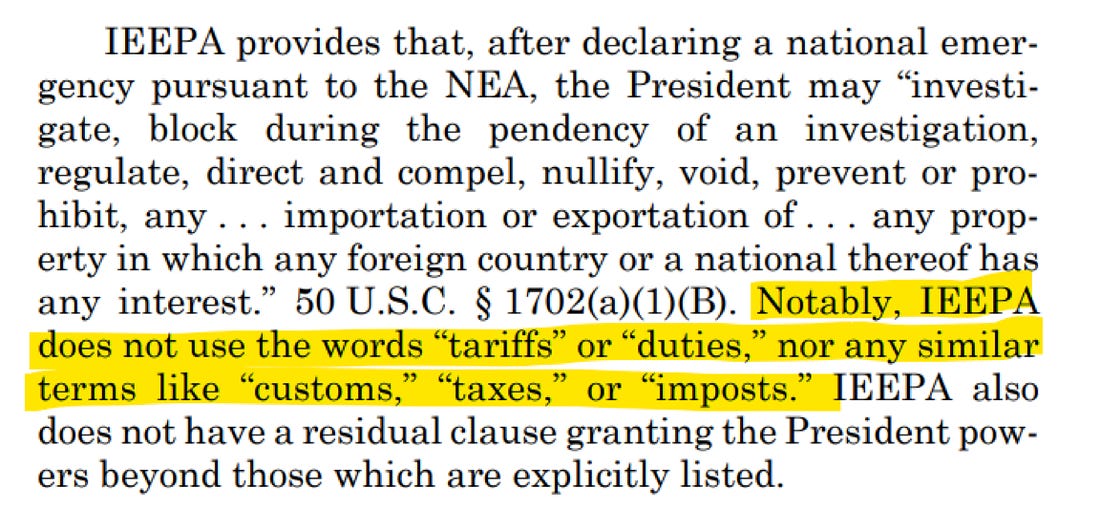
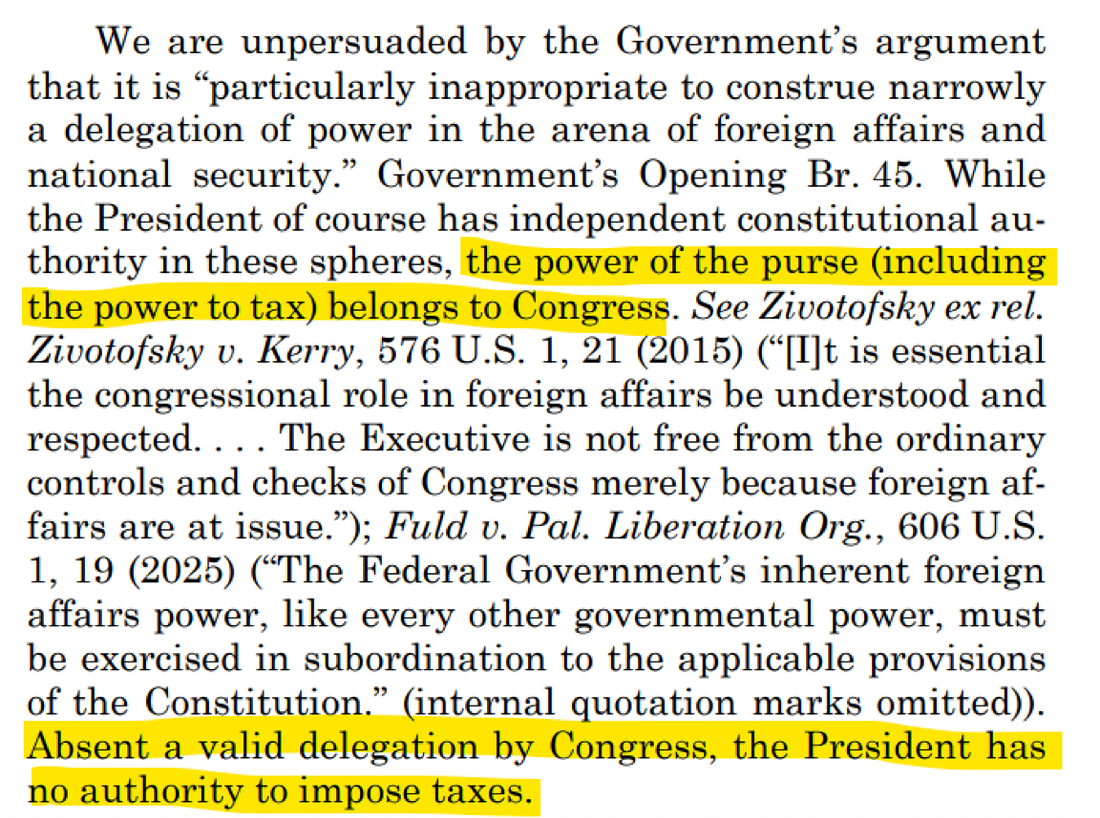
Overnight, Judge Sparkles Sooknanan in the District of Columbia promptly entered a temporary restraining order that barred the removal of named plaintiffs and followed up with one barring the deportation of all 600 unaccompanied Guatemalan children. Politico reported that many of the children were sitting on the tarmac in El Paso when the Judge ruled and that one may have already been in the air. The Judge moved up a hearing that had been set for Sunday afternoon, after allegations emerged that the administration was preparing to deport the children despite her order. During the hearing, the Judge referred to evidence that each child had expressed fear of return to Guatemala, including fear of abuse at the hands of one or both custodial parents. If this feels like a bit of a redo of the deportations to CECOT prison in El Salvador, where the government tried to get around Judge Boasberg’s order, it is. Judge Sookanan apparently remembers that too. During the hearing, she admonished the lawyer for the government that it was not to remove any of the children until she could hold a hearing and make a ruling later this week. The government’s lawyer responded, “We understand that. We certainly object to the TRO, but we understand that would be process at this point.” The government has already made an antagonist of the Judge, who explained that the matter began when she “got a call at 2:36 a.m. [Sunday morning] because the government chose the wee hours of the morning on the Sunday of Labor Day weekend to execute a plan to move these children. That's why we're here … the imminence that the plaintiff claimed proved true, because, in fact, those planes *were* loaded. One actually took off and was returned … absent action and intervention by the court, all of those children would have been returned to Guatemala, potentially to extremely dangerous situations.” Court Rejects Trump’s Tariffs The U.S. Court of Appeals for the Federal Circuit upheld the lower-court decision that rejected Trump’s effort to impose tariffs using a law known as IEEPA (I-E-Pa), the 1977 International Emergency Economic Powers Act. Tariffs imposed under other provisions aren’t impacted by this case, which means that the ruling is limited to the country-by-country tariffs that range from 34% for China to a base rate of 10% for the rest of the world and a 25% tariff Trump imposed on certain goods coming from Canada, China, and Mexico in retaliation for Trump’s claim they are permitting fentanyl to enter the U.S.. The 11-judge court ruled 7-4 that the tariffs were illegal, but it is allowing them to remain in place while the case moves forward. It held that the Constitution vests “The core Congressional power to impose taxes such as tariffs … exclusively in the legislative branch.” IEEPA is an emergency law that is used to impose economic sanctions in the case of threats against the U.S. It makes no mention of tariffs and the court held there was no indication Congress intended to transfer any of its power to the executive when it passed the law.
The statute does refer to “regulation” and “importation,” but the court concluded that reading the phrase in which they appear “to include imposing these tariffs is ‘a wafer-thin reed on which to rest such sweeping power.’” No prior president has attempted to use IEEPA to impose tariffs. And the court rejects Trump’s claim that he can use “national security” as a way around the constitutional grant of powers to each of the three branches of government.
DOJ has already promised to appeal. Trump could use other legal authority to impose tariffs, but that would require him to jump through procedural hoops to get there, and the tariffs would be limited to no more than 15% and could last no longer than 150 days. There will also be additional proceedings in the court below to reconsider whether the government is obligated to refund tariff payments to all companies that have already paid them, or only the companies that are party to the lawsuit. Trump is already setting up his attack on the Supreme Court if it rules against him. He criticized the Court of Appeals as “a Highly Partisan Appeals Court,” claiming that they “incorrectly said that our Tariffs should be removed. But they know the United States of America will win in the end.” Really, what Trump means is that he will win. King Trump is now “the United States” as far as he is concerned. He claimed that “If these Tariffs ever went away, it would be a total disaster for the Country. It would make us financially weak, and we have to be strong.” But Trump’s view on the economy can’t change the Constitutional duties assigned to each branch of government, nor does it mean he can use a law that says nothing about tariffs to impose them. Trump’s Effort to Fire Fed Governor Lisa Cook Cook’s efforts to block Trump from firing her will move forward in court this week. The issue will be whether Trump has cause for the firing, under a standard that has never been fully fleshed out in the courts. But Trump fired her without even a pretense of hearing her side of claims she had engaged in mortgage fraud, and in any event, those claims predated her work with the Fed and aren’t related to it. The commonly held view of cause in these situations requires it to be job-related. Cook has not been charged or convicted. The government argues that Trump’s decisions are entitled to “great deference” and that “The president has a constitutional obligation to follow the law — doesn’t always mean it is subject to judicial review,” according to DOJ lawyer Yaakov Roth, who represented Trump at a Friday hearing in the case. This is a nonsense standard that would let the president do whatever he wants, regardless of what the law says. Hanging over the proceedings is the clear indication that Trump wants to remove Cook because she has declined to vote in favor of measures he seeks. Cook is the first Black woman to serve on the Board. Thanks for being here and for caring enough to stay informed—it really matters. Paid subscriptions help me keep doing this work, and I’m so grateful to everyone who makes that possible. We’re in this together, Joyce You're currently a free subscriber to Civil Discourse with Joyce Vance . For the full experience, upgrade your subscription.
|
Sunday, August 31, 2025
The Week Ahead






Subscribe to:
Post Comments (Atom)
Oil Deals
Listen now (7 mins) | To read this letter, click here: ͏ ͏ ͏ ͏ ͏ ͏ ͏ ͏ ͏ ͏ ͏ ͏ ...

-
On Monday, Leon County Circuit Judge Angela Dempsey rejected Bear Warriors United's request for a temporary injunction to halt the s...
-
Police say information from a Reddit tipster who had a strange encounter with another man on a sidewalk outside Brown University provi...
-
The Trump administration has launched a new federal initiative called the U.S. Tech Force, aimed at hiring about 1,000 engineers and t...


No comments:
Post a Comment