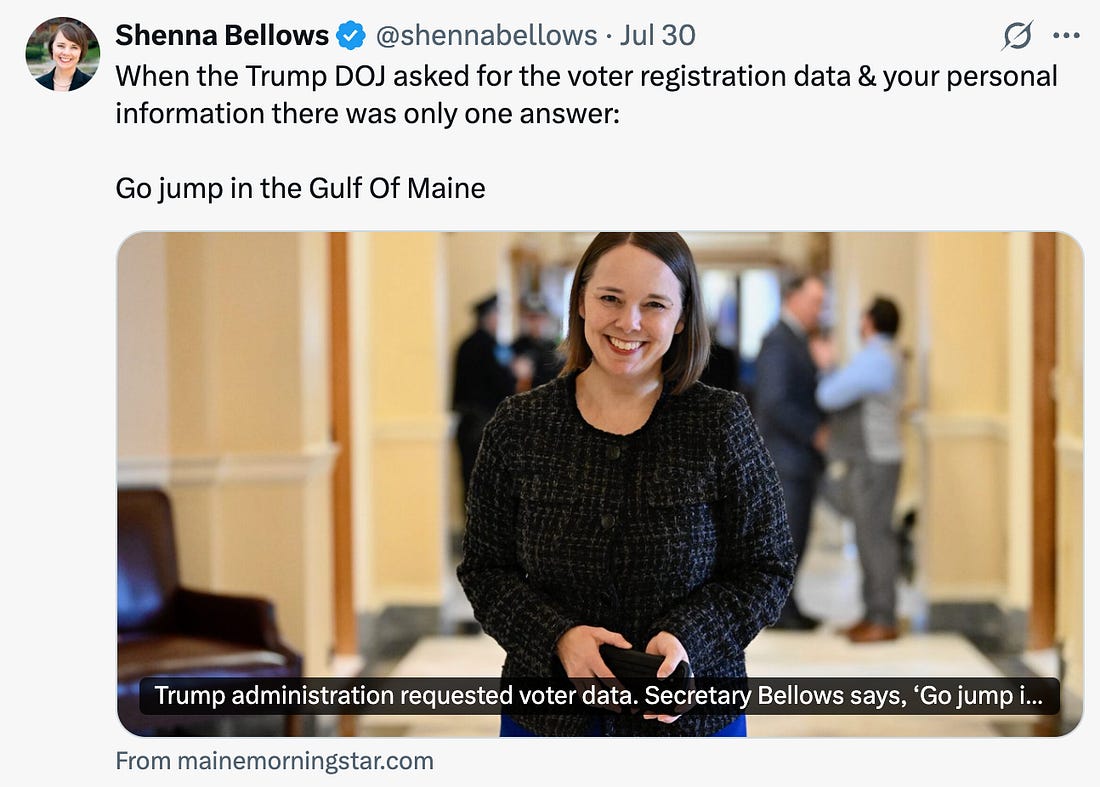
Your paid subscriptions help me devote the time and resources necessary to the newsletter. If you find value in the clarity and context Civil Discourse brings, I hope you’ll consider becoming a paid subscriber and tell your friends about it, too. On August 6, 1965, President Lyndon B. Johnson signed the Voting Rights Act, a landmark piece of civil rights legislation that prohibited racial discrimination in voting. We commemorate its 60th anniversary in a moment when it has been and continues to be under a sustained attack, with the president, Republican members of Congress and other elected officials, and even the Supreme Court denigrating the need for ongoing protection for Black and other minority voters. The VRA is pretty much at death’s door. Go Jump in the Gulf of Maine The Trump administration is skipping even the pretense of a VRA anniversary celebration, instead using email, letters, and phone calls to demand voter data and information about how elections are conducted from the states. It’s reminiscent of 2016 and Trump’s “Election Protection Commission,” formed after the election to search for voter fraud. The Commission didn’t find any, and when it came to light that hardcore right wingers on it, like Kansas Secretary of State Kris Kobach, were trying to use the exercise to collect data on voters that could be used to target them with disinformation and make it more difficult for them to vote, the Commission was forced to close down. Unlike 2016, when Republicans still had some shame, now the White House simply demands the information, with no apologies offered. Maine’s Secretary of State, Shenna Bellows, had an answer for them, though. “Go jump in the Gulf of Maine.”
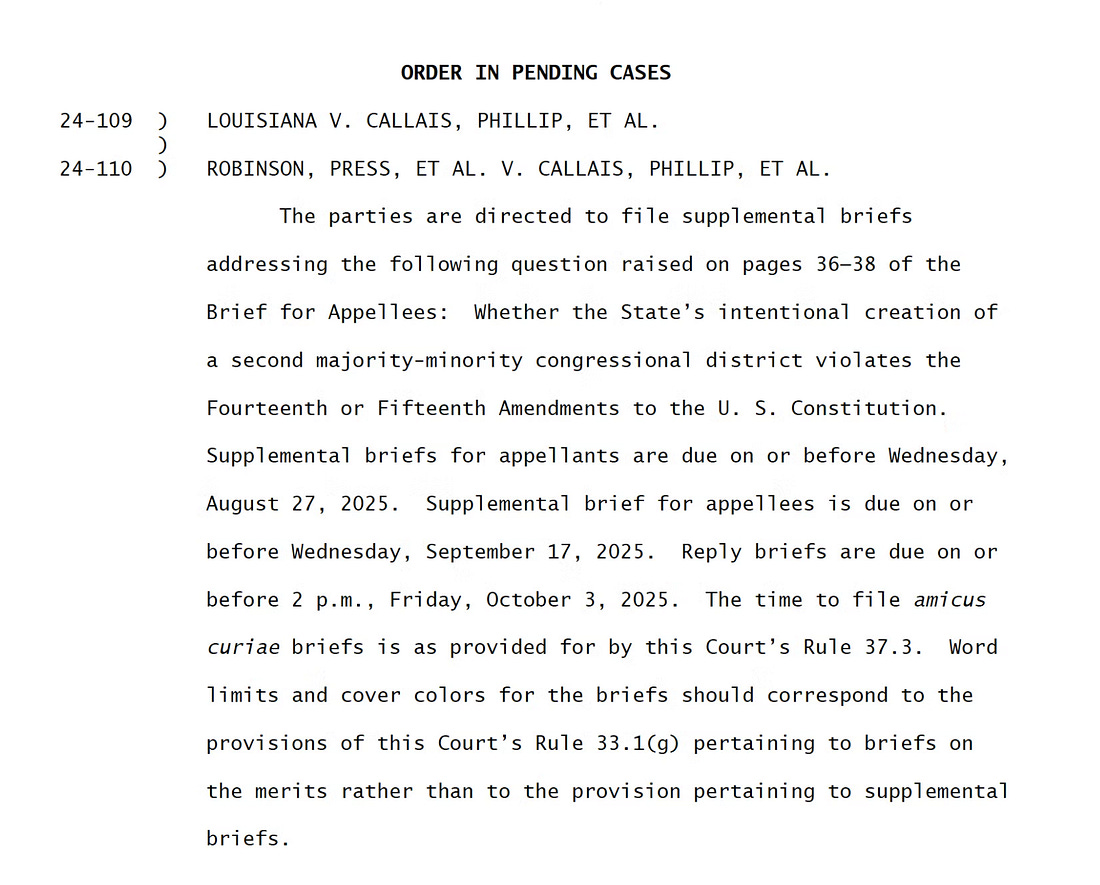
Bellows is the kind of Secretary of State who does whatever it takes to make sure all eligible citizens can vote. She’s neither apologetic nor political about it. The most important job any Secretary of State has is running the state’s elections, and although many of them are elected on a partisan basis, if they do the job right, they set any party allegiance aside and work to ensure all eligible citizens are able to register, vote, and have their vote counted. That work is made easier by the Voting Rights Act. Or at least it used to be. Section 5 of the VRA When it was enacted, the big gun for protecting the right to vote was found in Section 5 of the act. It created a “coverage formula” that applied to states and political subdivisions with a history of significant discrimination against Black voters in the 1960s and 1970s. The kinds of discrimination the act was designed to put an end to included Mississippi’s notorious soap-bubble test, which required Black voters to correctly guess the number of bubbles in a bar of soap in order to be permitted to vote, under the guise of an intelligence test. The act prohibited these discriminatory measures and required jurisdictions that had used them or other forms of discrimination to submit any new changes in their voting procedures—closing or moving polling places, requirements for more and more limited forms of identification, reduction in early voting days, purges to voter rolls—to either the Justice Department or the district court in the District of Columbia for approval before they enacted them. That process was called preclearance. “Was” is the operative word here. In April of 2010, Shelby County, Alabama, sued then-Attorney General Eric Holder in federal court in the District of Columbia, arguing parts of the Voting Rights Act were unconstitutional. The lower courts disagreed. Then came Chief Justice John Roberts’ majority opinion for a Court that split on party lines, gutting Section 5. Roberts held that the “blight of racial discrimination in voting” that had “infected the electoral process in parts of our country for nearly a century,” and which the act was designed to address, was substantially a thing of the past by 2013. The Court ruled that the changed circumstances meant that the criteria used to decide which states had to submit to preclearance were unconstitutional, in effect gutting Section 5. Congress could have acted and fixed this. Many people expected them to. They could have gathered 2013 data and used it to support new criteria for preclearance. But Republicans, who had played a role in renewing the bill repeatedly since 1965, refused. All that was left was Ruth Bader Ginsburg’s prescient dissent, which offered that “Throwing out preclearance when it has worked and is continuing to work to stop discriminatory changes is like throwing away your umbrella in a rainstorm because you are not getting wet.” Since Shelby County was decided, states have been free to pass and implement laws that do everything from reducing the number of polling places to making it a crime to hand a bottle of water to someone in line to vote. Lawyers can still challenge these laws after the fact, but there is no more preclearance requirement to keep the discriminatory ones from going into effect in the first place. Section 2 of the VRA Since Shelby County, many of the cases challenging new laws and practices after they go into effect have been brought under Section 2 of the act. But that section is being slowly corroded, and as we approach the act’s anniversary, the Supreme Court seems to have found its vehicle for gutting Section 2, having already done so to Section 5. First, a little background about Section 2: In 2021, Justice Alito wrote the majority opinion for the Court in Brnovich v. DNC. Alito wrote that he was not creating a test for all cases brought under Section 2, just announcing “certain guideposts” to inform them. We might as well have been back to the soap bubbles test; semantics aside, Alito made it much harder for plaintiffs alleging discrimination in electoral practices to prevail. The Court held that all that was necessary was for the political process to be “equally open,” to participation in it by minority and non-minority groups alike and that” and courts could consider a number of factors to decide whether that was the case, like whether the burden on voters went beyond “mere inconveniences” and whether the state had good reason for imposing the challenged voting practice. It was a roadmap for eroding Section 2. But the section could still be used in the most extreme, egregious cases, and lawsuits were brought by the Biden Justice Department or one of the civil rights groups on behalf of individuals who were harmed in those cases. Apparently, that’s not enough. The Supreme Court is now on track to obliterate Section 2. Last term, the Court declined, after the case was fully briefed and argued, to decide Louisiana v. Callais, a Louisiana redistricting case. The issue was whether a Louisiana congressional district created to comply with the Voting Rights Act resulted in an unconstitutional gerrymander that discriminated on the basis of race. The Callais plaintiffs were a group of “non-African Americans” who said the redistricted map violated the Constitution because it took race into account in violation of the 14th Amendment. The Court said it would rehear the case in the term of Court starting this fall, even though there was literally no reason it could not have decided the case in the term it was scheduled in. On Friday, the Court issued a new scheduling order for Callais. On a Friday in August, after 5 p.m., to be precise. But we were watching anyhow. The Court wants briefing on Section 2’s constitutionality. They’ve asked the parties to file additional briefs that delve into “Whether the State’s intentional creation of a second majority-minority congressional district violates the Fourteenth or Fifteenth Amendments to the U.S. Constitution.”
Typically, the Court only issues invitations like this when it has a purpose in mind, and given the views of the majority of this Court, it’s unlikely the Court did this to salvage Section 2. More than likely, along with Section 5, it will be out of commission by this time next year—on target to permit people who want to suppress the vote to run wild in advance of the midterm elections. What can we do about it? Perhaps the timing is just coincidental. Perhaps both the White House and the Supreme Court forgot the anniversary of the VRA was coming up this week. But the Supreme Court took a very long time to issue the supplemental briefing order for Callais. The timing, if intentional, is impeccable. Either way, the irony is hard to miss. Welcome to a sad anniversary week for the Voting Rights Act, compliments of the Trump administration, the Supreme Court, and the failure of Congress to act. As we head into the week ahead, we start with this layout of the legal landscape. We’ll hear from experts about what they expect, with midterm elections coming up fast. If this outlook makes you feel less than optimistic—and there’s no reason it shouldn’t—here’s a concrete step you can take right now: sign up to help with your local election. Presidents aren’t in charge of our elections; we are. Each state conducts its own election, and presidents aren’t permitted to interfere. We need to make sure it stays that way. Since the 2020 election, when two vote counters in Georgia, Ruby Freeman and her daughter Shaye Moss, suffered abuse at the hands of Rudy Giuliani and MAGA, and other workers in a number of other elections were threatened and intimidated, poll workers have been in increasingly short supply. Let’s reverse that trend and prepare to fight for the right to conduct free and fair elections. Search for “how do I sign up to be a poll worker” online to get information about your state. I applied today. It only took ten minutes, including tracking down the process for Alabama, finding the form to use, and figuring out where to email it. And I’ve been walking around with a grin on my face all day. It feels good to take action. We’re in this together, Joyce You're currently a free subscriber to Civil Discourse with Joyce Vance . For the full experience, upgrade your subscription.
|
Sunday, August 3, 2025
The Week Ahead





Subscribe to:
Post Comments (Atom)
Live Before Bedtime
Watch now (39 mins) | Substack Live with Katie Phang and me ͏ ͏ ͏ ͏ ͏ ͏ ͏ ͏ ͏ ͏ ͏ ͏ ...
-
17 Personal Finance Concepts – #5 Home Ownershippwsadmin, 31 Oct 02:36 AM If you find value in these articles, please share them with your ...


No comments:
Post a Comment