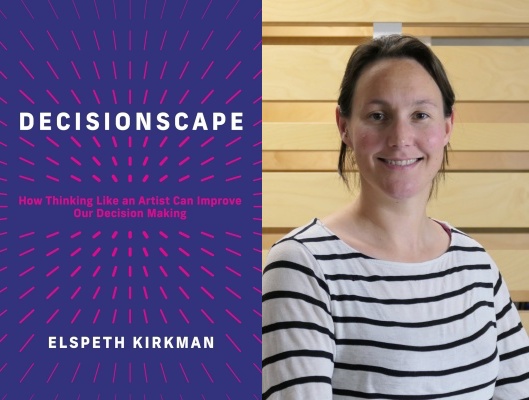
Running a business is different than painting a portrait, but the planning process can be surprisingly similar, according to Elspeth Kirkman, a visiting senior research fellow at the Policy Institute at King's College London.
In her new book from the MIT Press, Decisionscape: How Thinking Like an Artist Can Improve Our Decision-Making, Kirkman explores how we come to conclusions across endeavors. She spoke with b. about tackling decisions differently.
b.: How can business owners and leaders think more like artists?
Kirkman: When I say "thinking like an artist" … I don't mean being creative and radical and some of the other fun things that artists get to do, necessarily. … A mistake that you could [make] would be to think, "Oh great, I need to be really experimental with everything I do."
In the same way that an artist organizes their canvas when they're painting, we can organize all of the factors that go into our decisions. So, we can figure out what should be big and in the foreground, what should be minimized and shunted into the back, and which things do and don't appear, what we're focusing on …
b.: Like how an artist literally looks at the big picture?
Kirkman: An artist will be very deliberate when they're constructing a piece of work about whose perspective it's from, what that viewpoint looks like, and … where should the viewer of the art stand in order to see it.
But when we're making decisions, we tend to overestimate how universal our viewpoint is. We tend to think that what we see is an objective truth, rather than something that is just a lens that we're putting on the world.
[Figure] out what you want to represent, how you want to represent it, what lens you want to put on it, what you want people to take away from it.
b.: Can this become a habit instead of a conscious effort?
Kirkman: It's very, very hard for us — particularly in stressful moments — to change who we are, how we think, where we go …
So, for example, if you're a small business owner and you happen to know that you leave everything to the last minute [and] you're always going to be up at midnight smashing the submit button, then rather than berating yourself … you should either outsource that to somebody else — who doesn't do that — or design a set of false deadlines or processes that otherwise incentivize you.
b.: What kind of decision-making is most likely to lead people to regret?
Kirkman: Often, it's because they have a perspective after the fact that they didn't have … in the moment when everything was looming large.
If you're in the throes of the decision — some economic shock has happened and suddenly you have to decide if you're going to lay off some of your workforce, or an opportunity comes up and you've got to decide very quickly whether you're going to invest — then it's likely … the things that influence you [won't be what] you would have wanted had you had the benefit of planning.
If we were much better at recognizing the frame and questioning it — and finding what's in the adjacent possible world just outside it — I think we would design much more innovative, better, more powerful solutions to big problems.
Decisionscape is available now.










No comments:
Post a Comment