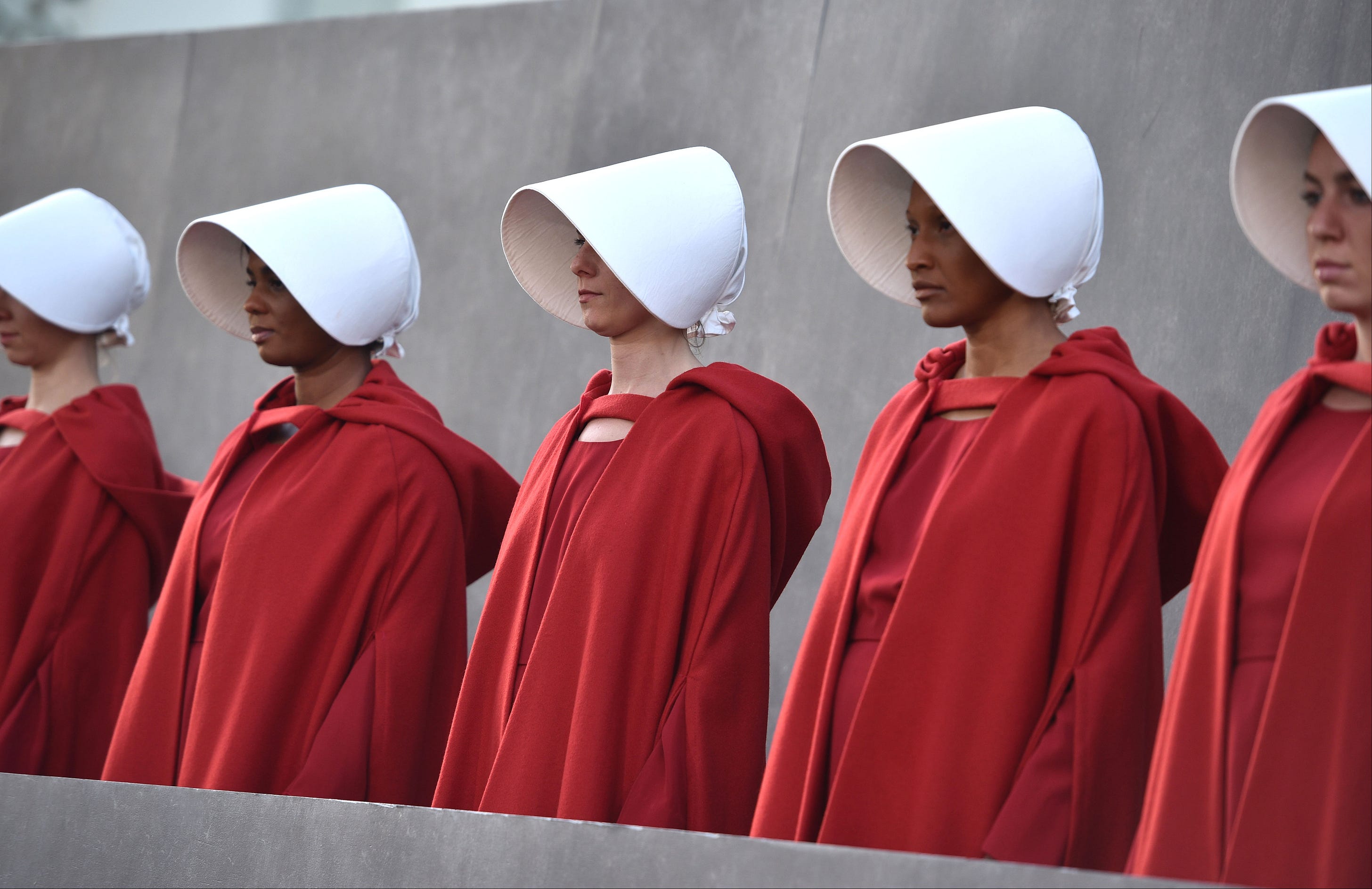
A lot has been written about today’s oral argument in FDA v. Alliance for Hippocratic Medicine, the mifepristone case that was argued in the Supreme Court this morning. Most of the pundits viewed the Court as skeptical about standing—the technical legal issue we discussed at the outset of this case, which requires a party to have suffered an injury that the courts have the capacity to redress before they can bring a lawsuit. The case appeared on our radar screen here at Civil Discourse in April of 2023, when I wrote about the District Judge’s surprising decision that mifepristone, one of two key drugs used for medicated abortion, should be banned despite 20 years of data showing safe and effective usage. I noted that mifepristone has a lower rate of complications than Tylenol. DOJ’s response was swift, filing notice it intended to appeal the decision with the court hours after it was made public. The reason was the scope of the ruling. Although he is in Amarillo, Texas, District Judge Matthew Kacsmaryk entered a nationwide injunction in this case. Had his ruling survived in its original form, it would have banned the drug nationwide. This is what I wrote at the time: “That’s not the legal landscape the Supreme Court said it was creating when it ended 50 years of abortion rights under Roe v. Wade in the Dobbs case. When the Court decided Dobbs, it said decisions about whether and under what circumstances abortion should be legal would be left up to each state. But now, Judge Kacsmaryk has made that decision for all of us—you and me, for our mothers, daughters, sisters, aunts, and friends, regardless of medical necessity or our personal religious and moral beliefs. Judge Kacsmaryk knows best.” I followed it up with this picture, which I believed then and continue to believe now, isn’t too far off of the direction some in this country would like to see us headed.
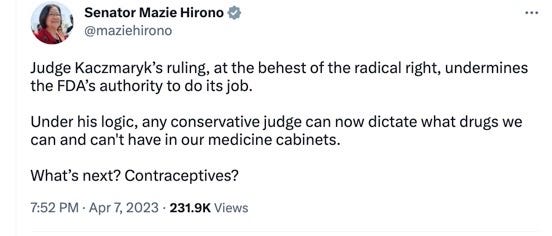
As Hawaii Senator Mazie Hirono pointed out at the time in a tweet, what was next if the FDA’s decisionmaking process for mifepristone was upended?
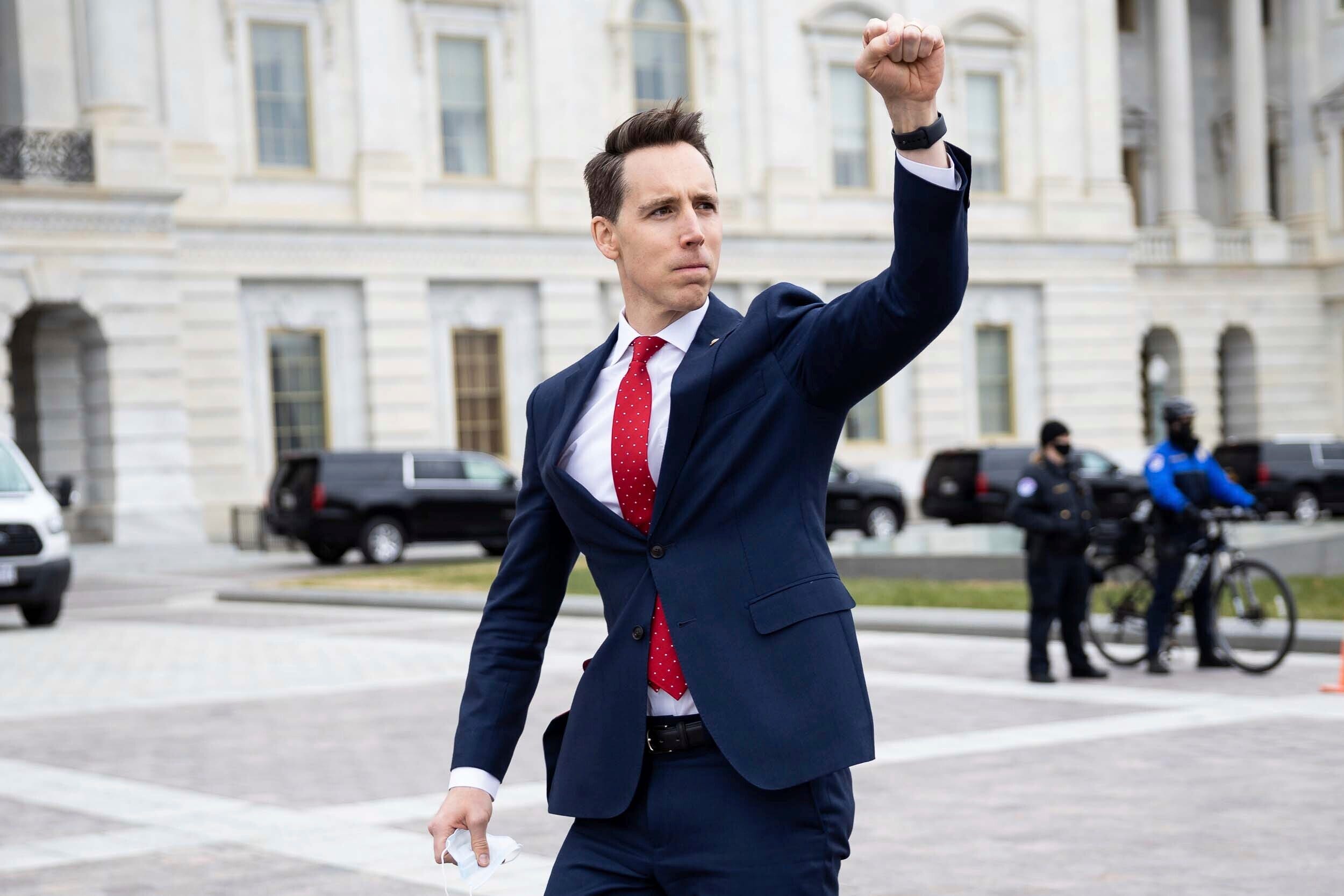
But it was the legal issue that was apparent at the outset of the case, the absence of “standing,” that was the focus of the Court’s argument today. You may recall from our earlier conversations that we aren’t at the merits of the case yet, but rather, the litigation involves whether Judge Kacsmaryk’s decision becomes law while the case is being litigated in front of him or whether it is stayed—put on hold—for the time that takes. The government wants the Court to dismiss the case without permitting any additional proceedings because, it argues, the plaintiffs lack standing. The plaintiff is an organization representing staunchly anti-abortion doctors. Their argument for standing is based on speculation about theoretical possibilities they might be called upon to treat women whose home medication abortions resulted in complications that required emergency room care. As several Justices pointed out, the carefully written affidavits from some of the doctors fell short of establishing that they had ever been called upon to provide care for a women that required them to do what Justice Barrett characterized as terminating embryonic or fetal life. Standing requires that plaintiffs have experienced an actual harm, not a purely speculative one. The doctors were represented by Erin Hawley, a law professor and very capable Supreme Court litigator, who is also the wife of Missouri Senator Josh Hawley. This guy.
She was well prepared and skillful at argument and gave the case as good of a hearing as possible, but most of the observers who followed the argument agreed that the Court seems unlikely to rule in their favor. I am one of them. The standing issue is an easy off-ramp for conservative Justices who don’t want to reach the merits of the argument for stay, which requires them to consider, for instance, whether the plaintiffs have a chance of success on the merits. Standing is their way out. The outlier may be Justice Alito, whose abortion jurisprudence has become increasingly untethered from legal principle. When a case is about abortion, he seems to focus only on the desired outcome: putting it out of reach for American women. Justice Alito tipped his hand on this case when it first came before the Court on the government’s emergency “shadow docket” request that it prevent Judge Kacsmaryk’s decision from going into effect while the stay issue was being litigated. The government won, but Justice Alito dissented, even questioning whether the government would obey the Court’s order if it lost the case. It was a preposterous thing for a Supreme Court Justice to say. Doubly so for Alito, who had staunchly defended the FDA decision-making process in an earlier case that involved a Judge weakening the restrictions around dispensing mifepristone. In that 2020 pandemic-era case, a Judge in Maryland lifted the FDA’s requirement that patients receive mifepristone in person at a doctor’s office, ruling that experience had shown in-office visits were unnecessary to safely prescribe the drug. The Supreme Court ultimately affirmed that decision, but Justices Alito and Thomas issued a strongly worded dissent counseling deference to the FDA’s decision making. Alito wrote, “A District Court Judge in Maryland took it upon himself to overrule the FDA on a question of drug safety,” saying the Judge disregarded the court’s guidance against “second-guessing of officials with public health responsibilities.” What a difference a few years and reversed positions of the parties seem to make in Justice Alito’s legal reasoning. In today’s argument, Ms. Hawley seemed to lose most of the other justices, perhaps including even Justice Thomas, because the harm her plaintiffs claim, being forced into procedures against their conscience, seems to be obviated by federal conscience protections, which Solicitor General Elizabeth Prelogar explained to the Court. She clarified how the lower court misunderstood the full protection federal law offers in this regard, which makes it possible for doctors to avoid participating in procedures that are contrary to their conscience. Justice Jackson went in for the closer on this argument, asking Hawley why those protections weren’t enough to meet the doctors’ concerns. The lawyer responded that they weren’t sufficient and didn’t have a response when Justice Jackson asked her to assume for the sake of argument that they were, and to then articulate why there was still standing. “Do we have to also entertain your argument that no one else … in America should have this drug in order to protect your clients?" Justice Jackson asked Hawley. As if the point wasn’t already clear, somewhere around the 80-minute mark in the argument, Justice Barrett jumped in to point out that not every D&C procedure performed involves an ongoing pregnancy and that scrutiny of the affidavits the plaintiff doctors had provided about their concerns suggested none of them had actually participated in a case that terminated what the Justice termed life. When you’ve lost Justice Barrett on this issue, you’re in trouble. Today’s argument doesn’t predict what might happen if plaintiffs with a better argument for standing brought a similar case before the courts. But for now, at least, the changes the FDA enacted that made mifepristone more accessible in 2016 and 2021 seem likely to stay in effect. As dangerous as tea leaf reading at oral argument is, the signs here were that the government would win. There is, of course, always the possibility Justices will change their minds as they consult with colleagues, but Solicitor General Prelogar summarized the government’s reasoning in her rebuttal argument and was permitted to do so without interruption from the Justices, frequently a signal to seasoned appellate litigators that a court is on your side. She told the Justices:
She concluded by asking the Court to remand the case with directions that it be dismissed without any further action by the lower court. When this case first surfaced, I wrote about some concerns a Republican Senator expressed about Judge Kacsmaryk. They are worth revisiting. When he went through the confirmation process to become a federal judge, Kacsmaryk took steps to conceal his strong anti-abortion bias. In anticipation of confirmation proceedings in 2019—he’s a Trump appointee—he asked that his name be removed from a law journal article he had authored, before it was published. The article was critical of legal protections for abortion and transgender people. Kacsmaryk’s name was replaced with those of some colleagues from a conservative religious legal group he was working for. The completed Senate Judiciary Questionnaire (SJQ) that federal judicial nominees submit under oath requires disclosure of every article a nominee has published as well as public commentary. Kacsmaryk failed to disclose the article and interviews he gave on Christian talk radio about his views on abortion and other issues, information the questionnaire calls for. You can read Judge Kacsmaryk’s SJQ in full. When these failures to disclose came to light, Senator Lisa Murkowski (R-AK) said of her vote for the Judge, “You want to talk about the ultimate bait and switch? I feel like I got duped. I feel like I voted for somebody based on what had been presented to me. And you do this? That is totally, totally wrong.” To be fair, there was plenty of other information in circulation about Judge Kacsmaryk, but that didn’t keep Donald Trump from nominating him for a federal judgeship. In fact, it may well have been the point. This is a good talking point when talking with folks about the upcoming election, especially those who believe women should have the ability to make their own decisions about healthcare, but who aren’t sure how to vote in the upcoming election. Tell them about Judge Kacsmaryk. The person who sits in the Oval Office matters for a lot of different reasons. But their unique role as the person who picks the people who become federal judges, whether that’s a district judge, an appellate judge, or a Supreme Court justice, matters deeply to all of our futures. We’re in this together, Joyce You're currently a free subscriber to Civil Discourse with Joyce Vance . For the full experience, upgrade your subscription.
|
Tuesday, March 26, 2024
Mifepristone






Subscribe to:
Post Comments (Atom)
January 18, 2026
You hear sometimes, now that we know the sordid details of the lives of some of our leading figures, that America has no heroes left. ͏ ...
-
17 Personal Finance Concepts – #5 Home Ownershippwsadmin, 31 Oct 02:36 AM If you find value in these articles, please share them with your ...


No comments:
Post a Comment