Does your business still need a printer? From electronic contracts and emailed receipts to document digitization, it's easier than ever to have a paperless office. No wonder printer and ink sales have been tanking (pun absolutely intended) for years. So, how can manufacturers respond to demand fading like the output of a cartridge exposed to air for too long?
HP is betting on a subscription model. Starting at $6.99 per month, the HP All-In Plan lets you rent a printer with as few as 20 allotted pages. HP will even replace the device on the next business day if it develops any technical problems — which is within the realm of possibility, as the average printer owner may well know.
|
Hiring process: Does yours have too many rounds? Training: Lessons are only worth it if they stick Dune: A sci-fi parable about fair trade? |
|
|
Round After Round: Is Your Hiring Process Too Long? |
The average hiring process takes three to six weeks, but some last for months on end. While you want to be diligent in your applicant evaluation with tests and interviews, "more" isn't always better. Some 60% of job seekers drop out halfway through application processes that are too long or complex. Roughly one-third have ghosted an employer altogether. On the plus side, a prolonged application process can filter out candidates who lack genuine interest or commitment. Those unwilling to invest the time and effort — or who are simply mass-applying for any job they find — may self-select out of the process, leaving only candidates genuinely interested in the company and position. The extended process also allows recruiters to assess not just skills but also a candidate's perseverance, a valuable trait in many professional settings. This can result in a more focused and dedicated talent pool. By taking too long, however, you might be draining that pool. Since talented individuals are in high demand, it can be a race to hire them first when they become available. Highly skilled workers in competitive industries get snatched up within just 10 days on the job market. If your application process lasts for months, they won't complete it. Your application process can also be seen as a direct reflection of your company's culture. Endless rounds (and waits to hear back between them) can deter highly qualified candidates who may perceive it as a signal of disorganization, inefficiency, and indecision. This can also lead top-tier candidates to pursue other opportunities … with your speedier competitors. |
|
| Take care of business any time, any place with Zoom |
Today's workplace is anywhere and everywhere, but your team still needs to collaborate and provide your customers with exceptional service. Zoom connects your business to employees and customers here, there, and everywhere. More than just a video conference platform, Zoom offers complete business communications systems with top notch features like voice over internet protocol (VoIP), contact center support, and virtual customer service agents. Zoom doesn't just support your business's communications, it helps bring them to the next level. Ready to upgrade how you stay in touch with employees, customers, and partners? |
|
|
How to Make Training Worth It |
Dr. Ben Baran is an associate professor at Cleveland State University and co-founder of Elevating What Works. Companies spend billions on employee training every year, but it won't do anything for the organization unless employees take what they learn and transfer it to their jobs. This "transfer of training" goes wrong frequently because the participants continue to work in the same old way. Before you spend money on training, therefore, be sure that you understand what it takes for this critical step of training transfer to occur: - First, choose training participants carefully. This doesn't apply to company-wide training, but when it's special training, pick people who are smart, motivated, and see the value in the training topic.
- Second, choose or design training programs that have clear objectives and use best practices. For instance, this may include providing examples of what "right" looks like, giving training participants opportunities to try new skills or behaviors, and offering feedback. (Other features may include allowing participants to make and learn from mistakes, and using training scenarios or environments that closely resemble the actual workplace.)
- Third, your own support of the training is paramount. You can't expect your employees to take the training seriously unless you do. Tell them that you care about the training topic and give them the time and resources to participate. Provide them with recognition when they successfully complete the training. Help training participants to use their new skills or knowledge on the job.
Training is important to keep the skills and knowledge of your employees fresh. But it wastes time and money if participants don't care, if the training isn't designed well, or if managers don't create an environment that reinforces the learning. |
|
|
On March 22 in Business History: |
- 1841: Inventor Orlando Jones patented a method for making corn starch. Without him, we wouldn't have perfect Thanksgiving gravy.
- 1960: Think a corn starch patent is surprising? On this day, Charles Hard Townes patented the laser, which contributed to innovations in physics, chemistry, and computing.
- 1993: Intel produced the first Pentium microprocessor. With a global market share of over 70% today, the company remains the leader in PC processing chips.
- 2005: God of War debuted in North America on PlayStation 2. The video game franchise has sold over 51 million copies since then.
|
|
|
Dune: A Sci-Fi Parable About the Value of Fair Trade? |
Spice. It's the most powerful commodity in the Dune universe, essential for space navigation, extending life, and granting extraordinary cognitive powers. Control over the spice mines on the desert planet of Arrakis is the ultimate prize in a galaxy-spanning struggle for dominance and survival. However, the native inhabitants of Arrakis — the Fremen, who've learned to thrive in the planet's harsh environment — have some strong feelings about local resource exploitation. The family of Paul Atreides (Timothée Chalamet) plans to help the Fremen mine spice in a genuine, sustainable partnership. However, the villainous Baron Harkonnen (Stellan Skarsgård) nearly wipes out House Atreides in his pursuit to monopolize spice mining, just like Harkonnen previously monopolized … uh … whale fur. Without spoiling things, let's just say that the Fremen side with Paul. Dune is an exciting movie based on a classic novel. Yet, it's also a reminder that ethical sourcing throughout your supply chain — as practiced by socially conscious brands such as Ben & Jerry's and Patagonia — pays dividends in goodwill, credibility, and preventing sandworm-assisted revolutions. As in all realms of business and interstellar politics, the spice (and other goods) must flow, but it flows best with a bit of mutual respect and cooperation. |
|
|
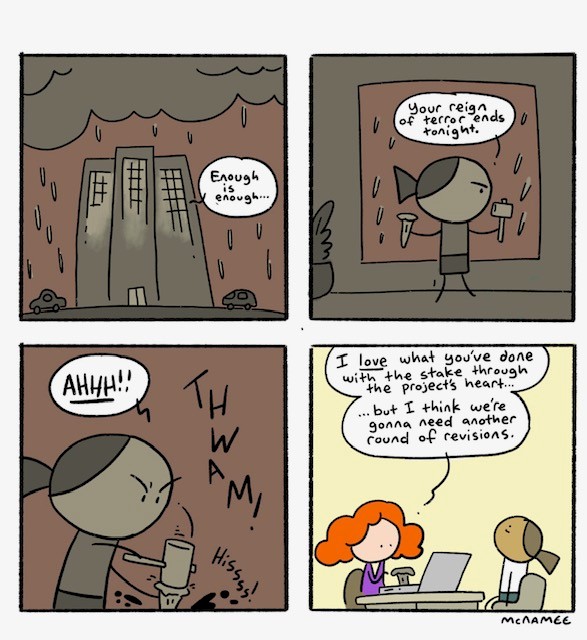
Written by Skye Schooley and Antonio Ferme. Comic by John McNamee. |
|
| 200 5th Ave., 2nd Floor Waltham, Massachusetts 02451 ©️ 2023 business.com. All Rights Reserved |
| | |
|












No comments:
Post a Comment